





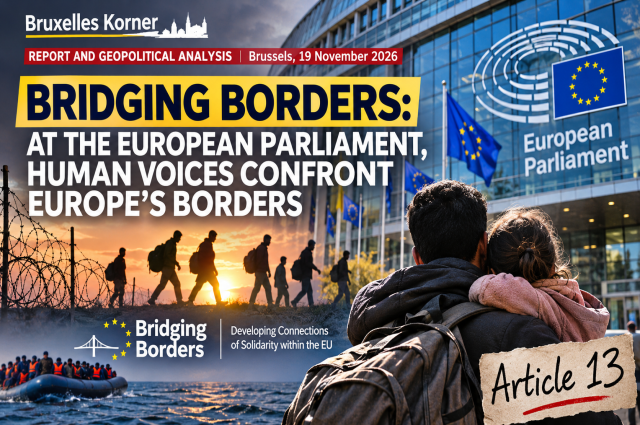
BRIDGING BORDERS: AT THE EUROPEAN PARLIAMENT, HUMAN VOICES CONFRONT EUROPE’S BORDERS
Report and Geopolitical Analysis | Brussels, 19 November 2026
By Kadir Duran — Bruxelles Korner

On 18 November 2026, I was invited to the European Parliament in Brussels to attend an event that went far beyond questions of immigration, borders and nationality. Behind the title Bridging Borders lay a fundamental question that resonated throughout the evening: why, in a world that proclaims the universality of human rights, do some lives appear to enjoy greater freedom, recognition and protection than others?

That Wednesday evening, in the European Parliament’s Spinelli 3C3 room, I did not simply attend a conference about refugees. I listened to men and women describe what it means to leave their country, lose their home, cross multiple borders, wait years for official documents and attempt to rebuild their lives in a society that does not always consider them to be among its own.
Organised at the initiative of Per Esempio ETS, an Italian association based in Palermo, and hosted by Italian Member of the European Parliament Cecilia Strada, a member of the Socialists and Democrats Group, the event formed part of the European project Bridging Borders — Developing Connections of Solidarity within the EU.

Its objective was to strengthen solidarity, encourage youth participation and examine the visible and invisible borders that divide European societies.
Cecilia Strada: “A Europe for Everyone, Without Exclusion”

From her opening remarks, Cecilia Strada placed solidarity at the heart of her message.
For the MEP, the European Union cannot be reduced to an area of economic mobility or an institutional structure. It must remain faithful to its fundamental values: democracy, freedom, equality and human dignity.
She highlighted a contradiction that she sees within European societies.
When a young European travels abroad to study or work, their mobility is generally celebrated. Yet when a young person from the Global South attempts to cross the same borders, that movement may become a political or security issue.
She also addressed the situation of young people from immigrant backgrounds who have grown up in Europe, attended European schools and learned European languages, but whose sense of belonging continues to be questioned.
Her intervention took on a more explicitly political dimension when she criticised certain European approaches to migrant returns and detention.
She also denounced what she considers a hierarchy of political outrage, contrasting reactions to damage inflicted on shops in Milan with political positions concerning Gaza.
These statements reflect Cecilia Strada’s political views and should not be interpreted as the official position of the European Parliament as a whole.
Nevertheless, her central message was clear: belonging to a society should not depend exclusively on a passport or place of birth.
From Palermo to Brussels: Building Bridges Rather Than Walls
Claudio Arestivo and Giulia Baruzzo, representatives of Per Esempio ETS, presented the philosophy and achievements of the project.

Claudio Arestivo emphasised that Palermo, a Mediterranean city often viewed as peripheral in traditional European narratives, could also become a centre for reflection on migration, solidarity and social transformation.
Giulia Baruzzo outlined the work carried out with 11 organisations across 10 countries and 11 European cities.

These activities brought together young people, local associations, residents and people from migrant backgrounds. Discussions addressed discrimination, disinformation, access to rights and democratic participation.
One of the contradictions highlighted by Giulia Baruzzo concerned Italy directly: a country that facilitates the legal entry of hundreds of thousands of foreign workers to meet its economic needs while maintaining a particularly firm political discourse on irregular immigration.
This tension deserves examination beyond political slogans.
“Article 13”: A Documentary That Gives Borders a Human Face

The screening of the documentary Article 13, directed by Mapi Rizzo, was the central moment of the evening.

Its title refers to Article 13 of the 1948 Universal Declaration of Human Rights, which recognises freedom of movement within a state and the right to leave any country, including one's own, and to return to one's country.
It is important to clarify that this article does not, by itself, establish a general right to enter and settle in any foreign country.
However, the documentary raises another question: how is this principle of freedom experienced by individuals whose passports, financial resources and personal histories are radically different?
The testimonies presented reveal profoundly contrasting realities.
For some people, travelling means discovering new cultures, studying abroad or choosing their next place of residence.
For others, crossing a border means facing inspections, visa refusals, smugglers, the fear of death and sometimes years of administrative uncertainty.
An Afghan, Ten Countries Crossed and a New Life in Belgium
One of the most striking testimonies came from Shafiullah Sahil, a former Afghan soldier.

He described crossing ten countries before finally reaching Belgium, following a difficult and dangerous journey.
In the documentary, he also recalls spending months without stable accommodation and sleeping in a tent on the streets of Brussels.
Yet his testimony was not limited to suffering.
During the panel discussion, he explained that Belgium had become his second homeland and that he would be willing to help defend it if the country were ever threatened.
His message, expressed with remarkable simplicity, captured much of the evening's meaning:
“We are human beings just like you. We have families and lives, just like you.”
He was not merely asking to be recognised as a refugee. He was asking to be recognised as a human being capable of contributing to the society that had welcomed him.
Ahmad Bouchi: “I Lost a Country, but Not My Humanity”
The testimony of Ahmad Bouchi, originally from Aleppo, Syria, brought a particularly emotional dimension to the event.
He spoke about seven years of exile, waiting and administrative difficulties.
In an almost poetic intervention, he described himself as a king without a kingdom—not because he had willingly abandoned his country, but because war had progressively taken it away from him.
He described war as an experience that goes beyond bombardments. It can also consist of silence, waiting and invisibility.
Then came his powerful statement:
“I lost a country, but I did not lose my humanity.”
His intervention highlighted a reality often absent from institutional debates: refugees do not lose their ambitions, memories or dignity when they cross a border.
Brussels: Solidarity Confronted with the Reality of Life on the Streets
The documentary also addressed Belgium's crisis in the reception of asylum seekers.
Images and testimonies depicted people forced to sleep outdoors because of insufficient accommodation in reception facilities.
One of the protagonists described waiting several months before obtaining a place in a reception centre.
This situation raises a particularly sensitive question in Brussels, the capital of the European Union: how can European commitments to fundamental rights be reconciled with the practical difficulties experienced by people seeking international protection?
The documentary also drew comparisons between different reception experiences, particularly those of people arriving from Ukraine and asylum seekers originating from other regions of the world.
It is important, however, to recall that Ukrainians benefit from a specific European temporary protection framework, distinct from the ordinary asylum procedure.
This legal distinction explains part of the differences in reception arrangements, without eliminating legitimate questions about equal treatment and material living conditions.
Giorgia Meloni's Italy: Between Labour Demand and Migration Control
The evening also prompted me to reflect on the migration policies pursued by Italian Prime Minister Giorgia Meloni.
Since October 2022, her government has made controlling irregular immigration a political priority.
Its strategy has included strengthening border controls, cooperating with transit countries, accelerating returns and externalising certain migration procedures.
The agreement signed with Albania in November 2023 became one of the most prominent symbols of this policy direction. Its implementation, however, has encountered significant legal obstacles.
At the same time, Italy continues to maintain legal labour immigration channels to meet the needs of its economy, particularly in agriculture, services and industry.
There is therefore a genuine tension between the country's economic requirements, its international protection obligations and the government's migration-control objectives.
Nevertheless, it would be inaccurate to claim that Italy has abolished the right to asylum. The country remains bound by the Geneva Refugee Convention and applicable European rules.
The central issue concerns effective access to protection and the human consequences of the policies being implemented.
The Passport: A Document That Can Determine the Course of a Life
Alberta Buffa, executive producer of the documentary, emphasised global inequalities in freedom of movement.

She compared the travel opportunities offered by different passports.
For someone holding a European passport, international travel can be a relatively straightforward decision.
For a person from Afghanistan, Syria or another country subject to significant travel restrictions, the same journey may require lengthy procedures, supporting documents and administrative applications that sometimes never succeed.
These differences do not mean that all border controls are illegitimate. States retain the authority to regulate the entry and residence of foreign nationals.
However, they reveal profound inequalities in people's practical ability to move across borders.
The Mediterranean tragically illustrates this contradiction: it is both one of the world's major tourism destinations and one of its deadliest migration routes.
My Perspective: Humanity Should Not Be Divided into Categories
As I left the European Parliament, one question kept returning to my mind.
Why do we sometimes feel the need to know someone's nationality, religion, origin or administrative status before fully acknowledging their suffering?
A child fleeing war remains a child.
A mother trying to protect her family remains a mother.
A man who has lost his home, his country or his loved ones does not thereby lose his dignity.
This does not mean that states must abandon their borders, laws or security responsibilities.
It means that national sovereignty and human dignity should not be presented as necessarily incompatible principles.
Europe must be able to debate reception capacity, integration, security, employment and legal obligations without turning every migrant into a potential threat.
It must also acknowledge that migration experiences differ. A refugee fleeing persecution, an asylum seeker awaiting a decision, a migrant worker and a European citizen exercising freedom of movement do not fall under the same legal frameworks.
But these differences in legal status should never justify differences in human dignity.
Conclusion — Building Bridges Without Ignoring Reality
Bridging Borders was not merely a conference about migration. It was an invitation to reconsider how we define belonging to a shared human community.
The contributions of Cecilia Strada, Claudio Arestivo, Giulia Baruzzo, Anna Bellan, Mapi Rizzo and the panel participants demonstrated that solidarity can be understood as a political, social and individual responsibility.

Yet it is above all the testimonies of the documentary's protagonists that will remain in my memory.
Behind migration statistics are individuals with families, skills, dreams and plans for the future.
One hopes to establish a business in Belgium. Another dreams of rebuilding his home. Others simply want to travel, study or see their loved ones again.
There is nothing extraordinary about these ambitions. They resemble the aspirations of millions of Europeans.
Perhaps this is precisely where the deeper meaning of the evening lies.
We are not all born with the same freedom of movement, opportunities or protections.
But we are all born with the same human dignity.
And if Europe wishes to remain faithful to its founding principles, it must be prepared to confront this reality.

Cinemaximiliaan's Participation: An Essential Contribution from Brussels
The Bridging Borders event, held on 18 November 2026 at the European Parliament, also benefited from the participation of Cinemaximiliaan, a Brussels-based cultural and cinematic initiative working with refugees and people from migrant backgrounds.
As a partner in the European Bridging Borders project, Cinemaximiliaan contributed to the production of the documentary Article 13, notably by bringing forward personal testimonies and human stories collected in Brussels.
This Belgian contribution gave the documentary a particularly concrete dimension, highlighting the difficulties faced by some asylum seekers: administrative delays, homelessness and isolation, but also solidarity, integration and personal reconstruction.

Alice Carson, representing Cinemaximiliaan, was among the speakers taking part in the panel discussion on mobility, belonging and the future of European citizenship.
Cinemaximiliaan's involvement reminds us that Brussels is not only the capital of European institutions. It is also a city where associations, volunteers and cultural organisations work every day to create connections between residents and newcomers.
Through this collaboration between Per Esempio ETS, Cinemaximiliaan and other European partners, Article 13 goes beyond cinematic testimony to become an appeal for the recognition of human dignity.
Personal Acknowledgements

I would like to express my sincere gratitude to Mr Yüksel Çilingir, co-producer of the documentary Article 13, for inviting me to this event at the European Parliament.
I am particularly grateful to him for giving me the opportunity to attend an evening filled with powerful testimonies, emotion and reflection on human dignity.
As a journalist, but also as a human being, this experience profoundly affected me. It reminded me that behind every migration journey lies a personal story, a family, suffering, but also hopes and dreams.
I would also like to thank the organisers, speakers and documentary protagonists for their courage, sincerity and commitment.
Because beyond our origins, nationalities and borders, one truth remains:
Before we are citizens of any country, we are all human beings.
Kadir Duran
Bruxelles Korner
www.bruxelleskorner.com

Yorum Yazın
Facebook Yorum