




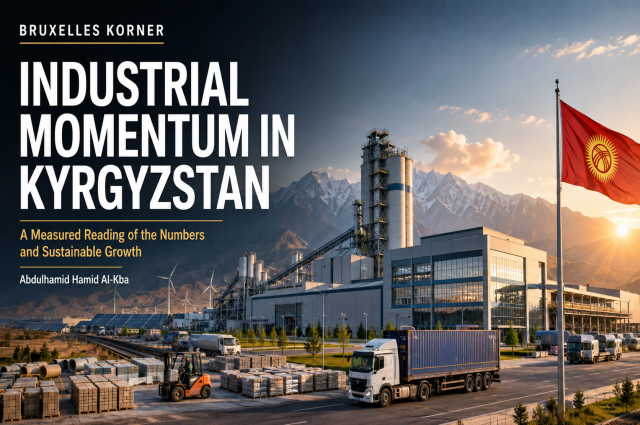
Industrial Momentum in Kyrgyzstan: A Measured Reading of the Numbers and Sustainable Growth
With industrial production rising by 12.7 percent in the first half of 2026, Kyrgyzstan is demonstrating both resilience and increasing diversification. The moderation recorded in June may signal not weakness, but a healthier normalization after a period of exceptionally rapid expansion.
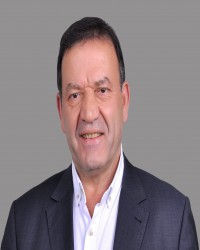
By Abdulhamid Hamid Al-Kba
Opinion writer specializing in Central Asian and Azerbaijani affairs
Bruxelles Korner
In economics, numbers are never merely dry statistics placed on a table. They are the pulse of an economy, revealing the direction, resilience and underlying transformation of entire sectors.
Having followed developments across Central Asia for many years, I find myself repeatedly drawn to Kyrgyzstan: a mountainous country with a strategic location, considerable natural resources and an industrial sector that continues to display remarkable resilience.

The first half of 2026 was no exception. Kyrgyz industrial production increased by 12.7 percent compared with the same period in 2025. This is more than a fleeting statistical performance. It reflects continuity and the country’s ability to maintain industrial momentum despite persistent regional and international uncertainty.
According to data from the Interstate Statistical Committee of the Commonwealth of Independent States, industrial output in June 2026 was 5 percent higher than in June 2025 and 4.2 percent above the level recorded in May 2026.
These figures merit careful interpretation. Industrial momentum remains firmly present, but the pace of expansion in June was less pronounced than during certain months of the previous year. What matters is therefore not reading each figure in isolation, but placing it within the broader trajectory of the Kyrgyz economy.
Growth remains strong, but is becoming more measured
During the first half of 2025, Kyrgyzstan’s industrial production had already risen by 12.5 percent compared with the corresponding period in 2024. In June 2025 alone, output increased by 11 percent year-on-year and by 10.3 percent compared with May.
The first-half performance recorded in 2026 was therefore slightly stronger than that of the previous year. Yet the June figures reveal a calmer monthly and annual rhythm.
This moderation should not automatically be interpreted as a sign of industrial weakness. It may instead reflect a natural normalization following the exceptionally high growth rates recorded in 2025.
Maintaining double-digit expansion over the first six months of 2026 demonstrates that Kyrgyzstan’s productive sectors continue to advance. At the same time, the slower pace recorded in June suggests that the economy may be entering a more balanced phase—one in which growth continues without placing excessive pressure on production capacity, prices and available resources.
That distinction is essential. Sustainable development is not defined by permanent acceleration. It depends on an economy’s capacity to consolidate earlier gains, improve productivity and expand its industrial base without creating major structural imbalances.
An industrial contribution extending beyond gold
According to reports from Kyrgyzstan’s Ministry of Economy and Commerce, total industrial output reached approximately 450.4 billion soms during the first half of 2026. The sector made a significant contribution to overall economic growth, with gross domestic product reportedly expanding by approximately 11.9 percent over the same period.
One of the most important features of this performance is that it was not driven exclusively by gold processing or basic metals.
Industrial production excluding gold-processing enterprises rose by 14.1 percent. This figure points to a broader transformation of the country’s productive structure and suggests that growth is becoming increasingly diversified.
For Kyrgyzstan, this development is strategically important. Gold has long played a central role in the national economy, export revenues and industrial statistics. Excessive reliance on a single commodity, however, leaves an economy exposed to fluctuations in international prices, production disruptions and external demand.
Growth outside the gold sector therefore represents more than a positive statistical detail. It is an indicator of increasing economic resilience.
Diversification becomes visible in the sectoral figures
The sectoral breakdown offers an even clearer picture of Kyrgyzstan’s industrial transformation.
Chemical production increased nearly 2.9-fold, while pharmaceutical output rose approximately 1.8-fold. Vehicle production expanded by 40.7 percent, construction materials by 33.4 percent, basic metals by 11.9 percent, and food products, beverages and tobacco by 8.2 percent.
Mining output increased by 12.8 percent.
These figures demonstrate that the current industrial momentum extends across several branches of the economy. The expansion of pharmaceuticals, chemicals and vehicle production is particularly noteworthy because these activities can generate more complex supply chains, encourage technological development and create skilled employment.
The strong increase in construction materials is closely connected to Kyrgyzstan’s construction boom. Expanding residential, commercial and public infrastructure projects have stimulated demand for cement, sand, gravel and other locally produced materials.
Construction is therefore acting as an important transmission mechanism: investment in buildings and infrastructure is creating additional demand throughout the domestic industrial economy.
The electricity, gas and steam sector was the principal exception, recording a slight decline of 1.2 percent, mainly because of lower electricity generation. While limited in scale, this decline highlights one of the structural challenges that Kyrgyzstan must address if it wants to sustain industrial expansion.
A growing manufacturing base requires reliable and increasingly diversified energy supplies. Investment in electricity generation, grid modernization and renewable energy will therefore be crucial to preventing energy constraints from becoming an obstacle to future industrial development.
Industrial policy begins to produce results
Government-led initiatives have also contributed to the present momentum. Projects such as “100 Industrial Enterprises – 2026” are beginning to produce tangible results in Bishkek and other parts of the country, while preparations are under way for the launch of additional production facilities.
Such initiatives can help reduce import dependence, expand domestic manufacturing and create new employment opportunities. Their long-term success, however, will depend on more than the number of factories inaugurated.
New enterprises must be economically viable, technologically competitive and capable of operating within regional and international supply chains. They also require access to financing, skilled workers, reliable energy, transport infrastructure and predictable administrative conditions.
The objective should not merely be to open factories, but to create an industrial ecosystem in which enterprises can survive, innovate and expand.
Geography and regional integration as economic assets
Kyrgyzstan’s industrial performance is not accidental. The country is benefiting from its position within the Eurasian Economic Union, its growing commercial relations with China and its efforts to expand domestic production.
Exports to China reportedly increased by approximately 50 percent for certain categories of goods during the first half of 2026. This development illustrates the opportunities created by Kyrgyzstan’s location between major regional markets.
The country occupies an important position at the intersection of Central Asia, China and the broader Eurasian space. If supported by improved transport corridors, customs modernization and efficient logistics, this geography can become one of Kyrgyzstan’s most valuable economic assets.
Membership of the Eurasian Economic Union gives Kyrgyz producers access to a larger regional market, while closer economic engagement with China offers opportunities for exports, investment and integration into cross-border supply chains.
Yet openness also creates competition. Kyrgyz enterprises must therefore improve quality, productivity and technological capacity if they are to compete successfully with larger regional producers.
Why the June slowdown may be healthy
Very high growth rates cannot continue indefinitely without creating inflationary pressure, production bottlenecks or excessive strain on energy and natural resources.
The moderation observed in June 2026 may therefore be constructive. It suggests that the industrial sector is moving from an exceptional phase of acceleration toward a more sustainable rhythm.
The central question is not whether every month can reproduce double-digit growth. It is whether Kyrgyzstan can maintain a positive medium-term trajectory while strengthening productivity, diversification and economic resilience.
From that perspective, a measured slowdown can be healthier than uncontrolled expansion. It allows companies to consolidate investment, authorities to address infrastructure constraints and the labour market to adjust to new industrial demand.
Sustainability will determine the next chapter
Sustainability is ultimately the decisive issue.
If Kyrgyzstan continues reducing its excessive dependence on gold while supporting manufacturing, pharmaceuticals, construction materials, renewable energy and modern infrastructure, the country will be well positioned to transform its current momentum into a durable foundation for long-term development.
The challenge lies in maintaining a careful balance: between speed and stability, domestic production and international openness, industrial expansion and environmental responsibility.
Energy security will also be essential. The slight decline in electricity generation serves as a reminder that industrial policy cannot be separated from energy policy. New factories and expanding cities will require reliable power supplies, greater efficiency and substantial investment in renewable resources.
Human capital represents another central pillar. Industrial diversification must be accompanied by vocational education, technical training and stronger cooperation between educational institutions and employers. Factories alone cannot modernize an economy without engineers, technicians, skilled workers and effective management.
Kyrgyzstan advances along a measured path
The figures speak quietly, but their message is significant.
Industrial growth of 12.7 percent during the first half of 2026 is not merely a statistical achievement. It reflects an economy that is gradually broadening its productive foundations and strengthening its capacity to withstand external shocks.
Kyrgyzstan is not advancing through gold production alone. Chemicals, pharmaceuticals, vehicles, construction materials, food processing and mining are all contributing to a more diversified industrial landscape.
The moderation recorded in June should therefore be seen within this broader context. It does not erase the underlying momentum. On the contrary, it may signal that Kyrgyzstan’s industrial expansion is entering a more mature and sustainable phase.
As a writer who has followed Central Asia for many years, I would describe the current trajectory in simple terms: Kyrgyzstan is not racing forward recklessly. It is advancing along a measured path.
In a world marked by volatility, disrupted supply chains and geopolitical uncertainty, that measured progress may prove to be one of the country’s most important achievements.








































Yorum Yazın
Facebook Yorum