




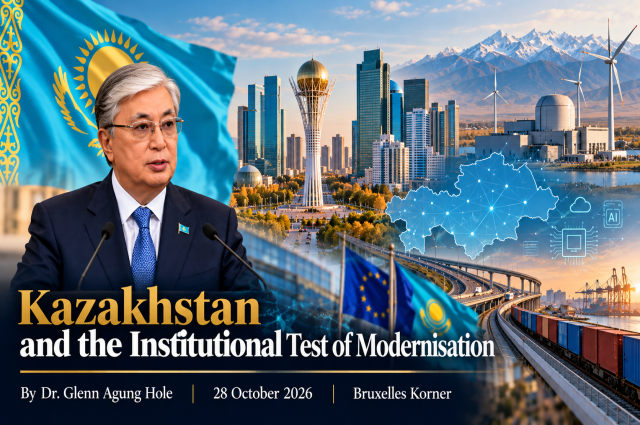
Kazakhstan and the Institutional Test of Modernisation
By Dr. Glenn Agung Hole | 28 October 2026 | Bruxelles Korner
President Tokayev has outlined an ambitious programme of economic renewal. Its success will depend on the institutions that govern investment, protect public resources and turn national priorities into lasting improvements in everyday life.

President Kassym-Jomart Tokayev’s address to the nation on 28 October placed infrastructure, energy, digitalisation and long-term financing at the centre of Kazakhstan’s development agenda. Read together, these priorities raise a fundamental question: how can political ambition become durable economic capacity?1
In commenting on the address for Silk Way TV from Norway, I approached this question through institutional capital. My assessment is that Kazakhstan’s development prospects depend heavily on its ability to make public commitments credible to citizens, entrepreneurs and international partners.
By institutional capital, I mean the accumulated trust and organisational competence that allow rules to function in practice. It develops when contracts are honoured, public officials apply regulations consistently and people can challenge decisions through effective procedures. These experiences influence whether businesses expand, whether knowledge is shared and whether citizens believe reform serves a broader public purpose.
The infrastructure programme provides a concrete test. Tokayev announced approximately 6.5 trillion tenge from the National Fund for infrastructure modernisation through the end of 2029.1
Expenditure on this scale requires rigorous project selection and scrutiny throughout delivery. Authorities should publish the expected benefits, procurement decisions and eventual costs of major projects. Maintenance must be funded from the outset. A completed road or hospital becomes a productive public asset only when it functions reliably and meets an identifiable need.
The regional dimension deserves particular attention. Local firms need a realistic opportunity to participate in procurement and develop the skills required by larger projects. Transparent tendering and proportionate qualification requirements can widen participation while preserving quality. Over time, this could help public investment support a broader base of competitive enterprises, with capabilities that survive beyond individual construction contracts.
Tax policy presents another test of institutional credibility. Tokayev called for targeted amendments to the Tax Code to resolve ambiguities and excessive burdens, while avoiding repeated changes to business conditions.1
For an entrepreneur considering a factory, new equipment or additional employees, uncertainty about administration can be as consequential as the formal tax burden. Consultation, clear guidance and reasonable transition periods should therefore form part of reform itself. Stability must allow necessary corrections, while giving businesses a sound basis for decisions whose returns may take years to materialise.
The address also called for greater bank participation in investment lending and deeper capital markets.1
Mobilising finance requires discipline in how it is allocated. Development institutions can help share risks that private investors cannot readily bear, but public involvement should be transparent and subject to commercial and social evaluation. Financial markets need reliable disclosure, protection for minority investors and credible arrangements for resolving insolvency. Without these foundations, additional funding may reproduce weaknesses in the allocation of capital.
Where pension savings contribute to development finance, the interests of savers must remain explicit. Governance arrangements should make risks, expected returns and responsibility for losses clear. National development objectives do not remove the obligation to protect the people whose deferred income provides part of the financing.
Tokayev’s emphasis on transferring nuclear expertise from foreign partners to domestic specialists addresses a further institutional challenge.1
Energy cooperation can build capabilities within Kazakhstan when contracts support training, operational knowledge and strong domestic oversight. Nuclear projects create obligations extending across generations. Their assessment must therefore encompass financing, safety regulation, waste management and environmental constraints. Strategic autonomy grows when the country can evaluate complex technologies and supervise their operation throughout their lifetime.
The same reasoning applies to digitalisation and artificial intelligence. Public agencies need the competence to commission systems, understand their limitations and retain control over essential data. Universities and employers also need sustained cooperation so that digital investment strengthens domestic expertise and creates opportunities beyond a small group of specialised organisations.
Digital government should be judged by the quality of the decisions and services it produces. A faster administrative process can still be unfair or inaccurate. Citizens need understandable explanations and accessible routes of appeal when automated systems affect their rights or access to support. Procurement should address cybersecurity and the ability to change suppliers without losing operational control.
Tokayev set 1 June 2027 as the deadline for a comprehensive public administration reform plan. This offers a specific milestone against which follow-through can be assessed.1
The plan should clarify who has authority to act, how performance is evaluated and where responsibility lies when delivery fails. Professional discretion matters because officials must respond to circumstances that central instructions cannot fully anticipate. That discretion needs independent oversight and effective remedies against arbitrary decisions. Administrative capacity and public accountability should develop together.
For Europe, this agenda has immediate relevance. At the April 2025 EU–Central Asia summit, the parties elevated their relationship to a strategic partnership and reaffirmed cooperation on transport connectivity and critical raw materials.2
The commercial value of a transport corridor depends on the reliability of the institutions along it. Customs procedures, interoperable documentation and predictable handling at borders affect delivery times and costs. European engagement should therefore support coordination across jurisdictions as well as physical infrastructure. This would help firms make practical use of the connections being developed.
The EU–Kazakhstan roadmap for 2025–2026 already includes research, skills and governance standards within cooperation on raw materials, batteries and renewable hydrogen.3
That provides a basis for partnerships involving universities, technical institutions and businesses. Joint training, research and supplier development could help Kazakhstan retain more knowledge and value within its economy. For European partners, stronger local capabilities could improve the reliability and durability of commercial relationships. Cooperation should respect Kazakhstan’s capacity to define its own development priorities.
The credibility of the broader programme will ultimately rest on evidence that people can observe. Useful indicators include procurement competition, the time needed to resolve business disputes, service reliability and access to economic opportunity across regions. Public reporting and independent scrutiny would make it possible to assess both progress and shortcomings. Political legitimacy requires space for citizens and businesses to question how reforms are implemented.
Tokayev has identified substantial tasks for the next phase of Kazakhstan’s development. The next test is whether public institutions can sustain delivery, learn from failure and preserve trust as difficult choices arise. For Kazakhstan and its European partners, investing in that institutional capital is essential to making economic modernisation endure.
Sources
1. President Kassym-Jomart Tokayev’s address to the people of Kazakhstan, 28 October 2026. Official Russian transcript, Prime Minister of Kazakhstan. Read source
2. First EU–Central Asia summit, 4 April 2025. Council of the European Union. Read source
3. EU and Kazakhstan take the next step in their cooperation on critical raw materials, 4 April 2025. European External Action Service. Read source
































Yorum Yazın
Facebook Yorum