




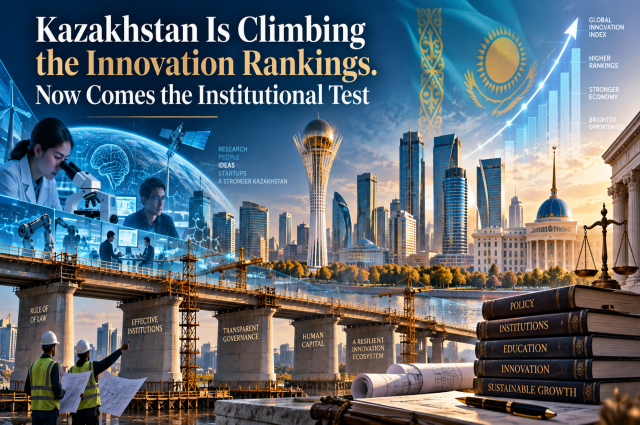
Kazakhstan Is Climbing the Innovation Rankings. Now Comes the Institutional Test
By Dr. Glenn Agung Hole, Institutional Economist
Kazakhstan’s eight-place rise to 73rd in the Global Innovation Index 2026 deserves attention in Brussels. It suggests progress in an economy whose importance to Europe is growing. Yet the development question behind the ranking is more demanding: how much of the knowledge and investment entering Kazakhstan becomes a lasting capability within its own firms?

WIPO identifies Kazakhstan as the strongest climber in Central and Southern Asia this year. Its methodology also requires caution when comparing annual rankings, which reflect changes in data availability as well as economic performance. The improvement is encouraging evidence, but cannot by itself establish that the economy has undergone a structural transformation.
For an institutional economist, the decisive issue is what happens between acquiring resources and putting them to productive use. A foreign investor can install advanced equipment. A university can train engineers. A public agency can finance a technology programme. Whether these activities reinforce one another depends on arrangements that are often less visible than the investment announcement: enforceable contracts, credible commercial incentives and organisations able to sustain cooperation when individual leaders change.
I use institutional capital to describe this accumulated ability to coordinate economic activity and retain the knowledge it generates. It develops through repeated cooperation under rules that participants can trust. Where those relationships function, an investment can produce learning across a supplier network. Where they remain fragile, the same investment may generate substantial output while leaving relatively little expertise outside the investor’s own operations.
This distinction matters for Kazakhstan because international integration can take very different forms. A transport corridor creates access to markets, but access becomes more valuable when domestic firms can meet the standards those markets demand. Imported technology raises productive potential, but its wider contribution depends on local employees learning to adapt it and suppliers acquiring the competence to support it. Economic diversification requires these changes inside businesses, over years.
Europe has a direct interest in that process. During President Kassym-Jomart Tokayev’s Brussels visit on 23 June, EU and Kazakh leaders reaffirmed cooperation in critical raw materials, energy and transport, alongside digitalisation and emerging technologies. They also welcomed expanding research and educational cooperation. This gives the partnership a basis for connecting industrial investment with the institutions through which knowledge circulates.
The commercial incentives deserve close attention. A European company may have sound reasons to use established international suppliers rather than develop unfamiliar local ones. A Kazakh university may reward academic publication more clearly than sustained collaboration with industry. A young firm may struggle to finance the certification needed to secure its first export contract. Each decision can be rational for the organisation concerned while collectively limiting the development of domestic capabilities.
Policy should address these specific obstacles. Supplier development is more credible when it includes technical assistance and a realistic route to becoming competitive. Joint research needs agreements on intellectual property and access to facilities before a project begins. Public procurement can provide an initial customer for emerging technology, provided selection remains transparent and contracts do not shelter firms indefinitely from competition. The objective is to make learning commercially viable.
Universities have a particularly important role here. Their contribution extends beyond supplying graduates or signing cooperation agreements. Long-term work with firms allows researchers to understand production problems and helps businesses identify knowledge they could use. That requires time, funding arrangements and professional recognition for academics who undertake such work. A partnership that exists only on paper adds little to an economy’s capacity to innovate.
Finance must also match the stage of development. Venture capital can support some technology businesses, but many industrial suppliers need patient credit, equipment finance or funding for applied development. Treating every innovation problem as a shortage of startup investment risks overlooking established firms that could improve productivity through relatively modest technological changes. Innovation policy should reach those businesses too.
There is a corresponding obligation to evaluate public support honestly. Programmes need evidence of additional private investment, successful commercial application and stronger firm-level capabilities. Political visibility is a poor guide to economic value. Authorities must be able to revise schemes that disappoint and end support where dependence replaces learning. Predictable rules and room for new entrants help keep industrial development from becoming a mechanism for protecting incumbents.
For the EU, this approach would also strengthen the practical meaning of a strategic partnership. European companies benefit when local suppliers become more reliable and technically capable. Kazakhstan gains a broader productive base and greater ability to negotiate future economic relationships. Such mutual benefits depend on the design of individual projects, including their training commitments and research relationships; they will not follow automatically from the volume of investment.
Kazakhstan’s next phase should therefore be judged through changes observable inside its economy. Can a domestic supplier win more demanding contracts? Can a university partnership yield a technology that a firm actually uses? Can a growing business secure finance without relying on personal access to decision-makers? Answers to those questions would tell us far more about the durability of progress than another movement in a league table.
The rise to 73rd provides a useful moment to ask them. Kazakhstan has an opportunity to use its expanding international relationships to deepen domestic competence. Europe can contribute by making that ambition a practical part of its cooperation. The lasting achievement would be an economy in which firms can keep learning and competing after the first investment project has ended.
Sources
WIPO — Global Innovation Index 2026
https://www.wipo.int/web-publications-preview/global-innovation-index-2026/en/gii-2026-results.html
European Council — Joint statement, 23 June 2026
https://www.consilium.europa.eu/en/press/press-releases/2026/06/23/strengthening-the-strategic-partnership-between-the-european-union-and-kazakhstan/















































Yorum Yazın
Facebook Yorum