




The Eastern Economic Forum:
The Eastern Economic Forum: Asia’s AI Boom, Industrial Relocation and the New Geography of Global Power
Roscongress Foundation experts highlight the economic forces reshaping Asia as artificial intelligence, supply-chain integration and geopolitical fragmentation accelerate the region’s rise
By Amr Yehia – Bruxelles Korner

Asia is no longer simply the world’s manufacturing centre. It is increasingly becoming one of the principal arenas in which the technological, industrial and geopolitical balance of the twenty-first century is being determined.
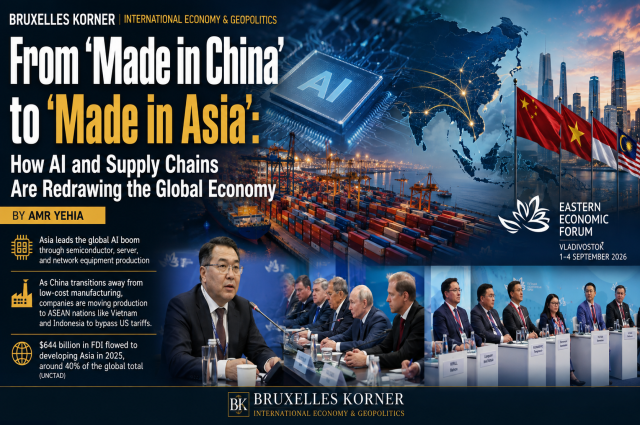
At the Eastern Economic Forum, taking place in Vladivostok from 1 to 4 September 2026, experts from the Roscongress Foundation have highlighted several structural trends transforming the Asian economy: the artificial-intelligence investment boom, the relocation of industrial production from China towards South-East Asia, the emergence of increasingly integrated regional supply chains and the growing strategic importance of Eurasian transport corridors.
.jpeg)
These developments are examined in the analytical review “Asia Trends 2026: The AI Boom, Industrial Relocation, and Geopolitical Fragmentation.”
The Eastern Economic Forum is being held on the campus of Far Eastern Federal University and is organized by the Roscongress Foundation with the support of the Government of the Russian Federation.
Asia is becoming one of the main engines of the world economy
The central argument of the Roscongress analysis is that Asia has become indispensable to global economic expansion.
The region accounts for a substantial share of global GDP growth and increasingly concentrates industrial production, trade, technology investment, financial flows and strategic resources.
Yet Asia should not be viewed as a single homogeneous economic bloc.
The gap between its economies remains considerable.
Advanced industrial economies such as Japan and South Korea face slower demographic and economic growth, while emerging economies including Vietnam, India, Indonesia and several ASEAN states continue to expand more rapidly.
IMF data illustrate this divergence. Emerging and developing Asian economies grew substantially faster than most advanced economies in 2025, while Vietnam was among the strongest performers and Myanmar remained among the weakest.
This creates what may become one of Asia’s defining economic characteristics: the continent is rising collectively, but not uniformly.
$644 billion in foreign investment
Foreign direct investment provides another indication of Asia’s changing position.
According to UN Trade and Development, developing Asia attracted approximately $644 billion in foreign direct investment in 2025.
That represented around 40% of global FDI flows and more than 70% of investment flowing towards developing economies.
But the headline figure hides an important structural weakness.
Capital is increasingly concentrated in a relatively small number of countries and sectors.
Eight of the ten largest FDI recipients among developing economies are located in Asia.
Investment is also increasingly directed towards strategically important industries such as artificial intelligence, semiconductors, data infrastructure, clean energy and critical minerals.
The result could be a widening economic divide within Asia itself.
Countries already integrated into advanced technological and industrial ecosystems may attract a growing proportion of capital, skills and infrastructure, while economies outside these networks risk falling further behind.

Asia at the centre of the global AI boom
Artificial intelligence is accelerating this transformation.
The AI revolution is often described primarily through software companies and large language models. But behind those technologies lies an enormous physical industrial infrastructure.
AI requires semiconductors.
It requires memory chips.
It requires servers, data centres, networking equipment, cooling systems, electricity generation and increasingly sophisticated supply chains.
A large share of that industrial ecosystem is located in Asia.
Taiwan, South Korea, China, Japan and parts of South-East Asia occupy crucial positions in semiconductor manufacturing, memory production, electronics, component manufacturing and equipment supply.
Consequently, the global AI investment cycle is simultaneously becoming an Asian industrial cycle.
Demand for computing capacity is supporting exports of advanced electronics and industrial components, providing another powerful growth engine for economies positioned inside these value chains.
The economic benefits, however, will depend heavily on where individual countries sit within the production hierarchy.
Designing advanced chips, manufacturing semiconductors, producing memory, assembling servers and packaging electronic components generate very different levels of technological sovereignty and economic value.
.jpeg)
China is changing its role rather than disappearing from manufacturing
One of the most important developments identified by Roscongress concerns China.
For several decades, China’s economic rise was associated with its role as the world’s low-cost manufacturing platform.
That model is changing.
Higher wages, technological upgrading, industrial policy and trade tensions with the United States are gradually pushing parts of labour-intensive manufacturing towards lower-cost economies.
Vietnam and Indonesia are among the principal beneficiaries.
Chinese companies themselves are increasingly investing or relocating production elsewhere in Asia, particularly within ASEAN.
US tariffs and trade restrictions have accelerated that process.
But this should not necessarily be interpreted as a straightforward industrial retreat by China.
China is increasingly moving upstream in the value chain.
Instead of producing every finished product domestically, Chinese companies can supply machinery, components, electronics and industrial inputs to factories located elsewhere in Asia.
Production moves.
The supply chain remains Chinese-linked.
.jpeg)
From “Made in China” to “Made in Asia”
This shift is helping create a much more integrated Asian manufacturing system.
A product may now involve research and development in China, semiconductor manufacturing in Taiwan or South Korea, components produced in China, assembly in Vietnam or Malaysia and final export to Europe or the United States.
The traditional concept of a product having a single national industrial identity is therefore becoming less meaningful.
The emerging model is increasingly:
Designed in one country.
Components produced in another.
Assembled in a third.
Sold globally.
This could gradually transform “Made in China” into something closer to “Made in Asia.”
The Roscongress report notes that Chinese exports of intermediate goods — including memory chips, semiconductors and industrial components — increased strongly in 2025.
In some cases, these exports appear to compensate indirectly for reduced Chinese shipments of finished goods to the United States.
A smartphone previously exported directly from China, for example, may instead be assembled in India or another Asian economy using components originating partly from China.
Trade flows change.
Industrial interdependence remains.
ASEAN gains — but also becomes a geopolitical battlefield
South-East Asia is one of the principal beneficiaries of this industrial redistribution.
Vietnam, Malaysia, Indonesia and other ASEAN economies are attracting manufacturing investment as companies diversify production outside China.
But this opportunity carries geopolitical risks.
ASEAN states increasingly operate between the economic gravitational pull of China and the strategic pressure of the United States.
China is simultaneously a competitor, an investor, a supplier and one of their largest trading partners.
Washington, meanwhile, is encouraging diversification away from Chinese-controlled supply chains and strengthening partnerships with strategically important Asian economies.
For ASEAN governments, the challenge is therefore increasingly delicate:
benefit from Chinese industrial integration without becoming excessively dependent on Beijing, while cooperating with Washington without being forced into a rigid geopolitical bloc.
This balancing act may become one of the defining diplomatic challenges of South-East Asia.
Geopolitical fragmentation is reorganizing globalization
The larger phenomenon behind these developments is not necessarily deglobalization.
It is the reorganization of globalization.
Supply chains are becoming more regional.
Governments increasingly treat semiconductors, energy, critical minerals, artificial intelligence and transport infrastructure as national-security issues.
Companies are diversifying suppliers not only according to cost but also according to geopolitical risk.
Concepts such as “friend-shoring”, “near-shoring” and “China+1” strategies have entered corporate planning.
The global economy is therefore becoming more fragmented politically while remaining deeply interconnected economically.
Asia sits at the centre of this contradiction.
Russia sees an opportunity in Eurasian connectivity
.jpeg)
The Roscongress analysis naturally also emphasizes Russia’s potential role in this emerging economic geography.
As global economic activity increasingly shifts towards Asia, Moscow is seeking to strengthen the connection between the Russian economy and Asian markets through its Far Eastern regions.
Russia’s Far Eastern Federal District occupies a potentially strategic position between the Russian interior and the Asia-Pacific.
Its ports, railways and natural resources could allow the region to function as both a logistics corridor and resource gateway.
Historically, however, infrastructure capacity has limited that potential.
Russia has therefore invested heavily in modernizing what it calls the Eastern Operating Domain, centred around two major railway systems:
the Trans-Siberian Railway and the Baikal–Amur Mainline.
According to figures cited by Roscongress, modernization programmes implemented since 2013 have increased the network’s carrying capacity substantially, reaching approximately 180 million tonnes in 2025.
Further expansion is planned towards 2030 and 2032.
Whether these projects can fully reposition Russia within Asian supply chains will depend not only on railway capacity but also on sanctions, investment availability, port infrastructure, trade demand and the broader geopolitical relationship between Russia and Asian economies.
The real shift is structural
The most important conclusion from the Eastern Economic Forum is therefore broader than any single investment statistic.
Asia’s rise is no longer based exclusively on cheap labour and export manufacturing.
A much more complex economic architecture is emerging.
Artificial intelligence is reinforcing demand for Asian technology.
Industrial production is spreading from China towards South-East Asia.
China itself is moving towards higher-value components, industrial equipment and technological sectors.
ASEAN is becoming an increasingly important manufacturing platform.
India is expanding its role within electronics and industrial supply chains.
And Eurasian powers are competing to construct the railways, ports, energy systems and trade corridors capable of connecting these new centres of production.
The world economy is not simply moving from West to East.
It is becoming multi-centred.
And across that new economic map, Asia is rapidly becoming one of the principal places where technology, industry, capital and geopolitical power converge.
Bruxelles Korner | International Economy & Geopolitics
Résumé en français
Le Forum économique oriental, organisé à Vladivostok du 1er au 4 septembre 2026, met en évidence une transformation profonde de l’économie asiatique. Selon l’analyse de la Fondation Roscongress, l’Asie devient progressivement l’un des principaux centres mondiaux de technologie, d’industrie, de commerce, de capitaux et de puissance géopolitique.
L’un des moteurs majeurs de cette évolution est le boom de l’intelligence artificielle. Derrière l’IA se trouvent des besoins massifs en semi-conducteurs, puces mémoire, serveurs, centres de données et équipements de réseau. Or une grande partie de cette chaîne industrielle est concentrée en Asie, notamment en Chine, en Corée du Sud, au Japon, à Taïwan et en Asie du Sud-Est.
Parallèlement, le modèle industriel chinois évolue. La Chine n’est plus seulement une plateforme de production à bas coût. Une partie de la fabrication est déplacée vers des pays comme le Vietnam, l’Indonésie ou la Malaisie, notamment pour réduire les coûts et contourner certaines barrières commerciales américaines. Mais cela ne signifie pas un recul de la Chine : Pékin conserve un rôle central en fournissant machines, composants, électronique et équipements industriels.
On assiste ainsi à un passage progressif du « Made in China » au « Made in Asia ». Un même produit peut être conçu dans un pays, utiliser des composants fabriqués dans un autre, être assemblé dans un troisième, puis exporté mondialement. Les chaînes de valeur deviennent donc beaucoup plus régionales et interconnectées.
Les pays de l’ASEAN bénéficient de cette redistribution industrielle, mais ils se retrouvent aussi au cœur de la rivalité entre la Chine et les États-Unis. Leur défi consiste à profiter des investissements chinois tout en évitant une dépendance excessive, et à coopérer avec Washington sans être enfermés dans une logique de blocs.
Les investissements étrangers illustrent également ce basculement : l’Asie en développement a attiré environ 644 milliards de dollars d’investissements directs étrangers en 2025, soit près de 40 % des flux mondiaux. Mais ces capitaux restent très concentrés dans quelques pays et secteurs, notamment l’IA, les semi-conducteurs, l’énergie propre et les minerais critiques.
Enfin, la Russie cherche à profiter de cette nouvelle géographie économique à travers son Extrême-Orient et ses grands corridors ferroviaires, notamment le Transsibérien et la Baïkal-Amour, afin de renforcer ses connexions avec l’Asie.
En une phrase
Le monde ne passe pas simplement de l’Ouest à l’Est : il devient multipolaire, avec une Asie qui s’impose comme l’un des centres majeurs de la technologie, de l’industrie, des capitaux et des nouvelles chaînes d’approvisionnement mondiales.
















































Yorum Yazın
Facebook Yorum