




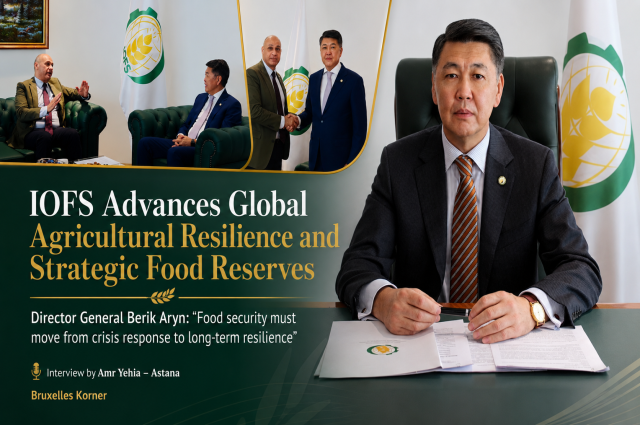
IOFS Advances Global Agricultural Resilience and Strategic Food Reserves
Director General Berik Aryn: “Food security must move from crisis response to long-term resilience”
Interview by Amr Yehia – Astana
Bruxelles Korner

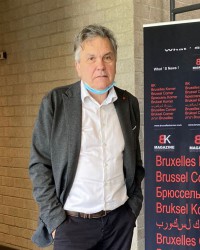
Ambassador Berik Aryn, Director General of the Islamic Organization for Food Security (IOFS), has outlined the organization’s global strategy to strengthen long-term agricultural resilience, secure supply chains and develop strategic food reserves across its Member States.
Speaking to Bruxelles Korner, Ambassador Aryn stressed that food security can no longer be approached solely as an emergency-response issue. According to him, the priority must now be to reinforce national productive capacities, diversify supply corridors, modernize agriculture and build stronger regional mechanisms capable of absorbing geopolitical, climatic and economic shocks.
He also emphasized the growing importance of multilateral partnerships, technological innovation and capacity-building programmes in transforming vulnerable food systems into more resilient and self-reliant economies across Asia, Africa and the Middle East.

Within this broader strategy, Ambassador Aryn identified Egypt as one of the IOFS’s key partners. Drawing on his own role in supporting Egypt’s accession to the organization during his tenure as Kazakhstan’s Ambassador to Cairo, he highlighted Egyptian expertise in agriculture, irrigation, strategic crops, food banking and large-scale land reclamation.
The objective, he explained, is to connect that experience with countries across Africa, Central Asia and the wider Islamic world.
Bruxelles Korner: Since assuming leadership of the IOFS in April 2024, what is your strategic roadmap for reinforcing food security mechanisms across OIC Member States?
Ambassador Berik Aryn:
Since taking office, my priority has been to make the IOFS more practical, project-oriented and responsive to the needs of our Member States.
The first pillar is partnership.
Food security requires collective action, so we have strengthened cooperation with the Islamic Development Bank (IsDB), FAO, UNDP, UN Women, CGIAR centres and regional organizations. These partnerships allow us to combine expertise, financing and implementation capacity.
The second pillar is active implementation.
We are establishing an international GenBank in Kazakhstan, advancing irrigation digitalization in Central Asia with the IsDB, implementing agricultural value-chain and livestock projects across Africa, and supporting women’s participation in agri-food value chains in cooperation with UN Women.
The third pillar is institutional development.
Together with the IsDB and SESRIC, we are preparing the OIC Strategic Plan for Food Security. We have also established a task force to revise the IOFS Strategic Vision 2031, with the objective of strengthening project delivery, monitoring and resilience across Member States.
BK: Severe geopolitical escalations across several regions and maritime routes have disrupted global supply chains, fertilizer availability and grain logistics. How is the IOFS assessing these combined shocks on vulnerable Member States?
Ambassador Berik Aryn:
The IOFS views geopolitical shocks as interconnected systemic risks that can rapidly trigger food insecurity, particularly in vulnerable, import-dependent and conflict-affected OIC Member States.
In response, the organization is addressing these vulnerabilities through a comprehensive resilience framework based on three main priorities:
diversifying trade corridors;
creating regional safety buffers;
empowering farmers through climate-smart risk-management mechanisms.
We are translating this strategy into measurable delivery on the ground.
This includes advancing the OIC Food Security Reserve System (OIC-FSR) to help stabilize supplies during maritime and land-route disruptions, implementing the National Food Sector Development Programme to improve regional trade coordination, and leveraging our subsidiary, the International Islamic Food Processing Association (IFPA), to strengthen cross-border private-sector logistics.
Furthermore, in close coordination with the IsDB and SESRIC, we are drafting the Strategic Plan for Ensuring Food Security in OIC Member States (SPEFS-OIC).
This plan is intended to serve as a roadmap for technology transfer, investment mobilization and the expansion of intra-OIC trade.
BK: What initiatives is the organization prioritizing to transform food security from reactive emergency aid into long-term agricultural self-reliance for developing Member States?
Ambassador Berik Aryn:
Our objective is to move away from a model that reacts mainly after a food-security crisis has emerged and toward one that builds resilience and productive capacity in advance.
To achieve this, we follow a country-driven approach.
We launch targeted pilot projects aligned with national priorities and then scale successful initiatives into broader regional programmes as local capacity strengthens.
Under the Afghanistan Food Security Programme (AFSP), the IOFS implemented targeted wheat, maize and soybean projects in Herat, Logar and Mazar-i-Sharif.
Co-financed by the Government of Kazakhstan, the IOFS, TIKA and CICA, the initiative supported more than 1,000 smallholder farmers by providing improved seeds, fertilizers, agricultural tools and practical field training.
On a broader institutional level, the IOFS is also supporting initiatives related to genebanks and the conservation of agricultural genetic resources.
We are working on digital and smart agriculture, water-management solutions and technology-oriented agricultural projects.
BK: What role did the IOFS play in Kazakhstan’s first Kurultai election?
Ambassador Berik Aryn:
The IOFS participated as an accredited international observer in Kazakhstan’s first parliamentary elections for the new unicameral Kurultai, a milestone in the country’s ongoing political transformation.
The IOFS observation mission comprised seven accredited international observers.
The mission reported that the polling stations it visited were well organized and technically equipped.
According to the observers, voting proceeded in a transparent and orderly manner, with clear voter information and signage available throughout the polling stations.
“Overall, our impression of the voting process has been positive. We observed a calm atmosphere, professional work by election commissions and citizens participating with a strong sense of civic responsibility.”

BK: Egypt possesses extensive agricultural expertise, large-scale reclamation projects and major regional initiatives such as the Egyptian Food Bank. How does the IOFS plan to leverage Egypt’s model and technical capacities to support other OIC Member States, particularly in Africa?
Ambassador Berik Aryn:
Egypt is one of the important and active Member States of the IOFS and has significant experience that can be shared with other OIC countries.
I have a personal connection to the development of IOFS–Egypt cooperation.
During my tenure as Ambassador of Kazakhstan to Egypt, President Abdel Fattah El-Sisi made an official visit to Astana in February 2016, during which Egypt signed the Statute of the Islamic Organization for Food Security.
We see Egypt as an invaluable source of practical knowledge in areas such as agricultural development, strategic commodities, irrigation, organic fertilizers, large-scale agricultural production, food storage and distribution.
For several years, the IOFS has used its platforms and capacity-building activities to facilitate the exchange of experience among Member States.
The experience of the Egyptian Food Bank is another good example of civil-society engagement in reducing hunger.
The IOFS has brought together food-bank institutions from African and Arab countries so that they can learn from the Egyptian model.
Going forward, we want to move from awareness-raising toward structured technical cooperation by linking Egyptian institutions and experts with counterparts in interested OIC countries, developing training programmes and supporting scalable pilot initiatives.
Last year, I met with Prof. Dr. Hani Sewilam, Minister of Water Resources and Irrigation, and Alaa El-Din Farouk Zaky El-Sayyed, Minister of Agriculture and Land Reclamation.
We agreed to work with both ministries and the Regional Center for Water Resources and Irrigation to implement regional capacity-building programmes and pilot initiatives supporting sustainable water management across OIC Member States.

BK: Egypt is currently undertaking major national mega-projects. In what concrete ways can the IOFS partner with Egypt to leverage these infrastructure investments?
Ambassador Berik Aryn:
Climate change is already affecting agricultural productivity, water availability and production costs.
The central question is therefore how to produce more efficiently under increasingly difficult climatic and water conditions.
The objective of the IOFS is to work with Egyptian institutions to facilitate the exchange and adaptation of technologies and know-how in several key areas:
climate-smart agriculture;
water-efficient irrigation;
controlled-environment agriculture;
digital farming;
renewable-energy applications in agriculture;
sustainable use of agricultural inputs.
Egypt’s experience in water management is particularly relevant.
The IOFS participates annually in Cairo Water Week and organizes dedicated sessions during the event. We use this platform to raise awareness among OIC Member States about innovative approaches in irrigation, digital water management, water-use efficiency and other technologies relevant to climate-resilient agriculture.
Through such platforms, the IOFS seeks to connect Egyptian and international expertise with the needs of other OIC Member States, particularly countries facing increasingly severe water scarcity.
From food security to strategic sovereignty
The interview with Ambassador Berik Aryn reveals a broader transformation in the way the IOFS defines food security.
The organization is seeking to move beyond the traditional logic of humanitarian response and emergency food assistance toward a model based on strategic reserves, regional production capacity, agricultural technology, resilient logistics and national self-reliance.
In an international environment increasingly marked by conflict, climate disruption, fragile maritime routes and pressure on global agricultural markets, food security is becoming inseparable from economic and geopolitical sovereignty.
For the IOFS, the challenge is therefore no longer simply to ensure that food is available.
It is to ensure that Member States possess the institutions, technologies, infrastructure and regional partnerships necessary to withstand the next global shock.
Amr Yehia – Astana
Bruxelles Korner

















Yorum Yazın
Facebook Yorum