




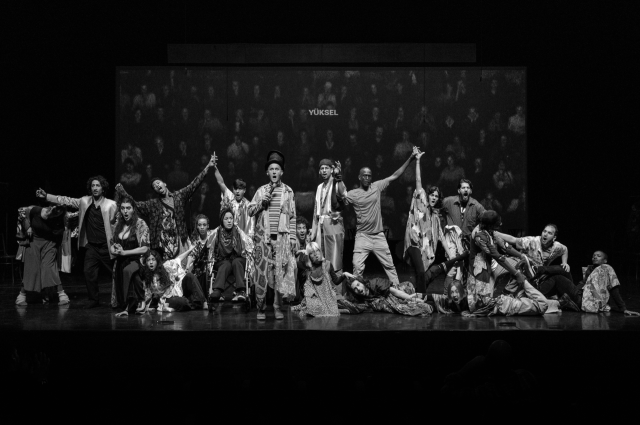
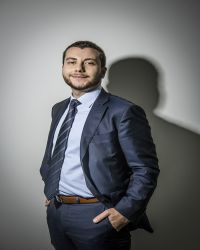
Photo: Vibe Stalpaert
There is a Turkish expression I use quite often: "iki arada bir derede kalmak", literally, “to be caught between two banks and a river.” We use it to describe those moments in everyday life when we do not know what to do, when we find ourselves caught between two difficult choices. More often than not, it is an exhausting kind of limbo. Sometimes, however, instead of becoming sharply polarised or blindly choosing one side, it can actually be good to remain “in between.” Of course, as long as you nurture that grey area with awareness and a genuine effort to make sense of it...
But sometimes those “in-betweens” multiply so much that you can completely lose your sense of direction. As the Turkish Romani singer Kibariye cries out in one of her songs: “The rivers won’t let me go, the in-betweens won’t give me a way...” For sometimes life can create artificial rivers in front of us, tying our hands and leaving us nowhere to go.
A thought-provoking example of being caught “iki arada bir derede” happened in Brussels, in the heart of Europe.
Our river is the Brussels Canal. On one side lies the City of Brussels, and on the other, the municipality of Molenbeek. On the Brussels side of the canal stands the historic Petit Château (‘Little Castle’), which serves as Fedasil’s Arrival Centre for asylum seekers. At the time, it also housed the Immigration Office’s registration service.
As you probably know, Belgium’s administrative system gives local authorities considerable autonomy; so much so that even local police forces responsible for public order are organised around police zones. Of course, all within the framework of national law.
About three years ago, this administrative autonomy, combined with a geographical boundary, gave rise to an absurd human drama. In front of Petit Château, refugees seeking shelter while waiting for the outcome of their asylum applications began putting up tents. Because simply arriving in a country and applying for asylum is not enough; until your official refugee status is approved, you may find yourself out on the streets.
But the local police of the City of Brussels did not want to allow these tents within their jurisdiction. “Move along,” they said. So where were these people supposed to go? To the other side of the canal, to Molenbeek... But the municipality of Molenbeek did not want to take sole responsibility for the crisis either, and they intervened as well.
So what happened in the end?
The tents were put up right on the bridge connecting the two sides.
The police on both sides had protected their own boundaries. Both municipal administrations could breathe a little easier.
But had the problem been solved?
Of course not.
It is easy to call someone simply a “refugee”, to classify a human being administratively within a category. But every person waiting on that bridge, in those tents, has a separate journey through life, their own reasons for leaving the land where they were born, their own story.
And it was precisely at this moment of helplessness that the healing power of civil society stepped in.
People from the surrounding neighbourhoods began helping. Some brought food; others welcomed people into their homes to provide them with basic necessities. Civil society organisations also became involved.
One of them was Cinemaximiliaan.
Cinemaximiliaan is an organisation that aims to make the transition into a new life easier for migrants through art, creating with them and for them. I have also been part of this organisation as a volunteer since 2019.
Together, we have spent several years walking hand in hand with those travellers of life who found themselves “iki arada bir derede”, caught between two banks and a river, on a bridge that was never meant to become home.
Through writing, photography, dance and music workshops, we first experienced what it meant to express ourselves. We laughed together, cried together, got excited together.
And this solidarity gradually evolved through storytelling on stage and outdoors, as well as through podcast productions, into a full-scale stage performance.
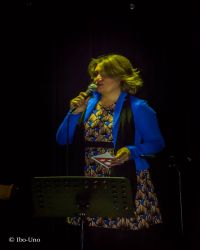
This year, that effort came to the audience as Bridge Stories, a co-production of Cinemaximiliaan and the renowned theatre organisation Needcompany, at the Royal Flemish Theatre (KVS).
As I mentioned earlier, our aim was not to do something to someone, nor to make someone do something. It was simply to move forward together, in solidarity, with and for one another.
You can find more about this special performance, which grew between these bridges and rivers, and in which I contributed both with a text I wrote during one of the writing workshops and as a performer on stage at this link.
May our lives find a way to flow together, may bridges bring us closer, without ever giving up our stories...
Stay well, with love.

Yorum Yazın
Facebook Yorum