




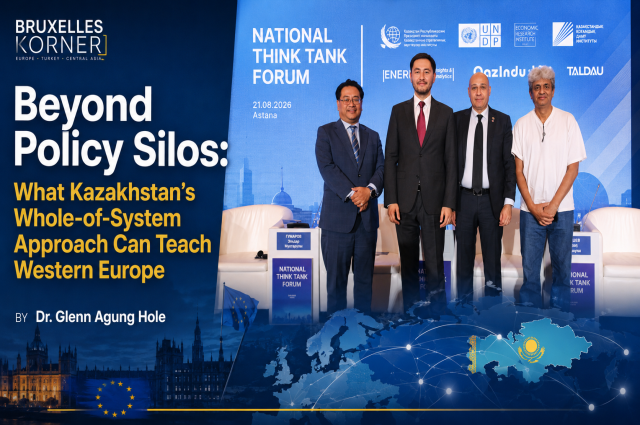
Beyond Policy Silos: What Kazakhstan’s Whole-of-System Approach Can Teach Western Europe
An Institutional Economist’s Reflections on Strategic Coherence, Institutional Capacity and the Architecture of National Development

Over several years of engagement with Kazakhstan, I have repeatedly encountered something that is surprisingly difficult to capture through conventional country analysis.
It is not any single reform, infrastructure project, university partnership or technological initiative that has attracted my attention. Nor is it one particular political decision.
It is the growing tendency to connect them.
During my most recent visit to Astana in August 2026, this became particularly visible. At the National Think Tank Forum on 21 August, discussions moved between artificial intelligence, energy, higher education, industrialisation, human capital, entrepreneurship, infrastructure and Kazakhstan’s future position in a changing international system.
At first sight, these appear to be separate policy areas.
They are not.
This is perhaps the most important lesson I have taken from Kazakhstan: national development cannot be understood piece by piece.
Energy policy affects digital capacity. Digital capacity affects productivity. Artificial intelligence depends on computing infrastructure, which in turn depends on electricity, capital and specialised human competence. Universities influence research, entrepreneurship and technological absorption. Entrepreneurship determines whether knowledge becomes commercially productive. Transport infrastructure influences trade, industrial location and investment. And all of this ultimately affects the strategic room for manoeuvre available to a state.
What I increasingly observe in Kazakhstan is an attempt—still incomplete and certainly not without institutional weaknesses—to understand these relationships as parts of one system.
For an institutional economist, that is much more interesting than any individual project.
The Missing Variable Is Not Resources, but Connections
Much economic and political analysis still begins by separating society into sectors.
We have energy policy, education policy, industrial policy, innovation policy, SME policy, transport policy, digital policy and foreign policy. Each develops its own strategies, institutions, budgets, experts and indicators.
This may be administratively convenient.
Economically, however, it can be deeply misleading.
Douglass North taught us that institutions structure incentives and reduce uncertainty in economic interaction (North, 1990). Albert Hirschman demonstrated that economic development emerges through linkages between activities rather than through isolated investments (Hirschman, 1958). Joseph Schumpeter placed innovation and entrepreneurship at the centre of economic transformation (Schumpeter, 1934), while the later literature on national innovation systems showed that technological development depends upon interactions between firms, universities, government, finance and research institutions rather than individual actors operating in isolation (Freeman, 1987; Lundvall, 1992; Nelson, 1993).
The implication is fundamental.
A country may possess capital without converting it into productive investment.
It may possess universities without converting knowledge into innovation.
It may possess entrepreneurs without creating scalable companies.
It may possess energy without converting it into industrial capacity.
And it may possess infrastructure without converting geography into strategic advantage.
The real question is therefore not simply what resources a society possesses.
The deeper question is:
Can its institutions connect those resources and convert them into productive and strategic capacity?
I describe this as institutional conversion capacity.
And it is here that Kazakhstan becomes particularly interesting.
Artificial Intelligence Begins With Electricity
Artificial intelligence provides one of the clearest examples.
Across Europe, AI is frequently discussed as a technological or regulatory question. We discuss models, algorithms, data governance, ethics, regulation and digital competitiveness.
All are important.
But AI is also an energy question.
It is an infrastructure question.
It is an education question.
It is an investment question.
And increasingly, it is an industrial and geopolitical question.
Kazakhstan appears to understand this interconnectedness.
The country has designated 2026 as the Year of Digitalisation and Artificial Intelligence and is developing its Data Center Valley in the Pavlodar region around the Ekibastuz energy hub. According to official government reporting, the first data-centre facility is planned with a capacity of 50 MW, while the wider infrastructure concept is intended to support future expansion of the cluster towards a total capacity of up to 1 GW.
What interests me is not primarily the size of the project.
It is the logic behind it.
Computing capacity is being considered alongside energy availability, grid infrastructure, investment conditions, cloud services, AI development, specialist competence and future industrial applications.
In other words, Kazakhstan is not treating artificial intelligence merely as software policy.
It is increasingly treating AI as energy policy, infrastructure policy, education policy, investment policy and industrial policy simultaneously.
That distinction matters.
No serious AI strategy can ultimately be separated from physical infrastructure. Data centres need electricity. Electricity requires generation and grid capacity. High-performance computing requires specialised labour. Research requires universities. Commercialisation requires firms, capital and markets.
The technological system is inseparable from the institutional system surrounding it.
This is systems thinking in practice.
It does not guarantee successful implementation. No strategy does.
But it begins with the correct question:
What must work together for the desired outcome to become possible?
Universities Are Not Simply Education Policy
The same pattern becomes visible in higher education.
Kazakhstan has significantly expanded the internationalisation of its higher-education system through foreign university branches, joint programmes and international academic partnerships.
Kazakh government reporting in early 2026 referred to around 40 foreign-university branches and related international programmes, alongside more than 35,000 international students studying in the country. The longer-term policy ambition is considerably higher, with Kazakhstan seeking to strengthen its position as a regional education and research hub.
Again, the number itself is not the most interesting point.
The institutional question is why this matters.
If Kazakhstan wants to develop as a regional centre for artificial intelligence, logistics, advanced production, digital services and entrepreneurship, importing technology and financial capital will never be sufficient.
A country must simultaneously accumulate human capital and institutional capital.
Universities therefore become part of economic policy.
Research becomes part of industrial policy.
International academic networks become part of technological absorption.
And education becomes part of the infrastructure through which a country develops its future productive capacity.
This was particularly visible during the National Think Tank Forum in Astana.
Human capital, education, artificial intelligence, industrialisation and energy were not treated as wholly unrelated discussions. Their interdependence was repeatedly visible.
UNDP Resident Representative in Kazakhstan Katarzyna Wawiernia similarly emphasised the need to understand education, skills, innovation and employment as interconnected elements of development, while highlighting Kazakhstan’s challenge of converting substantial physical and digital foundations into domestic innovation, productivity and technological capability.
This is precisely the institutional issue.
Building universities is not enough.
Educating more students is not enough.
The decisive question is whether the knowledge generated within the education system is converted into capabilities elsewhere in society.
Entrepreneurship Is an Ecosystem, Not an Individual Act
This connects directly to another field that has occupied much of my own academic work: entrepreneurship and SME development.
Governments everywhere say that entrepreneurship matters.
But entrepreneurship does not flourish because politicians praise entrepreneurs.
Schumpeterian entrepreneurship depends upon an environment in which individuals are able to combine resources, challenge established structures and transform knowledge into economic activity.
That requires institutions.
Official figures from Kazakhstan’s Bureau of National Statistics show that SMEs accounted for 40.9 per cent of GDP in 2025, compared with 38.9 per cent in 2024.
As of 1 January 2026, Kazakhstan had 2,175,605 operating SME entities, employing approximately 4.53 million people.
These numbers are significant.
But again, numbers should not distract us from the deeper question.
The challenge is not simply to create more enterprises.
It is to create an ecosystem in which micro-enterprises can become small firms, small firms can become medium-sized firms, and innovative companies can scale into internationally competitive enterprises.
That requires finance.
It requires competence.
It requires mentoring and networks.
It requires predictable regulation.
It requires access to universities and research.
It requires infrastructure.
It requires markets.
And it requires institutions capable of connecting these elements.
Kazakhstan’s Concept for the Development of Small and Medium-Sized Entrepreneurship until 2030, adopted through Government Resolution No. 250 of 27 April 2022, is therefore interesting because it explicitly addresses the need to create an institutional environment supportive of entrepreneurial activity.
This is an important distinction.
Entrepreneurship should not be regarded as an isolated policy area.
It is an outcome of the broader institutional ecosystem.
Geography Becomes Strategy Only When Institutions Make It Useful
Kazakhstan’s geography illustrates the same principle.
The country is the world’s largest landlocked state.
Conventional economic reasoning might begin by treating this as a structural disadvantage.
Institutional economics asks another question:
Can institutions convert geographical constraints into strategic opportunities?
Kazakhstan’s development of the Trans-Caspian International Transport Route—the Middle Corridor—is partly an attempt to do exactly that.
In February 2026, the World Bank approved an $846 million guarantee designed to mobilise approximately $1.41 billion in long-term commercial financing for rail connectivity and logistics development along Kazakhstan’s part of the corridor.
Railways may look like transport policy.
But transport infrastructure changes considerably more than transport.
It influences where companies invest.
It changes supply-chain possibilities.
It affects the competitiveness of exporters.
It creates new industrial locations.
It changes relationships between regions.
And, at the geopolitical level, additional transport routes reduce dependence on any single corridor.
Infrastructure therefore creates more than connectivity.
Properly embedded within an institutional strategy, infrastructure creates optionality.
This concept of strategic optionality is important.
A country with only one route, one supplier, one major export market or one dominant external partner has fewer strategic choices than a country with several credible alternatives.
Multi-Vector Foreign Policy as Institutional Optionality
Kazakhstan’s foreign policy is officially built around what its Foreign Policy Concept describes as a multi-vector, pragmatic and proactive approach.
This is often interpreted simply as geopolitical balancing between Russia, China, Europe, the United States, Türkiye, Central Asia and other partners.
I believe there is a deeper institutional dimension.
Multiple transport corridors, multiple investment partners, multiple university partnerships, multiple export markets and multiple technology relationships increase the number of credible choices available to the state.
This is not merely diplomacy.
It is the construction of strategic alternatives.
A state with credible alternatives has greater negotiating capacity than a state whose economic or infrastructural system makes it dependent upon one external actor.
Strategic autonomy is therefore not simply declared.
It must be institutionally produced.
In this sense, multi-vectorism can also be interpreted economically.
It is not merely about maintaining good relations with different geopolitical centres.
It is about building sufficient institutional and economic optionality so that the country retains room for manoeuvre.
The European Paradox
This brings me to Western Europe.
The comparison must be made carefully.
Kazakhstan and Western European countries have different political traditions, institutional histories, administrative systems, economic structures and constitutional arrangements.
There is no institutional model that can simply be copied from one context and transplanted into another.
Nor should Kazakhstan be romanticised.
Nevertheless, there is something Western Europe should examine seriously.
Europe does not lack resources.
It possesses some of the world’s strongest universities, highly developed infrastructure, sophisticated financial institutions, advanced industries, enormous accumulated capital and highly educated populations.
Europe’s problem is increasingly different.
It often struggles to connect what it already possesses.
Energy is discussed in one institutional architecture.
Climate in another.
Industrial development in another.
Universities in another.
Research in another.
Entrepreneurship in another.
Defence in another.
Regional development in another.
Infrastructure in another.
Each may be rational when considered separately.
But national and continental competitiveness does not emerge from each policy being individually rational.
It emerges from whether those policies are collectively coherent.
This is what I regard as the European paradox.
We may have stronger individual institutional components, yet still achieve weaker strategic outcomes because the interfaces between those components function poorly.
Mario Draghi’s report on European competitiveness describes important dimensions of precisely this challenge. Europe faces an innovation gap, comparatively high energy costs and strategic dependencies while simultaneously requiring enormous investment in technology, decarbonisation, defence and industrial capacity.
The European Commission’s subsequent Competitiveness Compass is equally revealing.
Its architecture connects innovation, decarbonisation, security, skills, financing, simplification and stronger policy coordination.
In other words, Europe itself increasingly recognises that competitiveness cannot be repaired through isolated interventions.
The challenge is systemic.
This leads to a question I believe Europeans need to ask much more seriously:
What if our central competitiveness problem is not primarily a shortage of knowledge, capital or technology, but an insufficient institutional capacity to combine them quickly and coherently?
If that diagnosis is correct, producing another strategy for each individual sector will not solve the problem.
We need institutional mechanisms capable of managing the relationships between sectors.
Strong Institutions Are Not Enough if They Cannot Convert
This distinction is central to my own understanding of institutional economics.
Institutional strength is often measured by examining individual qualities: rule of law, regulatory quality, government effectiveness, accountability, education, innovation capacity or financial development.
All of these matter.
But there is another dimension that deserves greater attention.
Institutions must be able to convert.
Natural resources must be converted into productive capital.
Education into competence.
Research into innovation.
Innovation into firms.
Infrastructure into connectivity.
Connectivity into trade.
Digitalisation into productivity.
Economic capacity into resilience.
And ultimately, institutional capacity must be converted into strategic capacity.
This transformation does not happen automatically.
It takes place through institutional linkages.
That is why holistic governance is not simply a fashionable management concept.
It is an economic capability.
A society can have excellent institutions individually and still suffer from weak institutional conversion if those institutions do not interact effectively.
The decisive question therefore becomes not only:
How strong are the institutions?
But also:
How effectively do they work together?
Kazakhstan Should Not Be Idealised
A serious academic comparison must also recognise the limits of Kazakhstan’s development model.
Strategic coordination is not the same as institutional quality.
The ability to formulate long-term priorities does not automatically ensure effective implementation, political accountability or meaningful participation.
The OECD’s 2025 Public Governance Scan of Kazakhstan is important precisely because it captures both sides.
It recognises progress in strategic planning, public administration reform and digital government, while also identifying the need for stronger coordination across government, improved monitoring and evaluation, greater institutional accountability and more systematic citizen participation.
This matters.
A holistic system can become ineffective if coordination turns into excessive centralisation.
Long-term planning can become rigid if institutions cannot adapt.
Strategic coherence can become problematic if it is detached from accountability and feedback.
And government effectiveness cannot be evaluated only by the speed at which decisions are implemented.
Institutional quality requires both capacity and correction mechanisms.
Kazakhstan’s challenge is therefore not simply to strengthen the state.
It is to develop a state that is simultaneously capable, adaptive, accountable and sufficiently open to information from society.
There is no contradiction in acknowledging both Kazakhstan’s progress and its institutional weaknesses.
In fact, serious institutional analysis requires us to do both.
The Lesson Is Not That Europe Should Become Kazakhstan
I therefore do not argue that Western Europe should copy Kazakhstan.
That would misunderstand both institutional economics and history.
Institutions are path-dependent.
They emerge from different political compromises, cultural traditions, legal systems and historical experiences. Institutional arrangements that function in one society cannot mechanically be transferred to another (North, 1990; Rodrik, 2007).
The lesson is something else.
Europe needs to rediscover the ability to think systemically.
We need to become better at asking what sits between our policies.
What connects universities with industry?
What connects energy strategy with AI ambitions?
What connects climate policy with industrial competitiveness?
What connects entrepreneurship with finance, research and regional development?
What connects infrastructure with geopolitical resilience?
And perhaps most importantly:
Who has responsibility for the whole?
My years of engagement with Kazakhstan have increasingly convinced me that this is one of the decisive institutional questions of our time.
National strategy is not the sum of a country’s strategies.
It is the architecture that makes them work together.
From Institutional Capacity to Strategic Capacity
The global economy is entering a period in which technology, geopolitics, energy, demographics, industrial capacity and national security are becoming increasingly intertwined.
In such an environment, states will not succeed merely because they possess more resources.
Nor will they necessarily succeed because they have individually excellent institutions.
The decisive advantage may belong to societies that are able to connect capabilities across institutional boundaries.
That is why Kazakhstan deserves closer attention.
Not because it has discovered a perfect model.
It has not.
Not because every reform will succeed.
They will not.
And not because Western Europe should abandon its own institutional traditions.
It should not.
Kazakhstan is interesting because it is attempting to think about development as an interconnected system at precisely the moment when many advanced economies are discovering the costs of fragmentation.
That is the lesson I have increasingly taken from my encounters with the country.
The twenty-first-century competition between states may ultimately be determined not by who possesses the most knowledge, capital, energy or technology individually, but by which societies develop the institutional capacity to connect them, convert them and reproduce them over time.
That is the transition from institutional capacity to strategic capacity.
And in my view, it is one of the most important development questions confronting both Kazakhstan and Western Europe today.
References
Bureau of National Statistics of the Agency for Strategic Planning and Reforms of the Republic of Kazakhstan. (2026). Monitoring of small and medium-sized businesses in the Republic of Kazakhstan as of January 1, 2026. https://stat.gov.kz/en/industries/businessstatistics/stat-org/publications/482972/
European Commission. (2024). The future of European competitiveness: A competitiveness strategy for Europe. https://commission.europa.eu/topics/competitiveness/draghi-report_en
European Commission. (2025). A Competitiveness Compass for the EU. https://commission.europa.eu/topics/competitiveness/competitiveness-compass_en
Freeman, C. (1987). Technology, policy, and economic performance: Lessons from Japan. Pinter Publishers.
Government of the Republic of Kazakhstan. (2022). Concept for the development of small and medium-sized entrepreneurship in the Republic of Kazakhstan until 2030 (Government Resolution No. 250, April 27, 2022). https://adilet.zan.kz/rus/docs/P2200000250
Government of the Republic of Kazakhstan. (2026). Development of the Data Center Valley project in the Pavlodar region. Official Information Source of the Prime Minister of the Republic of Kazakhstan. https://primeminister.kz/en/news/olzhas-bektenov-reviews-progress-of-data-center-valley-project-in-pavlodar-region-31770
Hirschman, A. O. (1958). The strategy of economic development. Yale University Press.
Lundvall, B.-Å. (Ed.). (1992). National systems of innovation: Towards a theory of innovation and interactive learning. Pinter.
Ministry of Foreign Affairs of the Republic of Kazakhstan. (2026). Kazakhstan expands international cooperation in higher education. Government of the Republic of Kazakhstan. https://www.gov.kz/memleket/entities/mfa-brussels/press/news/details/1167667?lang=en
Nelson, R. R. (Ed.). (1993). National innovation systems: A comparative analysis. Oxford University Press.
North, D. C. (1990). Institutions, institutional change and economic performance. Cambridge University Press.
OECD. (2025). OECD Public Governance Scan of Kazakhstan: Toward a more agile, responsive and effective public administration. OECD Publishing. https://www.oecd.org/en/publications/oecd-public-governance-scan-of-kazakhstan_f8298798-en.html
President of the Republic of Kazakhstan. (2020). Concept of the foreign policy of the Republic of Kazakhstan for 2020–2030. https://mirror.akorda.kz/en/legal_acts/decrees/on-the-concept-of-the-foreign-policy-of-the-republic-of-kazakhstan-for-2020-2030
Rodrik, D. (2007). One economics, many recipes: Globalization, institutions, and economic growth. Princeton University Press.
Schumpeter, J. A. (1934). The theory of economic development: An inquiry into profits, capital, credit, interest, and the business cycle. Harvard University Press.
Wawiernia, K. (2026, August 21). UNDP Resident Representative in Kazakhstan Katarzyna Wawiernia’s speech at the National Think Tank Forum. United Nations Development Programme. https://www.undp.org/kazakhstan/speeches/undp-resident-representative-kazakhstan-katarzyna-wawiernias-speech-national-think-tank-forum
World Bank. (2026, February 19). World Bank support to enhance rail connectivity and logistics in Kazakhstan. https://www.worldbank.org/en/news/press-release/2026/02/19/world-bank-support-to-enhance-rail-connectivity-and-logistics-in-kazakhstan
About the Author
Dr. Glenn Agung Hole is a Norwegian Associate Professor, institutional economist, geopolitical analyst and writer. His academic and professional work focuses on institutional economics, entrepreneurship, innovation systems, geo-economics and the relationship between institutional capacity and long-term strategic development. He has engaged with Kazakhstan over several years through academic cooperation, international policy dialogue and analysis of the country’s economic, institutional and geopolitical development.

















































Yorum Yazın
Facebook Yorum