



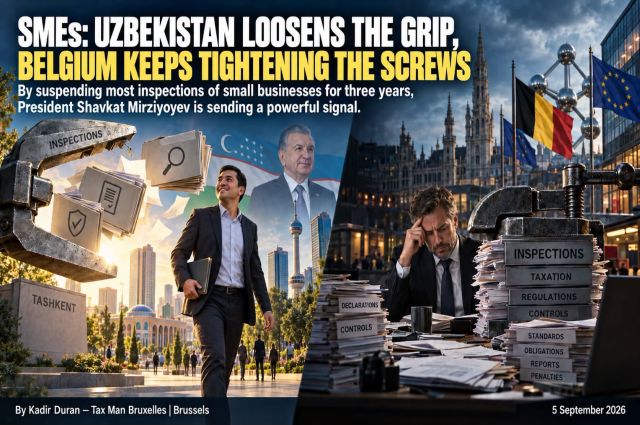
SMEs: Uzbekistan Loosens the Grip, While Belgium Keeps Tightening the Screws
By suspending most inspections of small businesses for three years, President Shavkat Mirziyoyev is sending a powerful message: entrepreneurs should no longer be treated as permanent suspects. Belgium could usefully draw inspiration from this decision—without abandoning essential oversight.
By Kadir Duran – Tax Man Bruxelles | Brussels
5 September 2026

A word to the wise—especially in Belgium, where self-employed workers and SME owners face an accumulation of formalities, inspections, tax uncertainty and sometimes disproportionate penalties.
This is not about abolishing all oversight. Fraud, violations of workers’ rights, public-health risks and unfair competition must, of course, be tackled. But a modern state must distinguish honest entrepreneurs from fraudsters, offer support before imposing sanctions, and focus on prevention before punishment.
There is a proverb that our political leaders would do well to remember: “Not knowing is no disgrace; refusing to learn is.”
When it comes to supporting small and medium-sized enterprises, perhaps we simply need to look beyond the end of our own noses. Not necessarily towards the economic models that Europe usually cites, but towards a Central Asian country seeking to transform its relationship with entrepreneurs: Uzbekistan.
On 27 August 2026, President Shavkat Mirziyoyev signed a decree introducing a three-year moratorium on most inspections of small businesses. The measure, which will remain in force until 2029, is intended to reduce administrative pressure and protect entrepreneurs from unjustified, repetitive or arbitrary inspections.
The political message is particularly clear: businesses are not adversaries to be permanently monitored, but economic actors that must be allowed to work.
A Significant Moratorium, but Not Blanket Immunity
It is important, however, to be precise. Uzbekistan has not abolished every form of inspection, nor has it granted small businesses absolute immunity.
Certain inspections will remain possible, particularly when they are connected to criminal proceedings, public-health risks, compliance with labour law, complaints lodged by citizens, VAT refund claims or the liquidation of a business.
The moratorium therefore mainly applies to routine inspections that are not justified by a specific risk. Inspections conducted outside the permitted exceptions will be considered unlawful, and the officials responsible may be held accountable. The system thus seeks to replace indiscriminate control with risk-based oversight.
This distinction is essential. Supporting SMEs does not mean turning a blind eye to fraud, violations of workers’ rights, health hazards or unfair competition. A responsible state must continue to protect citizens, employees and honest businesses.
But it must also understand that administrative inspections come at a cost.
They consume time, require businesses to locate and produce documents, sometimes involve the services of an accountant, tax adviser or lawyer, and create uncertainty that can last for weeks or even months. A large company with dedicated legal and financial departments may be able to absorb that burden. For a small business, it can bring operations to a standstill.
In Belgium, Entrepreneurs Face an Administrative Maze
Belgium likes to present itself as a country that supports entrepreneurship. Yet in everyday reality, self-employed workers and SME owners must navigate a genuine administrative maze.
Federal taxation, social-security contributions, VAT, payroll withholding tax, accounting requirements, regional legislation, municipal regulations, employment law, environmental standards, consumer protection, risk-prevention rules and digital obligations: each area often pursues a legitimate objective, but their accumulation has created a system that is increasingly difficult to understand.
This complexity is compounded by the number of different authorities involved. The same company may be inspected or contacted by several public bodies, each with its own procedures, deadlines and interpretation of the rules.
The problem is therefore not limited to the amount of tax or social contributions paid. It also concerns the time spent understanding the rules, anticipating amendments, gathering evidence and demonstrating good faith.
Administrative time is never free. Every hour spent completing a form is an hour not devoted to customers, innovation, business development, training or recruitment.
SMEs Are the Backbone of the Belgian Economy
This pressure is all the more concerning because SMEs account for the overwhelming majority of Belgium’s business landscape.
According to the Belgian Federal Public Service Economy, Belgium had approximately 1.186 million active SMEs in 2024, an increase of 1.6% in one year. Behind that figure are shops, restaurants, craftspeople, family businesses, consultants, healthcare professionals, technology companies and thousands of organisations that keep neighbourhoods and municipalities alive.
These businesses create jobs, collect VAT, pay social-security contributions and taxes, and help finance the state. Yet they find it proportionately more difficult than large corporations to cope with administrative complexity.
A multinational company can distribute its regulatory obligations among several departments. The owner of a small business often has to act simultaneously as salesperson, manager, human-resources officer, buyer, administrative specialist and point of contact for the authorities.
When a new obligation is introduced, it is not absorbed by a specialised department. It lands directly on the owner’s desk—usually at the end of the day, after dealing with customers, suppliers and employees.
Better Inspections, Not More Inspections
Belgium should not, of course, mechanically reproduce the Uzbek model. The two economies, legal systems and institutional structures are different.
But the underlying principle deserves consideration: should a company that complies with its obligations and presents no particular risk be subjected to the same level of scrutiny as a business that has been repeatedly reported or has shown persistent irregularities?
A modern policy could be based on several straightforward principles:
* inspections based on objective risk indicators;
* better coordination between public authorities to avoid repetitive requests;
* a right to correct mistakes made in good faith before penalties are imposed;
* limits on successive inspections covering the same periods;
* official recognition of voluntary preventive audits;
* a clear distinction between administrative error, negligence and organised fraud;
* effective accountability for public authorities in cases of abusive or manifestly unfounded inspections.
A small business should not face the same penalty for a formal error with no financial consequences as for the deliberate concealment of income.
Proportionality should once again become the guiding principle of administrative action.
Public Authorities Must Also Be Accountable
In many European tax systems, taxpayers are required to comply with strict deadlines, while public authorities may sometimes take months to answer a question, issue a refund or close a case.
This imbalance reinforces the sense of a one-sided relationship: businesses must immediately justify, prove and pay, while the state is not always subject to the same requirements of speed and predictability.
Restoring trust therefore requires more than safeguards governing the obligations of entrepreneurs. Administrative action must also be properly regulated.
When an inspection is opened, the company should be clearly informed of its purpose, legal basis, the period concerned and the expected timetable. When no violation is found, the case should be closed promptly. When an authority makes a mistake, it should acknowledge and correct it without forcing the taxpayer into a disproportionate legal battle.
The rule of law does not merely require citizens and businesses to obey the rules. It also requires public authorities to respect the limits of their powers.
The Uzbek Experience Should Not Be Idealised
The moratorium introduced by Tashkent will naturally need to be assessed over time.
Reducing inspections can free private initiative, but insufficient oversight may also encourage abuse, undeclared work, harm to consumers or distortions of competition. The reform’s success will therefore depend on the quality of its implementation, the transparency of its exceptions and the independence of the available appeal mechanisms.
It would be premature to claim that Uzbekistan has permanently resolved every difficulty faced by its small businesses. But the country has at least asked the right question: how can an economy be protected from abuse without suffocating those who produce, invest and create jobs?
That question should also be asked in Brussels.
A Signal for Kazakhstan and Its New Kurultai
Uzbekistan’s decision has also resonated in Kazakhstan.
Former MP and entrepreneur Tanirbergen Berdongar expressed the hope that representatives of the new Kurultai would become genuine defenders of entrepreneurs. His message reflects a reality that extends beyond national borders: SMEs are going through a difficult period, marked by rising costs, regulatory uncertainty, inspections and penalties.
As Kazakhstan enters a new institutional cycle, it has an opportunity to demonstrate that political modernisation can also produce a new economic culture.
Defending entrepreneurs does not mean defending fraud. It means protecting those who take risks, invest their capital, create jobs and keep wealth circulating in the real economy.
Business Is Not the Enemy of the State
Political debate too often creates an artificial opposition between the interests of the state and those of businesses.
Yet without profitable companies, there can be no sustainable jobs, reliable tax revenue or stable financing for social security. The state and business are not two opposing camps. They belong to the same ecosystem.
Fighting fraud remains essential. But generalised suspicion ultimately discourages honest entrepreneurs, while professional fraudsters learn how to circumvent the rules.
True political courage does not consist of announcing ever more inspections. It means building a public administration capable of inspecting less, but more effectively; identifying genuine risks; preventing errors; and firmly sanctioning deliberately fraudulent conduct.
Uzbekistan has begun to loosen the administrative grip on its small businesses. Belgium does not necessarily have to copy this decision, but it would be wrong to ignore it.
Sometimes, solutions come from places we do not expect. We must simply be willing to look beyond our certainties.
And, above all, have the humility to learn.
Kadir Duran
Tax Man Bruxelles |












































Yorum Yazın
Facebook Yorum