




BRUXELLES KORNER | OPINION
EUROPEAN INDUSTRIAL STRATEGY
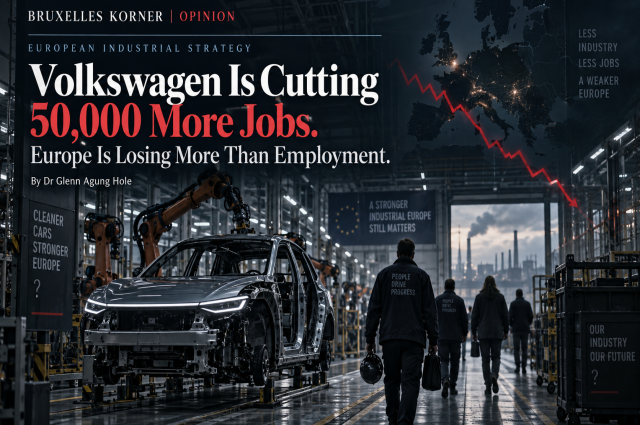
Volkswagen Is Cutting 50,000 More Jobs.
Europe Is Losing More Than Employment.
Europe's largest carmaker plans to remove a further 50,000 positions worldwide, on top of roughly 50,000 reductions already under way. Brussels should read the announcement not simply as a corporate restructuring, but as a warning that Europe is failing to reproduce the industrial capabilities on which its prosperity, security and green transition depend.
By Dr Glenn Agung Hole

On 3 September 2026, Volkswagen's supervisory board approved the most extensive restructuring in the group's 89-year history. The new "Future Plan 2030" foresees a further reduction of around 50,000 positions worldwide, including management roles, in addition to approximately 50,000 job reductions already under way. The company has not yet disclosed the timetable or geographical distribution of the additional cuts.
The employment figure is only one part of the plan. Volkswagen says its European factories have more than 500,000 units of excess capacity. Four German plants - Emden, Zwickau, Hanover and Neckarsulm - cannot be guaranteed new models as present production is phased out between 2031 and 2034. The group intends to halve its model range, reduce product complexity by roughly 75 per cent by 2035, and lift its operating margin from 3.8 per cent in the first half of 2026 to 9 per cent by 2030. At the same time, it plans EUR 135 billion in capital expenditure and research and development between 2027 and 2031.
Financial markets initially welcomed the settlement. Volkswagen's shares rose 7.9 per cent on the announcement. From the perspective of the firm, the logic is understandable: reduce fixed costs, simplify governance, concentrate volume and restore investability.
From the perspective of Europe, however, the announcement is more than a cost-saving programme. It is a stress test of the continent's industrial system. If the new 50,000 positions are viewed only as a labour-market event, policymakers will miss the deeper risk. Europe is not merely losing jobs. It may be eroding the institutional capital required to produce, innovate and industrialise at scale.
This is not a morality tale about one company
Volkswagen's difficulties should not be romanticised or attributed entirely to Brussels. The group has accumulated excessive complexity, slow decision-making structures, overlapping brands and costly capacity. Chinese competition and United States tariffs have intensified the pressure, but they did not create every internal weakness. Nor should public policy attempt to preserve every existing position indefinitely. Technological transitions necessarily reallocate labour and capital, and productivity improvement often means producing more with fewer employees.
That counterargument is important because industrial policy becomes self-defeating when it protects corporate inefficiency rather than productive capability.
Yet the opposite error is equally serious: assuming that every firm-level efficiency gain is automatically a social gain. A restructuring can be rational for Volkswagen and still reveal a systemic failure for Europe. The decisive question is not whether old jobs disappear. It is whether new productive capabilities - in batteries, power electronics, semiconductors, software, artificial intelligence, advanced materials and manufacturing equipment - are being created in Europe quickly enough to replace the value that is leaving.
If they are not, Europe is not experiencing creative destruction. It is experiencing destruction without sufficient creation.
The transition is being measured incorrectly
European debate often measures the automotive transition through visible outputs: the number of electric vehicles sold, battery factories announced, charging points installed or euros committed. These indicators matter, but they can conceal where economic value, technological control and industrial learning actually reside.
A vehicle may be assembled in Europe while a growing share of its value is imported. The battery cells, active materials, production machinery, semiconductors, power electronics, operating systems and data architecture may originate elsewhere. Under those conditions, final assembly can remain European while the high-margin, knowledge-intensive and strategically decisive layers of the value chain move abroad.
Deloitte estimates that Europe's dependence on non-European battery cells, upstream inputs, production equipment and specialist labour could result in EUR 100-150 billion in lost value added by 2030. This is not merely an import bill. It represents factories not constructed, engineers not employed, supplier relationships not formed, patents not commercialised and profits not reinvested within Europe.
The distinction is fundamental. A green transition is not automatically an industrial transition. Europe can electrify transport and still become less capable of producing the technologies on which electrification depends.
The appropriate metric is therefore not nominal European production, but retained European value added. Policymakers should ask who owns the intellectual property, where the capital equipment is produced, where supplier learning occurs, where engineering teams accumulate experience, and where cash flow is reinvested. Without those questions, Europe risks mistaking consumption sovereignty for production sovereignty.
Industrial ecosystems do not contract in a straight line
The automotive industry is not a collection of isolated factories. It is a layered system of original-equipment manufacturers, component suppliers, machine builders, chemicals and metals companies, logistics providers, software firms, research institutes, vocational schools, banks and specialised small and medium-sized enterprises.
These relationships are cumulative and path-dependent. Capabilities develop through repeated production, problem-solving and investment. Engineers learn from suppliers; suppliers specialise around customers; educational institutions adapt to regional demand; financiers learn which technologies and management teams are credible. Much of this knowledge is tacit. It cannot be fully codified, stored and purchased later.
This is what I describe as institutional capital: the accumulated capacity of organisations, networks and public institutions to coordinate knowledge, investment and execution over time.
Such capital can erode far faster than it can be rebuilt. Automotive suppliers typically carry high fixed costs in factories, tooling, engineering and certification. When vehicle volumes fall by 10 per cent, their costs do not fall by 10 per cent. Margins can therefore deteriorate much faster than revenue. Investment is postponed, skilled employees leave, and the ability to win the next contract weakens.
The warning signs pre-date Volkswagen's latest announcement. CLEPA recorded 54,000 announced job losses among European automotive suppliers in 2024 and a further 50,000 in 2025. It also reported that three quarters of suppliers expected margins below the critical 5 per cent level in 2026, while almost one in four anticipated losses. Volkswagen's additional 50,000 reductions will therefore enter a supplier system already under strain.
This is where linear policy analysis fails. The first-order effect is the job removed at Volkswagen. The second-order effect is the volume lost by a supplier. The third is the investment that supplier cancels. The fourth is the apprenticeship not offered, the laboratory not expanded and the regional contractor that closes. Eventually, the region becomes less attractive for the next industrial investment.
At that point, restructuring becomes institutional erosion.
An automotive crisis becomes a fiscal and security crisis
The European Commission itself describes the automotive sector as contributing around EUR 1 trillion to EU GDP, supporting 13 million direct and indirect jobs, and accounting for approximately one third of private research and development investment in the Union. These figures explain why Volkswagen cannot be treated as a narrowly German concern.
Europe must simultaneously finance ageing populations, welfare states, defence expansion, energy infrastructure, climate adaptation and technological renewal. None of these commitments exists independently of the productive economy. They are claims on future value creation.
When a high-productivity export ecosystem weakens, corporate tax receipts decline, wage-tax bases narrow and social expenditure rises. Lower investment reduces the future capital stock. Weaker exports place pressure on the external balance. The state is then asked to assume greater strategic responsibility precisely as the economic base financing that responsibility becomes less productive.
Industrial capacity is therefore not simply an economic asset. It is fiscal capacity in productive form. It is also a component of strategic autonomy. The same engineering, materials, electronics, energy and production systems that sustain civilian manufacturing are relevant to defence mobilisation, infrastructure resilience and technological security.
Europe cannot credibly separate its debates on cars, competitiveness, welfare, defence and sovereignty. They rest on the same institutional foundation.
Brussels understands the problem but still governs in silos
The European Union is not unaware of the challenge. The Draghi report identified high energy prices, weak investment and fragmented capital markets as central obstacles to European competitiveness. The Clean Industrial Deal seeks to combine decarbonisation with industrial renewal. The Commission's Automotive Action Plan recognises batteries, software, artificial intelligence, skills, supply-chain resilience, trade conditions and the business environment as parts of the same transition.
The diagnosis is increasingly systemic. Delivery remains fragmented.
Energy policy is negotiated as energy policy. Climate targets are administered as climate policy. State aid is assessed through competition policy. Chinese electric vehicles are addressed through trade instruments. Skills are assigned to labour and education programmes. Research funding is distributed through separate innovation mechanisms. Regional consequences are left largely to Member States.
Each instrument may be defensible in isolation. The industrial system experiences their combined effect.
This creates a characteristic European implementation gap: the Union recognises interdependence in strategy documents but reproduces administrative separation in execution. Companies make investment decisions across energy, capital, technology, skills and market access simultaneously. European governance too often responds sequentially, through different institutions, funding windows and political timetables.
There is also a distributional weakness. Relaxed state-aid rules may accelerate investment, but Member States do not possess equal fiscal capacity. If industrial renewal depends primarily on national subsidies, the largest economies can defend their production bases more effectively than smaller ones. Europe may then weaken the single market while failing to build sufficient continental scale.
The problem is not a lack of plans. It is insufficient conversion capacity: the ability to turn political ambition, finance and regulation into operating factories, competitive technologies, skilled workforces and durable supplier systems.
Europe should preserve capabilities, not corporate structures
A credible response must avoid two temptations. The first is protectionism without transformation: shielding incumbents from competition while leaving their cost structures and technologies unchanged. The second is market fatalism: accepting the disappearance of industrial ecosystems on the assumption that capital and labour will move frictionlessly into equally productive activities.
Neither approach is adequate. Europe needs a capability-centred industrial policy built on five principles.
First, every major support instrument should be assessed against a European value-capture test. Public funding should be tied not merely to the location of final assembly, but to measurable commitments in research, intellectual property, supplier development, workforce formation, production equipment and reinvestment. The objective is not autarky. It is to ensure that strategic openness does not become structural dependency.
Second, policy must transform the supplier base before volumes collapse. Many viable suppliers face a financing gap between declining combustion-engine cash flows and the heavy investment required for electrification, electronics, software and advanced manufacturing. Europe needs patient transition capital - including guarantees, co-investment and quasi-equity - linked to credible transformation plans. Waiting until insolvency turns an industrial problem into a social-support problem is both more expensive and less effective.
Third, energy must be treated as industrial infrastructure. Batteries, chemicals, metals, semiconductors and advanced manufacturing require reliable electricity at globally competitive and predictable prices. Temporary compensation does not substitute for a durable energy system. Grid capacity, generation, long-term contracts, permitting and cross-border interconnection must be planned alongside industrial investment, not after it.
Fourth, trade and inward investment policy should maximise capability transfer. Europe benefits from foreign capital and competition, including partnerships with Asian firms. But public incentives and market access should reward local research, European supplier participation, workforce development and meaningful technology diffusion. A foreign-owned factory that imports its machinery, critical inputs, engineers and software may increase output without creating a deep European ecosystem.
Fifth, Brussels needs an integrated automotive delivery mechanism with authority to connect policy fields and intervene before regional capability loss becomes irreversible. It should track retained value added, supplier investment, energy cost, scale-up time, skills formation and technology ownership - not merely announced capacity and expenditure. What is not measured systemically will continue to be governed administratively.
The real meaning of Volkswagen's warning
Volkswagen's restructuring may make the company leaner and more competitive. Europe should hope that it does. A failed Volkswagen would not protect European workers or strategic autonomy.
But the market's positive reaction should not be confused with a positive verdict on Europe's industrial trajectory. Capital markets reward a company for reducing costs. Public institutions must ask whether the capabilities released by that process are being recombined into new productive systems or simply allowed to dissipate.
That is the central distinction between corporate restructuring and economic renewal.
The additional 50,000 positions matter not because every position can or should be preserved. They matter because they bring the total reductions under way or envisaged across Volkswagen to around 100,000 and arrive after 104,000 announced supplier job losses in 2024 and 2025. Taken together, these are not isolated adjustments. They are evidence of simultaneous contraction across a production system whose replacement architecture is not yet sufficiently European.
The ultimate cost will not be measured only in redundancy payments or closed assembly lines. It will be measured in the factories that are never built, the patents commercialised elsewhere, the engineers who leave industrial regions, the suppliers that no longer bid for the next platform, and the tax base that fails to materialise.
Europe still has formidable assets: world-class engineering, strong research institutions, sophisticated suppliers, deep consumer markets and substantial savings. The question is whether its institutions can combine them quickly enough to preserve industrial scale during a technological transition.
Volkswagen has announced another 50,000 reductions. Brussels should hear more than the sound of jobs disappearing. It should hear the warning of a productive system approaching a threshold.
Prosperity is not inherited. It is reproduced. Europe must now demonstrate that it still knows how.
Author
Dr Glenn Agung Hole is an institutional economist and strategic adviser on geo-economics and state capacity. He is an Associate Professor at the University of South-Eastern Norway, holds international visiting professorships, and is the founder of The Institutional Capital Project. He writes on industrial capacity, institutional economics, entrepreneurship and European strategic resilience.
Selected sources
Reuters (3 September 2026), “Main points of Volkswagen's restructuring plan”
Deloitte (2026), “Europe's Battery Industry at a Crossroads”
CLEPA (14 January 2026), “Structural pressures on Europe's suppliers: policy delivery is key”
CLEPA (26 March 2026), “The automotive map is being redrawn - Europe must decide its place”
European Commission (5 March 2025), “Industrial Action Plan for the European automotive sector”
European Commission (2025), “Clean Industrial Deal”
European Commission (2024), “The Draghi report on EU competitiveness”














































Yorum Yazın
Facebook Yorum