




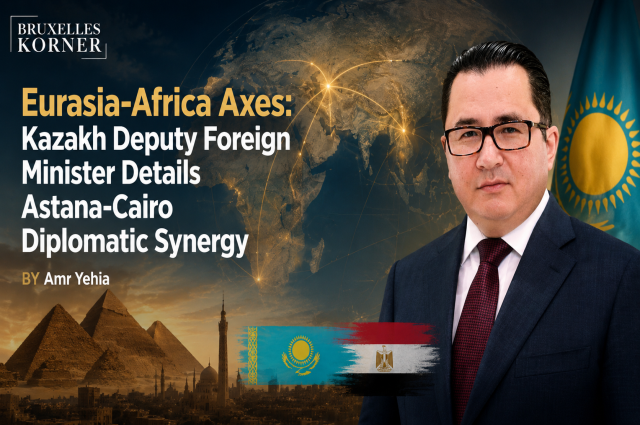
Eurasia-Africa Axes: Kazakh Deputy Foreign Minister Details Astana-Cairo Diplomatic Synergy
Amr Yehia, from Astana
Astana and Cairo have systematically translated mutual political trust into high-level multilateral coordination within the UN, OIC, CICA, and Non-Aligned Movement. As Kazakhstan advances its domestic political architecture and solidifies its position as Eurasia's primary transit hub, its diplomatic engagement with Egypt offers a vital bridge connecting East Asian manufacturing networks to African and Mediterranean markets.
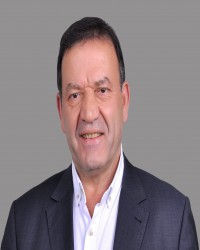
In an exclusive interview in Astana, Deputy Minister of Foreign Affairs of Kazakhstan, Arman Kairatovich Isagaliyev—a veteran diplomat who previously served as Ambassador to Cairo—outlines Astana's vision for economic and technological synergy across transcontinental trade corridors.

How do you evaluate political coordination between Egypt and Kazakhstan across platforms like the UN, OIC, and CICA?
For over 34 years, Kazakhstan and Egypt have enjoyed fraternal relations based on mutual trust and respect. The nine rounds of political consultations between our Ministries have become an effective mechanism for strengthening bilateral cooperation. As two important anchors of regional stability in the Middle East and Central Asia, our countries maintain regular high-level contacts and coordinate positions on key global issues.
We highly value our constructive interaction within the United Nations, OIC, CICA, and the Non-Aligned Movement. These platforms allow us to promote common principles, including respect for sovereignty, territorial integrity, peaceful settlement of disputes, non-interference, and international law. Looking ahead, closer political coordination will further strengthen relations, enabling both nations to make meaningful contributions to global peace, security, and sustainable development.
How does your personal background in Cairo shape your vision for advancing bilateral relations in your new role?
It is a distinct honor to engage with the public through Al-Ahram. The years I spent in Egypt—first during my studies at the Diplomatic Institute and later as Ambassador—have left an unforgettable mark on my professional career and personal life.
Understanding Egypt’s politics, economy, and regional influence helps me guide our partnership today. In my new role, I am dedicated to turning deep mutual trust into practical, advanced projects. We want to expand trade, improve transport connections, and build stronger partnerships in agriculture, pharmaceuticals, and tourism. Furthermore, amidst current global turbulence, close coordination within multilateral frameworks is more vital than ever to promote peace. My mission is to ensure this strategic partnership continues on an upward trajectory.
How does Kazakhstan view Egypt's leadership in advocating for a Gaza ceasefire, relief efforts, and a two-state solution?
Kazakhstan highly values Egypt’s strategic leadership and consistent efforts regarding the crisis in Gaza. Cairo has played a crucial role advocating for an immediate, sustainable ceasefire, ensuring uninterrupted humanitarian access, facilitating dialogue, and promoting the two-state solution as the only viable foundation for lasting peace.
Astana supports Egypt’s efforts to prevent further escalation and believes that international law and UN resolutions must remain the basis for resolving the conflict. Kazakhstan has consistently called for the protection of civilians, delivery of humanitarian aid, and creation of conditions for a comprehensive settlement. As a nation with a strong tradition of mediation, Kazakhstan believes cooperation between Astana and Cairo can further strengthen international peace efforts.
How does the Foreign Ministry evaluate Kazakhstan’s constitutional reforms and the transition to a unicameral legislature (Kurultai)?
The Ministry of Foreign Affairs views the comprehensive constitutional reforms initiated by President Kassym-Jomart Tokayev as a historic milestone in the evolution of our statehood. The transformation of the political architecture, including the enhanced role of Kurultai as a key institution for nationwide dialogue, reflects the consistent implementation of the "Listening State" concept.
The transition to this model significantly increases the efficiency of the state apparatus, strengthens checks and balances, and ensures broader citizen participation in decision-making. Internal transformations serve as a solid foundation, reaffirming Kazakhstan's commitment to high international standards of democratic governance. The successful modernization of our institutions enhances internal stability while reinforcing Kazakhstan's authority as a reliable international partner.
How do initiatives like the Middle Corridor and Belt and Road alignment transform global trade routes between Asia, Europe, and Africa?
Kazakhstan has systematically redefined its transit geography, moving from a landlocked state to Eurasia’s central "land-linked" trade bridge. In an era of supply chain vulnerabilities, route diversification and predictable logistics are imperative. President Tokayev’s strategy focuses on building an integrated transport architecture connecting East Asian manufacturing centers with markets in Europe, the Middle East, and North Africa.
The Trans-Caspian International Transport Route (TITR), or Middle Corridor, is the centerpiece of this strategy, operating in synergy with the Belt and Road Initiative. Transit along the TITR has demonstrated solid performance: in 2025, containerized transit surged by 15% to 42,000 TEUs, while overall transit volumes grew by 12%. When maritime straits face persistent risks of closure, supply chain predictability becomes vital currency in global trade. To guarantee this, Kazakhstan is executing sweeping infrastructure upgrades—launching major railway expansion projects, establishing a dedicated container hub on the Caspian coast, and developing a 17-unit commercial trade fleet by 2030 through private investment.
How does Astana define its role as a "middle power" maintaining strategic autonomy amidst global polarization?
As a leading "middle power", Kazakhstan defines its responsibility through strengthening multilateralism, upholding international law, and reinforcing the central role of the United Nations. We firmly believe that small and medium-sized states should not become hostages to bloc-based mentalities or passive observers of geopolitical rivalries. On the contrary, our mission is to act as a constructive bridge-builder, a platform for dialogue, and a reliable mediator in conflict resolution.
Guided strictly by our national interests, we actively expand strategic partnerships with key players across the East, West, North, and South. For Astana, safeguarding strategic autonomy does not mean isolationism; rather, it means strategic diversification of our foreign policy, transport-logistics, and economic ties. By spearheading critical initiatives like the Middle Corridor, Kazakhstan demonstrates that a nation's sovereign autonomy is reinforced when its domestic stability serves the collective interest of the international community.
What mechanisms are boosting trade, and how can the Suez Canal Economic Zone act as a hub for Kazakh products?
Egypt holds a distinct place in the Middle East and North Africa as a long-standing economic partner for Kazakhstan. Our bilateral trade demonstrates solid momentum: trade turnover reached $351.9 million in 2025 (a 28.5% year-on-year increase) and accelerated to $329.9 million in just the first five months of 2026 alone. Our Embassy in Cairo plays a central role establishing direct ties with major Egyptian private sector conglomerates to turn political understanding into concrete joint ventures.
Food security remains a key area where Kazakhstan offers quality and reliability. Last year, Kazakhstan expanded grain exports to North Africa, delivering nearly 390,000 tonnes of wheat to Algeria for the first time and resuming supplies to Morocco. We stand ready to apply these proven supply mechanisms to Egypt, while boosting deliveries from our metallurgical, chemical, and food industries.
Utilizing specialized industrial platforms within the Suez Canal Economic Zone will allow Kazakh companies to establish manufacturing bases in Egypt. Processing raw materials within Egyptian economic zones enables goods to attain local origin status, unlocking tariff-free access across the 1.5-billion-consumer African market under the AfCFTA. Furthermore, as Eurasia’s digital leader ranked 24th globally in the UN e-Government index, Kazakhstan actively exports GovTech platforms. A clear example of our technological presence in Egypt is the Kazakhstani IT platform inDrive, which has expanded across more than 25 Egyptian cities.
How do you evaluate the partnership between Nur-Mubarak University in Almaty and Al-Azhar Al-Sharif in countering extremism?
The Egyptian University of Islamic Culture "Nur-Mubarak" in Almaty occupies a special place in Kazakhstan’s educational and spiritual landscape. Since its establishment, the University has served as an important bridge between Kazakhstan and Egypt, making a significant contribution to training qualified religious scholars and promoting moderate Islamic values.
We highly value the University’s close cooperation with Al-Azhar Al-Sharif, one of the world’s most respected centers of Islamic learning. Through academic exchanges and educational programs, Nur-Mubarak benefits from Al-Azhar’s rich intellectual traditions while adapting them to the cultural context of Kazakhstan. In the face of growing challenges related to radicalization, quality religious education based on authentic Islamic knowledge is one of the most effective tools for preventing extremist narratives.
Over the years, Nur-Mubarak has trained approximately 2,500 qualified religious scholars. Kazakhstan supports further strengthening Nur-Mubarak and its cooperation with Al-Azhar Al-Sharif, with the vision of transforming the University into a prestigious international institution of higher Islamic education in Central Asia to promote religious tolerance, social harmony, and regional stability.
Résumé en français
Le Kazakhstan et l’Égypte cherchent à transformer une relation diplomatique ancienne en partenariat stratégique reliant l’Eurasie, le Moyen-Orient et l’Afrique. Dans un entretien accordé à Astana, le vice-ministre kazakh des Affaires étrangères, Arman Isagaliyev, ancien ambassadeur au Caire, insiste sur la complémentarité politique, économique et logistique entre les deux pays.
Sur le plan diplomatique, Astana et Le Caire coopèrent depuis plus de 34 ans et coordonnent leurs positions au sein de l’ONU, de l’Organisation de la coopération islamique, de la CICA et du Mouvement des non-alignés. Ils défendent notamment la souveraineté des États, le règlement pacifique des différends et le respect du droit international.
Le Kazakhstan soutient également le rôle de l’Égypte dans les efforts visant à obtenir un cessez-le-feu à Gaza, faciliter l’aide humanitaire et promouvoir une solution à deux États. Astana considère Le Caire comme un acteur important de la stabilité régionale et estime qu’une coopération accrue pourrait renforcer les initiatives internationales de médiation.
Un axe économique Astana–Le Caire en pleine expansion
Le commerce bilatéral progresse rapidement. Les échanges ont atteint 351,9 millions de dollars en 2025, soit une hausse de 28,5 %, avant d’atteindre déjà 329,9 millions de dollars au cours des cinq premiers mois de 2026. Les secteurs prioritaires sont l’agriculture, les céréales, la métallurgie, la chimie, les produits alimentaires, les médicaments et les technologies numériques.
L’un des projets les plus stratégiques concerne la zone économique du canal de Suez. Des entreprises kazakhes pourraient y transformer ou produire leurs marchandises afin de bénéficier d’un meilleur accès aux marchés africains. Le texte présente ainsi l’Égypte comme une future plateforme industrielle et commerciale pour les produits kazakhs vers l’Afrique.
Le Kazakhstan veut devenir le pont terrestre de l’Eurasie
Astana développe parallèlement le Middle Corridor, ou corridor transcaspien, afin de relier les centres industriels d’Asie orientale à l’Europe, au Moyen-Orient et à l’Afrique du Nord. En 2025, le transit conteneurisé par cette route aurait progressé de 15 % pour atteindre 42.000 EVP, tandis que le volume global de transit augmentait de 12 %.
La stratégie kazakhe consiste donc à ne plus se considérer comme un pays simplement enclavé, mais comme un État « land-linked », situé au centre des nouvelles routes commerciales eurasiatiques.
Une diplomatie de « puissance moyenne »
Le Kazakhstan se définit également comme une middle power, cherchant à préserver son autonomie stratégique entre la Chine, la Russie, l’Europe, les États-Unis, le Moyen-Orient et l’Afrique. Astana rejette une logique de blocs rigides et privilégie la diversification de ses partenariats, la médiation et le multilatéralisme.
Enfin, la coopération entre l’université Nur-Mubarak d’Almaty et Al-Azhar au Caire constitue un autre pilier de la relation. L’objectif est de promouvoir un enseignement religieux modéré et de lutter contre les discours extrémistes. Nur-Mubarak aurait déjà formé environ 2.500 spécialistes religieux.
En une phrase
Astana veut utiliser son partenariat avec Le Caire pour prolonger les corridors économiques eurasiatiques jusqu’à l’Afrique : le Kazakhstan fournirait les marchandises, les infrastructures et les technologies, tandis que l’Égypte offrirait l’accès au canal de Suez, au monde arabe, à la Méditerranée et au marché africain.


































Yorum Yazın
Facebook Yorum