




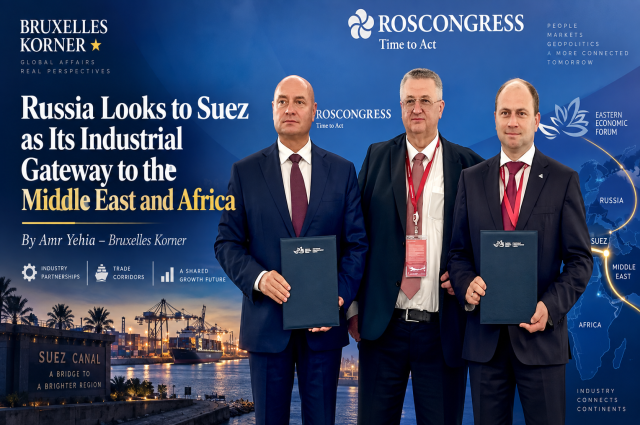
Russia Looks to Suez as Its Industrial Gateway to the Middle East and Africa
Russian Industrial Zone enters a new phase as Moscow seeks a manufacturing foothold on the Suez Canal
The Crystal Fund is being positioned as a “single window” for Russian investors, while pharmaceuticals, petrochemicals, engineering and food processing emerge among the priority sectors. For Moscow, Egypt offers something more strategic than an industrial park: access to African and Middle Eastern markets and to Cairo’s network of trade agreements.
By Amr Yehia – Bruxelles Korner

Vladivostok / Cairo
Russia is accelerating efforts to transform its planned industrial zone in Egypt into a manufacturing and export platform capable of serving markets well beyond the Egyptian economy.
The latest developments surrounding the Russian Industrial Zone within the Suez Canal Economic Zone were highlighted during the Eastern Economic Forum held in Vladivostok from 1 to 4 September 2026, as Moscow seeks to give the long-discussed project a more operational structure.
The Eastern Economic Forum itself was held at the Far Eastern Federal University under the theme “The Far East – Development for the Benefit of the People”, bringing together Russian and international policymakers and investors around infrastructure, industry and Russia’s growing economic orientation towards Asian and emerging markets.
From diplomatic project to industrial strategy
The Russian Industrial Zone is one of the flagship economic projects linking Moscow and Cairo.
Its importance goes considerably beyond bilateral trade.
Located within Egypt’s strategically positioned Suez Canal Economic Zone, the project could allow Russian manufacturers to establish production facilities close to one of the world’s most important maritime corridors and use Egypt as a platform for exports towards the Middle East, Africa and other international markets.
Egyptian and Russian authorities had already intensified negotiations during the first half of 2026. Cairo officially described the project as a major strategic initiative expected to strengthen industrial capacity, investment, exports, technology transfer and employment.
In July, another important obstacle was removed when Russia settled on the institutional structure responsible for attracting and accompanying investors.
The Crystal Fund, established by former Russian Far East Development Minister Alexander Galushka and Alexander Krutikov, was designated as the comprehensive development institution for the Russian Industrial Zone.
It will effectively operate as a single point of access for Russian investors, developers and future residents of the zone.
For Russian Deputy Minister of Industry and Trade Roman Chekushov, the decision was intended to move the project from prolonged preparation towards practical implementation.
The message from Moscow is clear: the Russian Industrial Zone is no longer being presented merely as a diplomatic symbol, but as an industrial infrastructure project designed to integrate Russian companies into new international supply chains.
Pharmaceuticals, petrochemicals and advanced manufacturing
The industrial profile envisaged for the zone is particularly significant.
Among the sectors considered for localisation are:
pharmaceuticals and medical equipment;
chemicals and petrochemicals;
engineering and machinery;
metallurgy and metal processing;
electrical equipment and electronics;
construction materials;
wood processing;
cosmetics and related chemical industries.
Russian and Egyptian discussions have also identified significant potential in fertilisers, energy equipment and industrial feeder sectors.
Food processing could become another strategic component.
Egypt is already an important destination for Russian agricultural exports, particularly grain, meaning that processing activities could potentially bring Russian agricultural supply chains closer to consumers in Africa and the Middle East.
This introduces another dimension into the project: Egypt would not simply receive Russian products but could increasingly become a location where some Russian-origin commodities are processed, transformed and re-exported.
The attraction of the Suez Canal
Geography explains much of Moscow’s interest.
The current project site covers around 50 hectares in the northeastern section of the Suez Canal Economic Zone and has access to the Port of Ain Sokhna. Russian plans cited by Interfax foresee project design and construction work between 2026 and 2029, with operations targeted for around 2030.
From Ain Sokhna, companies can reach the Red Sea, the Gulf, East Africa and Asian shipping routes while remaining directly connected through the Suez Canal to Mediterranean and European markets.
For Moscow, this potentially provides an industrial bridge between Russia, Africa, the Arab world and Asia.
For Cairo, the equation is different but complementary: attracting manufacturing investment, creating employment, expanding local industrial capacity and increasing exports from the Suez Canal corridor.
The “Made in Egypt” advantage
One of the potentially most powerful incentives concerns the origin of goods manufactured inside Egypt.
Products meeting the necessary Egyptian local-content and rules-of-origin requirements could qualify as Egyptian-made products, potentially allowing manufacturers to benefit from trade arrangements available to Egyptian exports.
That distinction is crucial.
A Russian company exporting directly from Russia faces one commercial environment. A Russian-controlled factory producing qualifying goods in Egypt could operate under a very different trade framework.
This is why Moscow increasingly describes the zone not merely as an overseas industrial estate but as a gateway into third-country markets.
The strategy resembles a wider global trend in which industrial powers seek production bases inside countries that combine competitive manufacturing costs, major ports and preferential access to several regional markets.
Strong incentives — but conditions matter
Russian officials involved in promoting the project have also highlighted substantial investment incentives.
Alexander Galushka has referred to exemptions from property taxation and to reductions that could reach 50% of corporate profit taxation for a period of five years, alongside infrastructure support within the Suez Canal Economic Zone.
Such incentives, however, need to be understood within the applicable Egyptian investment legislation, the precise status granted to each project and the eligibility conditions negotiated with the SCZone authorities.
The broader principle is nevertheless clear: Cairo wants the Suez Canal corridor to compete internationally for industrial investment.
Egyptian officials have repeatedly emphasised the facilitations and legislative incentives being offered to accelerate implementation of the Russian project.
Egypt at the centre of Russia’s southward economic strategy
There is also a geopolitical dimension.
Western sanctions and the restructuring of international trade since 2022 have pushed Russian companies to search more aggressively for alternative markets, logistics corridors and industrial partnerships across Asia, Africa and the Middle East.
Egypt occupies an exceptional position in that strategy.
It is simultaneously an Arab country, an African economy, a Mediterranean power, a member of BRICS and the custodian of the Suez Canal.
Relations between Presidents Abdel Fattah al-Sisi and Vladimir Putin have meanwhile expanded around several strategic projects, most notably the El Dabaa nuclear power plant and the Russian Industrial Zone. The Egyptian presidency itself has described both projects as pillars of the broader strategic relationship with Moscow.
The industrial zone therefore cannot be analysed in isolation.
It belongs to a broader Russian attempt to build durable economic infrastructure outside its traditional markets.
A Russian window onto Africa
If the project reaches full implementation, its significance will not depend solely on the number of Russian factories established along the Suez Canal.
Its real importance will lie in what those factories allow Russian companies to do.
Producing inside Egypt could shorten supply chains, reduce logistical barriers, facilitate regional distribution and potentially allow qualifying products to access markets under trade arrangements unavailable to goods exported directly from Russia.
That transforms the equation.
For Cairo, Russia represents investment, industrialisation and technology.
For Moscow, Egypt represents geography, logistics and market access.
And this is precisely why the Russian Industrial Zone could become much more than another bilateral investment project.
Situated alongside the artery connecting Europe and Asia and facing the markets of Africa and the Middle East, the Suez Canal may gradually become one of Moscow’s most important industrial windows towards the Global South.
Amr Yehia
Bruxelles Korner


































Yorum Yazın
Facebook Yorum