




Europe Cannot Build Strategic Autonomy on Industrial Retreat
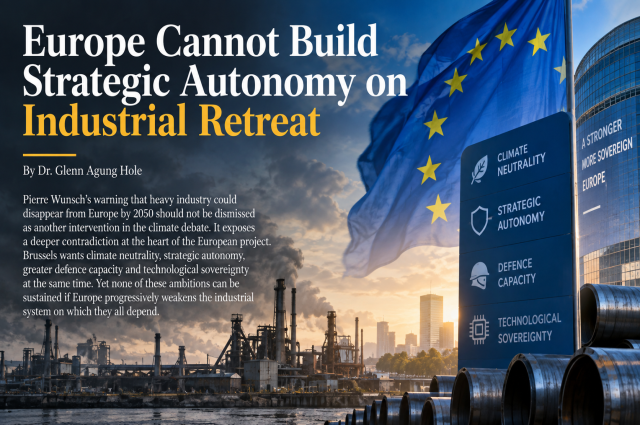
Pierre Wunsch’s warning that heavy industry could disappear from Europe by 2050 should not be dismissed as another intervention in the climate debate. It exposes a deeper contradiction at the heart of the European project. Brussels wants climate neutrality, strategic autonomy, greater defence capacity and technological sovereignty at the same time. Yet none of these ambitions can be sustained if Europe progressively weakens the industrial system on which they all depend.
By Dr. Glenn Agung Hole

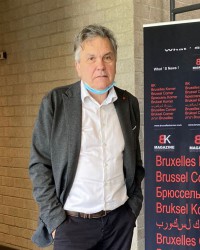
When Pierre Wunsch, Governor of the National Bank of Belgium and a member of the European Central Bank’s Governing Council, warned in Brussels that heavy industry could effectively disappear from Europe by 2050 under current policies, the most important part of his intervention was not the date.
Nor was it the precise carbon price.
The real issue is whether Europe has constructed an institutional architecture in which the policy instruments designed to deliver one strategic objective increasingly undermine the productive capacity required to achieve the others.
That is a much more fundamental European question.
Europe wants to reach climate neutrality. It wants greater strategic autonomy. It wants to rebuild defence capacity, reduce technological dependence on the United States and China, secure critical supply chains and establish a stronger position in artificial intelligence, clean technology and advanced manufacturing.
Each objective is understandable.
Taken together, however, they require an enormous expansion of physical, technological and industrial capacity.
They require electricity.
They require grids.
They require steel, chemicals, cement, specialised metals, machinery, transformers, semiconductors, engineering capabilities, industrial infrastructure and capital.
In other words, Europe’s post-geopolitical ambitions are extraordinarily industrial.
This is why Wunsch’s warning matters.
A Europe that becomes geopolitically more ambitious while becoming industrially weaker is moving in two directions at once.
The contradiction cannot be solved rhetorically.
It must be solved economically.
Belgium provides a particularly useful lens through which to understand the problem.
The National Bank of Belgium has already documented that energy-intensive industries face growing competitive pressure from energy costs and carbon pricing. Chemicals, basic metals, mineral products, paper and refining are particularly exposed, and Belgian energy-intensive industries appear in several respects more sensitive to energy shocks than equivalent industries in France, Germany and the Netherlands. In 2025, transmission tariffs for large Belgian electricity consumers doubled compared with the previous year.
This matters because Belgium is not an abstract case at the margins of European industry.
The Belgian economy sits at the centre of one of Europe’s most sophisticated industrial and logistical systems. Its chemical and petrochemical clusters, ports, transport networks and advanced manufacturing capabilities form part of deeply integrated European value chains.
Energy-intensive industries themselves account for only around 4 per cent of Belgian value added and 3 per cent of employment. But this understates their systemic importance. The National Bank estimates that a negative shock to these industries could directly affect as many as 130,000 jobs, with three quarters of Belgian employment in energy-intensive industries concentrated in Flanders.
The deeper issue is therefore not how many people stand inside the factory gate.
It is how much economic activity depends upon what happens behind it.
Modern industrial capacity exists as an ecosystem. Chemicals feed pharmaceuticals, manufacturing, construction and agriculture. Metals enter machinery, transport, energy systems and defence. Industrial gases, refining, specialised materials and engineering services intersect across thousands of production processes.
Remove enough foundational capacity and the consequences propagate far beyond the sector where the original production loss occurred.
This is where Europe’s current policy debate becomes too fragmented.
Climate policy is discussed as climate policy. Energy policy is discussed as energy policy. Competitiveness is treated as another policy portfolio. Defence, capital markets, technology and strategic autonomy are debated in still other institutional silos.
But firms do not experience Europe in silos.
An industrial company experiences all these policies simultaneously through one economic calculation.
It sees the electricity price, the carbon price, the cost of capital, the time required to secure a permit, the availability of grid capacity, the tax system, the regulatory burden, the labour market and the expected demand for its output.
Then it decides whether to invest.
This is the point at which political ambition becomes economic reality.
And this is where Europe is struggling.
The European Commission itself now acknowledges that affordable energy is fundamental to competitiveness and that energy costs materially shape investment decisions in energy-intensive sectors. Its Affordable Energy Action Plan is explicitly designed to reduce costs, improve energy-market integration and accelerate investment.
The recognition is important.
But it also reveals how far the European debate has moved.
Only a few years ago, competitiveness was often treated as something that would emerge almost automatically from the green transition: Europe would regulate early, innovate first and create industrial leadership in the technologies of the future.
The reality has proven more complicated.
Decarbonisation requires technologies, but technology requires capital. Capital requires an investable project. And an investable project requires an expected return that compensates for risk.
The chain cannot simply be reversed by political intention.
This is where the sequencing of European policy becomes decisive.
A high carbon price can be an economically coherent mechanism if industry already has viable substitutes available at scale: abundant low-carbon electricity, sufficient grid capacity, commercially mature technologies and financing structures capable of supporting the transition.
The same carbon price has a very different effect when those alternatives remain expensive, infrastructure-constrained or technologically immature.
In the first case, the carbon price accelerates substitution.
In the second, it may accelerate exit.
That distinction is fundamental.
Europe should therefore be extremely careful not to confuse the pricing of the old industrial system with the construction of the new one.
They are not the same economic process.
The EU Emissions Trading System can make carbon-intensive production progressively more expensive. It cannot, by itself, build a power station, reinforce a transmission grid, construct a hydrogen network or create an internationally competitive low-carbon steel plant.
Those are capital-formation problems.
And capital formation follows a different logic.
This is also why the Carbon Border Adjustment Mechanism, although economically sophisticated, cannot solve the entire competitiveness problem.
CBAM attempts to prevent carbon leakage by requiring certain imports into the European market to face a carbon cost comparable to that imposed on European producers.
That helps address an obvious distortion in the internal European market.
But it does not fully solve the position of European exporters.
The National Bank of Belgium has explicitly noted this limitation: CBAM does not provide an equivalent mechanism to compensate EU producers competing in markets outside the Union.
This creates a potentially important asymmetry.
A European producer may be partly protected from lower-carbon-cost competition inside Europe while still being disadvantaged when selling into the global market.
Europe could therefore preserve production for its internal market while gradually losing competitiveness internationally.
That would be a peculiar form of industrial sovereignty.
It would protect the European market without necessarily preserving Europe as a globally competitive production base.
And that distinction matters enormously.
Strategic autonomy is not autarky.
Europe cannot define success as maintaining sufficiently protected production for its own consumers while surrendering global industrial scale.
Scale matters because it supports productivity, research and development, supplier specialisation and future investment.
Industrial capacity that loses international competitiveness will eventually struggle domestically as well.
Europe has responded increasingly through industrial subsidies and state aid.
Again, there are legitimate reasons for doing so.
The geopolitical environment has changed profoundly. Energy security, defence production, critical technology and resilient supply chains create strategic externalities that ordinary market prices do not always capture.
But the growing reliance on national state support creates another European contradiction.
Under the Clean Industrial Deal State Aid Framework, member states have received substantially greater scope to support energy, clean technology and industrial transformation. During 2026 alone, the Commission approved major national schemes including a German electricity-capacity mechanism of up to €35 billion, an Italian renewable-energy scheme of €23 billion, a Spanish capacity mechanism of €9 billion and other large national interventions.
These measures may individually be justified.
Collectively, however, they raise an institutional question Brussels cannot avoid.
If Europe responds to a common competitiveness problem primarily through national fiscal capacity, countries with the strongest public balance sheets gain greater ability to compensate industry for the disadvantages generated by Europe’s common economic environment.
The risk is that the European solution to industrial fragmentation becomes another source of fragmentation.
A single market cannot indefinitely rely on twenty-seven different fiscal capacities to maintain a common industrial base.
Europe may otherwise move from competition between firms to competition between national treasuries.
That is not industrial integration.
It is the partial renationalisation of European industrial policy.
The deeper issue is therefore institutional.
Europe does not primarily suffer from an absence of policy.
Few political systems produce more strategies, frameworks, regulations, funds and initiatives.
Nor does Europe lack capital, engineering knowledge or scientific capacity.
What Europe increasingly struggles with is the conversion of these resources into sufficient productive capacity at sufficient speed.
This is what I describe as institutional conversion capacity.
The quality of an economic system cannot be measured only by the resources it possesses.
The more important question is what the institutional system is capable of turning those resources into.
Europe has savings.
Can it convert them into productive investment?
Europe has universities and research.
Can it convert them into firms that scale?
Europe has climate targets.
Can it convert them into new energy infrastructure before existing industrial capacity becomes uneconomic?
Europe has a large single market.
Can it convert that scale into lower costs and faster commercial deployment?
Europe has geopolitical ambitions.
Can it convert them into the industrial capacity necessary to sustain strategic power?
These are not separate questions.
They are different expressions of the same institutional problem.
This is why the current debate over European competitiveness cannot be reduced to deregulation either.
Reducing unnecessary regulatory burdens would certainly help. Faster permitting would help. Better capital-market integration would help.
But Europe’s challenge is larger.
It concerns whether the continent can once again coordinate energy, infrastructure, capital, entrepreneurship, industrial capability and strategic priorities into a coherent productive system.
Mario Draghi’s competitiveness report was important precisely because it began to connect these elements rather than treat them as independent policy portfolios. The Commission itself acknowledges that slower productivity growth, higher energy costs, demographic pressures and intensified global competition now challenge Europe’s long-term prosperity.
The next step is more difficult.
Europe must move from diagnosis to institutional execution.
That means judging policies not primarily by how ambitious they appear at the moment of adoption, but by what forms of economic capacity they reproduce ten and twenty years later.
This distinction is essential.
A successful transition should leave Europe with lower emissions and a stronger productive base.
If it leaves Europe with lower territorial emissions because industrial production has migrated abroad, Europe will have solved an accounting problem while creating an economic and geopolitical one.
The same applies to strategic autonomy.
Europe cannot become strategically autonomous by importing the physical foundations of autonomy from states on which it seeks to become less dependent.
There is no meaningful European defence autonomy without metallurgy, chemicals, electronics and advanced manufacturing.
There is no technological sovereignty without energy systems, semiconductors, data infrastructure and industrial capital.
There is no artificial-intelligence leadership without enormous amounts of electricity, grid capacity and physical infrastructure.
The twenty-first-century economy may be digital at the interface.
At its foundation, it remains remarkably physical.
That is why the future of European heavy industry cannot be dismissed as nostalgia for an old economic model.
The question is not whether Europe should preserve every existing factory or every legacy technology.
Capitalism necessarily involves structural transformation.
Joseph Schumpeter called it creative destruction.
But creative destruction requires both elements.
If policy succeeds at destruction without creating the economic conditions for sufficiently large-scale replacement, the result is not transformation.
It is simply destruction.
That is the risk Europe must now confront with considerably greater intellectual honesty.
The latest Belgian evidence already suggests that companies are becoming more selective. The National Bank reported in June that investment remained targeted towards automation, digitalisation, artificial intelligence, maintenance and efficiency rather than broad capacity expansion. Firms also cited uncertainty, complex permitting, regulatory burdens and infrastructure bottlenecks, including grid connections, as factors influencing the timing, scale and location of investment. Several internationally active companies indicated that these constraints were making Belgium and Europe less attractive investment locations.
This should attract far more attention in Brussels than another debate about a distant 2050 projection.
Because industrial decline rarely begins with a dramatic decision to leave Europe.
It begins quietly.
The existing plant remains.
Maintenance continues.
Employment declines only gradually.
But the next production line is built somewhere else.
The next generation of technology is scaled somewhere else.
The supplier follows the new investment.
The engineering competence gradually follows the supplier.
Research follows production.
Eventually an entire ecosystem that once appeared permanent becomes difficult to reconstruct.
This is why the decisive metric for European industrial policy should not be the number of strategies adopted, subsidies announced or targets legislated.
It should be whether the next generation of productive capital is actually being built in Europe.
Pierre Wunsch may or may not be literally correct that heavy industry will disappear from Europe by 2050.
In one sense, that is almost beside the point.
The more important question is what proportion of the industrial capital that will define 2050 is being allocated to Europe today.
That is where Europe’s future is being decided.
Brussels does not need to choose between climate ambition and industrial competitiveness.
But it does need to recognise that the two become compatible only when climate policy is embedded within a broader architecture of energy abundance, investment, infrastructure and productive capacity.
The objective should therefore not be to preserve yesterday’s industry indefinitely.
Nor should it be to subsidise every activity that can no longer survive European cost structures.
The objective must be to create an institutional environment in which the next industrial generation finds Europe economically rational.
That is a higher standard than regulatory compliance.
It is also a more demanding test of European governance.
Europe has spent decades building perhaps the most sophisticated regulatory state in the world.
The challenge of the coming decade is whether it can become equally sophisticated at building productive capacity.
Because strategic autonomy cannot be legislated into existence.
It must be produced.
And Europe cannot become more sovereign by becoming less capable of producing the material foundations of its sovereignty.











































Yorum Yazın
Facebook Yorum