




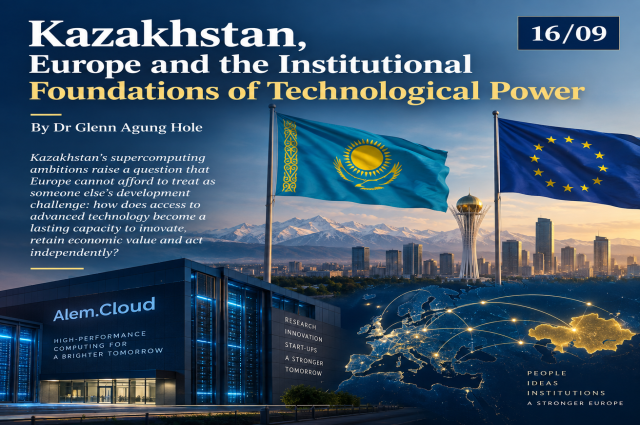
Kazakhstan, Europe and the Institutional Foundations of Technological Power
By Dr Glenn Agung Hole
Kazakhstan’s supercomputing ambitions raise a question that Europe cannot afford to treat as someone else’s development challenge: how does access to advanced technology become a lasting capacity to innovate, retain economic value and act independently?
In October 2025, Kazakhstan’s government addressed a question that deserves a place in Europe’s debate about technological sovereignty. It approved rules for allocating the computing resources of Alem.Cloud, its national supercomputing centre, with the stated aim of providing access to universities, scientific organisations, start-ups and commercial projects. The significance lay in the proposed relationship between advanced infrastructure and the wider economy.
Who gains access to computing power, under what conditions, and with what opportunities to develop a viable business around it? These questions receive less attention than processing speeds. Yet they help determine whether a technological investment becomes a source of productive capability or remains an expensive installation with limited effects beyond its immediate users.
Alem.Cloud belongs to the domain of classical high-performance computing. Its relevance is not that it establishes Kazakhstan’s leadership in quantum technology, but that it exposes an institutional challenge shared by technologically ambitious states: acquiring an advanced asset is only one stage in developing the capacity to benefit from it.
For Brussels, the appropriate response is neither to celebrate Kazakhstan as a model nor to dismiss its ambitions as a peripheral development story. It is to examine the conditions under which technological investment changes a country’s economic possibilities—and the conditions under which it merely changes the form of its dependencies.
From computing access to productive ownership
The economic case for shared computing infrastructure begins with a plausible mechanism. Where access is affordable and predictable, a smaller enterprise can undertake experiments that would otherwise require prohibitive investment. Engineers can test applications, researchers can work with more demanding models, and potential customers can assess solutions before committing to deployment.
But this mechanism has several points of failure.
Consider a hypothetical engineering company developing software for industrial maintenance. Computing access may enable it to build a working application. Commercial success would still depend on suitable data, technical staff, a customer willing to test the product and financing that lasts beyond the demonstration phase. A promising application could stall even while the national computing facility operates exactly as intended.
This is why entrepreneurship belongs inside technological strategy, rather than being appended to it as an expected consequence.
Entrepreneurs perform the difficult work of turning knowledge into something another organisation will use and pay for. Their ability to do so depends on an environment that connects research to customers, capital and practical expertise. Supporting one part of that environment while neglecting the others can produce impressive project statistics without durable businesses.
By institutional capital, I mean the accumulated rules, organisational knowledge and relationships that enable a society to coordinate productive activity and renew its capabilities. Its importance becomes visible in these connections. A university may be excellent, a financing programme well administered and a computing centre technically advanced, while the arrangements between them remain inadequate.
Infrastructure and the broader business environment therefore need to be considered together. An assessment of a computing investment should examine the reliability of electricity and connectivity alongside the availability of engineers. A commercialisation programme should consider whether firms can finance expansion and plan under predictable tax and regulatory conditions.
Taxation, in this context, cannot be assessed solely through the revenue collected in a particular year. Its design should also be evaluated against the ability of productive enterprises to retain capital and finance uncertain development. That does not establish a case for indiscriminate tax reductions. It establishes a case for judging fiscal policy and industrial ambition together.
The strategic return is not exhausted by the first successful application. It also includes the expertise, commercial relationships and accumulated capital that make the next application possible.
Kazakhstan’s test is whether the benefits spread
Kazakhstan’s published access policy expresses an intention to connect computing resources with a broad range of users. The announcement alone does not establish that access is equitable, that commercially successful applications have emerged or that the benefits extend beyond organisations already close to public resources.
That distinction matters because the country’s wider institutional constraints are substantial. In its assessment published in January 2026, the International Monetary Fund identified the state’s large economic presence as a constraint on private-sector development. Its Executive Directors argued that investment in digitalisation and infrastructure should be accompanied by stronger legal protections, secure property rights and a more level playing field for private enterprise.
These are not qualifications to be placed politely at the end of an otherwise celebratory technological narrative. They concern the mechanism through which the investment is supposed to work.
If access favours established or politically connected organisations, public infrastructure can reinforce existing concentrations of economic power. If independent enterprises can compete on credible terms, the same infrastructure can widen participation and create opportunities that incumbents would not develop themselves.
The state’s challenge is therefore more demanding than selecting a national priority and financing it. It must create conditions in which actors it does not directly control can identify uses, challenge assumptions and retain a meaningful share of the value they create.
Public support can be justified where experimentation generates knowledge that individual firms cannot fully capture. But support should come with independent evaluation and the possibility of redirecting resources. A programme that cannot acknowledge failure cannot reliably distinguish learning from waste.
For Alem.Cloud, evidence of institutional progress would include transparent allocation decisions, meaningful participation by independent firms and credible accounts of what users achieve. The relevant question is whether capabilities spread through the economy, rather than remaining concentrated around the facility.

Europe’s problem is the connection between its strengths
Europe should recognise this challenge without assuming that Kazakhstan’s circumstances are equivalent to its own.
European technological capability is real. Germany’s JUPITER Booster ranked fifth in the June 2026 TOP500 supercomputer list. Europe’s position cannot reasonably be described as one of regulatory activity without technical achievement.
Yet scientific and infrastructural strength do not resolve every part of the economic problem. The European Commission’s Quantum Europe Strategy, adopted in July 2025, explicitly identified difficulties in translating innovation into market opportunities, together with fragmentation across national strategies and roadmaps. Its proposed response connected research, infrastructure, industrial development, investment and skills.
The institutional diagnosis is consequently more precise than the familiar claim that Europe simply regulates too much. The question is whether its different policies reinforce the same productive process.
A research agency may fund a promising technology while procurement arrangements make it difficult for a young company to secure an initial customer. An infrastructure programme may expand computing access while firms struggle to finance the next stage of development. Each intervention can fulfil its own mandate without the combined system producing the intended result.
The unit of evaluation should therefore be the full path from knowledge to productive use, not merely the performance of individual programmes.
Ownership enters the argument at this point. Where a company must relocate key activities to obtain growth financing, the concern is not simply that foreign investors receive a return. It is that decisions about future research, reinvestment and capability development may increasingly be taken elsewhere.
Foreign capital can also expand domestic capability. Acquisition need not destroy local expertise, and national ownership does not guarantee productive investment. The appropriate test is what happens to the capacity to develop technology and make consequential decisions—not the passport of every shareholder.
Europe should accordingly distinguish between attracting activity and retaining the institutional conditions for its renewal. Hosting a successful project is valuable. Remaining a credible location for its next generation requires a deeper alignment of skills, capital, infrastructure and incentives.
Quantum security makes institutional delay consequential
The same problem appears in the protection of information against future quantum attacks.
Frédéric Rosard’s recent analysis of quantum geopolitics draws attention to the dependence that can arise when countries lack the knowledge and facilities needed to participate in advanced technological systems. An institutional perspective extends that concern to their ability to adapt and replace the systems on which they already rely.
A sufficiently capable quantum computer could threaten important public-key cryptographic systems. The timing remains uncertain. However, information requiring long-term confidentiality can be exposed to a present-day collection risk: an adversary may retain encrypted material in the expectation of decrypting it later. This is why preparation need not—and should not—depend on predicting the precise date of a technological breakthrough.
The technical foundations for a transition are already being established. NIST released its first three finalised post-quantum cryptography standards in August 2024, covering key establishment and digital signatures, and encouraged organisations to begin integrating them.
The EU’s June 2025 roadmap, meanwhile, calls for all member states to begin transitioning by the end of 2026, with the protection of critical infrastructure transitioned as soon as possible and no later than the end of 2030. These are recommended implementation milestones, not evidence that the necessary organisational changes have occurred.
The institutional work is concrete. Organisations need to identify where cryptography is used, understand supplier dependencies and plan changes across systems that may have different owners and replacement schedules. NIST’s guidance specifically recommends inventories and engagement with technical departments and vendors.
From there, responsibility must connect to budgets and procurement decisions. A security team cannot complete a transition through technical expertise alone if it has no authority over the contracts or systems that need to change.
This is the wider lesson for technological sovereignty: a society needs the capacity to revise earlier technological choices. The ability to install a system and the ability to replace it are distinct capabilities. Strategic resilience requires both.
Cooperation should leave both sides more capable
For Europe and Kazakhstan, this institutional perspective suggests a more useful basis for cooperation than declarations about digital leadership.
A partnership should be designed around a problem that participating organisations are equipped to address. For example, a jointly funded research-to-industry programme could connect computing access with technical training, independent project selection and trials with potential customers. Its evaluation would examine whether participants developed expertise and applications that remained useful after the initial funding ended.
This would differ from an arrangement whose principal achievement was the delivery of equipment. It would also differ from training disconnected from any organisation capable of employing the resulting skills.
The conditions of cooperation would matter as much as its technological content. Rights to use research results should be clear. Commercial confidentiality and personal data should be protected. Academic participants should retain the freedom to question methods and report disappointing findings. Sensitive technologies would require proportionate security assessments.
Such safeguards are part of the productive value of a partnership. They make it more credible for researchers, firms and public organisations to commit resources beyond a single transaction.
Neither side should assume that cooperation requires eliminating every foreign dependency. A more practical objective is to make critical dependencies understandable and manageable. Where several systems rely on the same underlying supplier, purchasing through different intermediaries may offer little additional freedom. Where local teams gain the knowledge to assess alternatives, negotiate terms and reorganise operations, international cooperation can increase autonomy.
For Kazakhstan, that would mean using external partnerships to expand domestic productive capability rather than merely multiplying suppliers. For Europe, it would mean treating a potential partner as a participant in knowledge production, while maintaining demanding standards for security and accountability.
Both would need to assess success over a longer horizon than the announcement of an investment.
The decisive test comes when the original equipment needs upgrading, the first grant expires or a commercial relationship changes. Can the institutions that have formed around the investment retain expertise, mobilise new capital and make an informed decision about what comes next?
That is where institutional capital becomes strategic capacity.
For Astana and Brussels alike, the most consequential outcome would be an economy better able to undertake its next technological transition—not simply better equipped at the end of this one.















































Yorum Yazın
Facebook Yorum