




INTERVIEW| Malaysia, Egypt shift trade toward high-value industries: Malaysia trade commissioner
Amr Yehia , Sunday 13 Sep 2026
Following record bilateral trade of $718 million in 2025, commercial relations between Cairo and Kuala Lumpur are shifting toward high-value technology sharing, joint manufacturing, and supply-chain integration.

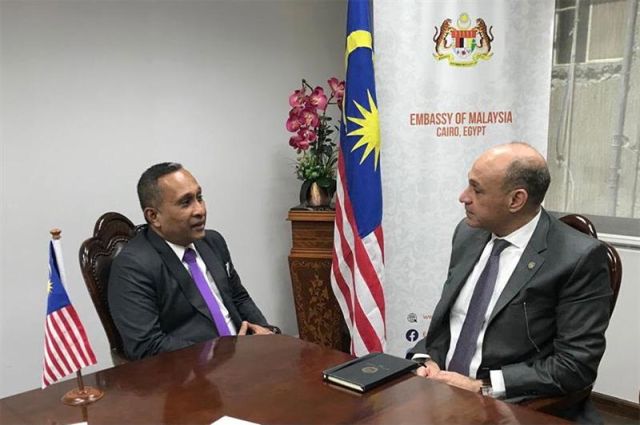
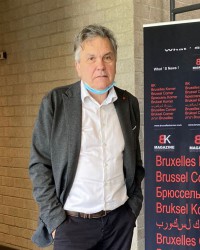
In an exclusive interview with Ahram Online, Mohd Khairy Maidin, the trade commissioner of the Malaysia External Trade Development Corporation (MATRADE) in Cairo, outlined how MATRADE is leveraging this momentum across Egypt’s mega-projects, digital trade corridors, and MIHAS 2026.
Ahram Online (AO): Since assuming your role as trade commissioner in Cairo, and with MATRADE’s expanded regional mandate, what have been the standout achievements and key milestones in driving Malaysia-Egypt commercial relations, especially given the record $718 million bilateral trade volume achieved in 2025?
Mohd Khairy Maidin: It is an incredibly exciting time to be steering this ship. Hitting that $718 million mark in 2025 was not just a numerical victory; it proved the deep economic resilience and mutual synergy between our two nations. However, if you ask me what I am most proud of, it is the qualitative shift in how we trade.
The standout milestone is undoubtedly the inauguration of the Proton Saga completely knocked-down (CKD) assembly facility in Giza, operated in partnership with Ezz Elarab Elsewedy Automotive Factories (ESAF). This multi-million-dollar joint venture completely shifts our dynamic. We are no longer just exchanging bulk commodities; we are now trading in high-value industrial technology, manufacturing capacity, and shared expertise.
We have successfully broadened our trade basket; while palm oil remains a fundamental pillar, we are seeing aggressive, sustainable growth in electrical and electronics (E&E), automotive components, and machinery.
AO: The trade basket between both nations is evolving rapidly from traditional commodities to industrial technology. What specific Malaysian sectors offer the strongest immediate export potential to Egypt, and vice versa?
KM: You have hit the nail on the head regarding the evolution of our bilateral trade. On the Malaysian side, the immediate potential lies in integrating our suppliers directly into Egypt's localized industrial supply chains.
Following the Proton assembly expansion in Giza, there is massive room for Tier 1 and Tier 2 Malaysian automotive parts manufacturers to supply the Egyptian market.
Beyond automotive, our Electrical & Electronics (E&E) sector, particularly semiconductors and smart manufacturing equipment, is perfectly positioned to support Egypt’s ongoing industrial leap. We also see robust demand for our green technologies and solar components, alongside high-value Halal F&B, such as specialized ingredients and sustainable palm oil derivatives.
Looking at what Egypt offers Malaysia, the trade flow is highly complementary. Egypt is a recognized powerhouse in fertilizers and agrochemicals, which are critical for Malaysia's extensive agriculture and plantation sectors.
Furthermore, we are increasingly sourcing Egyptian fresh produce, like citrus fruits and high-quality dates, and exploring petroleum products to support Malaysia's energy diversification goals.
AO: Egypt is undergoing a massive transformation with nationwide mega-projects and smart cities. How do you see Malaysian enterprises benefiting from and contributing to this growth?
KM: Malaysia brings a proven, practical track record to this space. We built our own green administrative capital from scratch in Putrajaya, as well as our primary tech hub in Cyberjaya. Therefore, we do not view Egypt's mega-projects merely as bidding opportunities for foreign contractors; we are actively positioning Malaysian firms as long-term strategic partners in green construction and smart urban management.
We are encouraging Malaysian suppliers to provide high-value building materials, such as specialized architectural glass, sustainable timber, and advanced insulation tailored specifically for desert climates.
More importantly, MATRADE is actively encouraging our software and technology firms to form joint ventures with Egyptian engineering giants. This ensures that as we introduce IoT-enabled transit technology and smart city software for projects like the New Capital, we are also facilitating genuine knowledge transfer and local capacity building.
AO: With Egypt serving as a strategic gateway into Africa through the AfCFTA and Malaysia offering a doorway into Southeast Asia as an ASEAN powerhouse, how is MATRADE facilitating concrete B2B linkages and supply chain integration?
KM: This "dual-gateway" framework is the absolute core of our pitch to the private sector. We consistently tell Malaysian businesses: do not look at Egypt simply as a consumer market of 105 million people. Look at it as your strategic manufacturing launchpad for the entire African Continental Free Trade Area (AfCFTA).
The Proton Giza assembly plant is a perfect example, as the facility prepares to export assembled vehicles to North and Sub-Saharan Africa by the end of 2026.
To operationalize this strategy, MATRADE Cairo is actively facilitating institutional linkages, including institutional MoUs between the Federation of Egyptian Chambers of Commerce (FEDCOC) and the National Chamber of Commerce and Industry of Malaysia (NCCIM).
We are physically connecting Egyptian raw material exporters with Malaysia's manufacturing hubs, utilizing Malaysia's world-class port infrastructure so Egyptian exporters can use us as a primary redistribution hub for the 600-million-strong ASEAN market.
AO: What key operational challenges are Egyptian and Malaysian exporters currently facing, and what policy solutions or institutional mechanisms are being deployed to streamline trade flows?
KM: I prefer to be candid: international trade is never without friction. Currently, currency volatility, localized foreign exchange constraints, and complex customs documentation are the primary hurdles facing our exporters.
However, we are actively deploying concrete mechanisms to address these issues. To mitigate hard currency constraints, we are elevating bilateral dialogues around alternative trade settlement mechanisms, including local currency trade and structured barter-like frameworks.
On the regulatory front, we are working to strengthen mutual recognition between Malaysia's halal authority (JAKIM) and Egyptian certification bodies to eliminate double-certification bottlenecks at customs ports.
Finally, we are advocating for digital, blockchain-based trade corridors to make customs documentation paperless, which will drastically reduce port clearance times for time-sensitive cargo.
AO: Looking ahead, what are your primary targets and strategic priorities for MATRADE Cairo to deepen trade and further elevate the commercial partnership?
KM: Our quantitative target is to sustain 10 percent to 15 percent year-on-year growth in overall bilateral trade. However, the qualitative composition of that growth matters far more than the headline number; we want it driven predominantly by non-traditional, high-value sectors rather than bulk commodities.
Strategically, my primary priority is achieving true investment reciprocity. We need to move beyond traditional buying and selling toward genuine cross-border Foreign Direct Investment (FDI). I want to see Egyptian private capital and sovereign funds investing in Malaysia's tech parks and Halal hubs, just as Malaysian capital is establishing roots in Egypt.
Additionally, we are prioritizing tech capacity building, specifically exporting Malaysian Software-as-a-Service (SaaS), cybersecurity, and Islamic fintech solutions to directly support Egypt's digital transformation agenda.
AO: Finally, with the 22nd edition of the Malaysia International Halal Showcase (MIHAS 2026) taking place September 23–26 in Kuala Lumpur, what is the core agenda, and what benefits can participating Egyptian enterprises expect?
KM: MIHAS is the benchmark event for the global Halal economy, and this 22nd edition, running from 23 to 26 September at the Malaysia International Trade and Exhibition Centre (MITEC) in Kuala Lumpur, will be groundbreaking. This year, the core theme centres on embedding trust, governance, and technology into international trade, with artificial intelligence featured as a standalone sector for the first time.
My expectations for Egyptian participation are exceptionally high. We anticipate robust delegations from both the public and private sectors, particularly across pharmaceuticals, modest fashion, cosmetics, and processed food industries. The tangible benefit for an Egyptian business attending MIHAS 2026 is that they are not just selling to Malaysia; they are entering a global sourcing hub with buyers from over 80 countries.
Through MATRADE’s International Sourcing Programme (INSP), we pre-schedule targeted B2B meetings for Egyptian exporters with pre-vetted global buyers, offering them a gateway to integrate into the $3 trillion global halal ecosystem.































Yorum Yazın
Facebook Yorum