




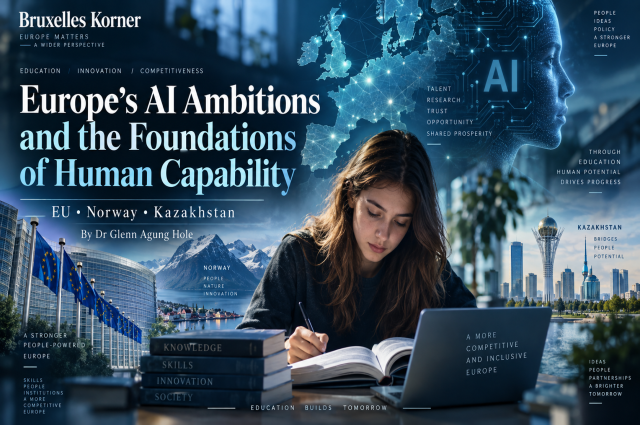
Europe’s AI Ambitions and the Foundations of Human Capability
Evidence from the EU, Norway and Kazakhstan raises a shared question: how do education, technological investment and institutions combine to build lasting capability?
By Dr Glenn Agung Hole
Institutional economist and Associate Professor, University of South-Eastern Norway
Europe’s competitiveness agenda connects innovation, industrial development, economic security and skills. The European Commission’s Competitiveness Compass identifies education, financing and coordination as components of that agenda. The educational foundations on which these ambitions depend are now receiving renewed scrutiny. [1]
Published on 8 September 2026, the OECD’s PISA 2025 results document further difficulties in reading and mathematics across many participating education systems. They provide evidence about the capabilities of a generation growing up alongside increasingly sophisticated digital technologies. [2]
Kazakhstan’s stated development agenda brings education, technological development, entrepreneurship and infrastructure into a connected discussion of national development. The question is how these connections are being articulated, and whether institutions can translate them into capabilities that endure beyond individual programmes.
Recent articles by Aida Haidar in The Astana Times and Birgit Rodvelt, reporting on Norway’s National Reading Centre, provide the starting point for this comparison. Haidar examines the coexistence of digital familiarity and weak foundational learning in Kazakhstan; Rodvelt reports concerns about reading endurance and critical reflection in Norway. [3, 4]

The question for the European debate is therefore one of institutional conversion: under what conditions do knowledge, technology and investment become lasting productive and strategic capability?
The comparison concerns how education, technology and economic development are connected in stated objectives and institutional arrangements. It does not evaluate the relative effectiveness of national reforms. PISA measures selected student skills; strategy documents describe ambitions and planned action. The relationship between them has to be investigated rather than assumed.
Europe: position is not trajectory
PISA assesses how 15-year-olds apply knowledge and skills in reading, mathematics and science. Its results describe selected educational outcomes, not a comprehensive measure of national competitiveness. The OECD average is also distinct from an EU average. [18]
The European results are far from uniform. Ireland and Estonia recorded reading scores of 500 and 499 respectively, compared with an OECD average of 461. Belgium scored 466, Germany 465 and France 456. The Netherlands recorded 441 in reading but 483 in mathematics, placing its reported averages on different sides of the respective OECD benchmarks. These are comparisons within subjects, not an assumption that scores in different subjects measure identical capabilities. [6]
A count of the published estimates shows that 15 of the EU’s 27 member states had reading scores numerically below the OECD average. Among the 26 with a reported 2022–2025 reading comparison, 25 had negative point estimates. These counts do not mean that every difference or change is statistically significant. Table 1 provides the full comparison. [5, 6]
Relative position and direction of travel are separate issues. Ireland and Estonia remained above the reported OECD reading average while their scores fell by 16 and 12 points respectively. Educational capability can therefore weaken even where a country retains a comparatively high position. [6]
The OECD attaches sampling cautions to results for the Netherlands and Norway. More generally, uncertainty, population coverage and the composition of comparison groups matter when interpreting differences. A small numerical gap is not automatically a meaningful educational distinction. [7]
The European agenda already recognises the links
The EU has not simply overlooked foundational learning. Presented in March 2025, the Commission’s Union of Skills connects human-capital development with competitiveness. Its accompanying Action Plan on Basic Skills and STEM Education Strategic Plan address foundational learning, scientific and technical education, and preparation for digital and clean-technology transitions. [8]
The basic-skills agenda also encompasses apprenticeships, teacher development, mentoring and cooperation among educational, cultural and community organisations. It therefore recognises that learning takes place through relationships between institutions, not only within an individual classroom. [9]
Responsibility is nevertheless distributed. EU member states organise their education systems and determine teaching content, while the Union supports and complements their activities. National PISA outcomes cannot simply be attributed to a single European education policy. [10]
For Brussels, the analytical issue is how shared economic objectives interact with national implementation and local professional capacity. Consider a manufacturing supply chain spanning several countries: new equipment addresses one requirement, while the ability of technicians, managers and suppliers to understand specifications and adapt production addresses another. Neither investment tells us, by itself, how the complete system will perform.
What Kazakhstan is attempting to connect
Kazakhstan’s recent initiatives offer a concrete example of these connections in an official development agenda. A presidential decree signed on 16 May 2026 places reading culture within the fields of culture, education and innovation. It links the agenda to human-capital development and calls for modernised libraries, wider literary access and a reading-culture concept for 2027–2031 explicitly situated within the development of artificial intelligence. [11]
At the AI Development Council meeting on 4 May, the official account connected universities and applied research with commercialisation, venture investment and computing infrastructure. It also discussed digital development in relation to industrial applications, energy and logistics. These were stated priorities and implementation requirements, not independently demonstrated results. [12]
Foundational learning and advanced technology appear within a connected account of economic development. The documents describe relationships between capabilities that can subsequently be investigated, rather than establishing that the relationships already function effectively.
Kazakhstan’s educational evidence makes that distinction indispensable. Only 36 per cent of students reached at least Level 2 proficiency in reading, compared with 69 per cent across the OECD. Meanwhile, 47 per cent reported using AI chatbots to support learning at least weekly. These aggregate findings show that widespread technological use can coexist with substantial foundational difficulties; they do not establish that AI caused those difficulties. [13]
Nor can an assessment conducted in 2025 demonstrate the effectiveness of measures adopted in 2026. The relevant comparison concerns the connection between stated objectives, institutional arrangements and subsequent outcomes. It does not support a claim that Kazakhstan has already resolved the problems facing its education system.
Norway: substantial resources, a steep reading decline
Norway adds a useful European comparison. It is outside the EU but participates in the single market through the European Economic Area. Its institutional experience is therefore relevant to the wider European discussion without being conflated with EU member-state results. [14]
The scale of Norway’s reading decline deserves particular attention. Its reported score fell from 477 in 2022 to 453 in 2025: a loss of 24 points, compared with 14 points across the OECD. The Norwegian decline was therefore 10 points larger than the published OECD change. These are changes in test-score points, not percentages. [5, 6]
The National Reading Centre reports the lowest reading performance recorded for Norway in PISA, with 41 per cent of boys and 27 per cent of girls among low performers. Its researchers also identify difficulties with sustained reading, reflection and comparing information across texts. [4] The OECD describes the 2025 results as extending the decline already observed between 2018 and 2022. [19]
The resource context makes this particularly striking. OECD expenditure data for 2022 record government spending of USD 19,797 per full-time-equivalent student from primary to post-secondary non-tertiary education, adjusted for purchasing power. [20] Substantial resources coexist with deteriorating measured reading proficiency. This does not establish why results declined; it makes the conversion of resources into learning a question that spending totals alone cannot answer.
The OECD’s sampling caution remains material: Norway excluded 10.4 per cent of its target population, compared with 7.3 per cent in 2022. High exclusion rates may bias performance estimates upwards. This limits the precision of comparisons and does not provide a simple correction to the reported scores. [7, 19]
A related institutional issue appears in the Office of the Auditor General’s investigation, published on 16 June 2026. It found insufficient information about the contribution of several measures to foundational learning. Despite extensive research, the education ministry also lacked information about how the measures worked together. This investigation preceded the publication of PISA 2025 and is not an evaluation of those new results. [15]
The presence of programmes, research and resources does not establish their combined effect. Norway’s audit examines implementation, whereas Kazakhstan’s cited decrees describe intended action. They illuminate different stages of development; they are not a matched evaluation of national effectiveness. [11, 12, 15] Norway’s higher measured proficiency than Kazakhstan’s therefore needs to be distinguished from the substantial decline in Norway’s own results. [5, 6]
From individual skills to institutional capability
An institutional-capital perspective focuses on the arrangements through which societies preserve, transmit and apply knowledge over time. Foundational literacy is one component of this process, not a complete explanation of productivity, entrepreneurship or institutional performance.
The distinction becomes practical when an engineering firm evaluates an AI-generated technical proposal. Access to the system changes its technological resources. Determining whether the proposal is sound requires people who understand the problem, check assumptions and recognise when further expertise is needed. Producing an answer and exercising judgement about it are different activities.
The same distinction can be examined in entrepreneurship. A prospective founder may obtain a market summary almost instantly. Assessing its relevance still involves questioning the evidence, comparing alternatives and understanding constraints. A mentoring relationship or applied university project can provide a setting in which those judgements are discussed and tested; whether it improves outcomes is a matter for evaluation.
From this perspective, the central unit of analysis is not simply the skill possessed by an individual, but the institutional relationships through which that skill becomes useful. These include connections among schools, universities, firms, investors and professional communities. The question is whether those relationships help knowledge circulate, enable experimentation and preserve learning when individuals leave.
PISA does not directly measure these professional or organisational outcomes. Connecting achievement at age 15 to later economic activity requires additional evidence. [18] This raises a research question: how does foundational learning develop into professional competence, and under what institutional conditions can that competence be applied and renewed?
A practical setting in EU–Central Asia relations
For Brussels, these questions extend to international cooperation. At the first EU–Central Asia summit in April 2025, the European Commission announced a €12 billion Global Gateway investment package covering transport, critical raw materials, digital connectivity, water and energy. This was a regional package, not an allocation exclusively to Kazakhstan, and an announcement is distinct from completed investment. [16]
The summit also included commitments to deepen cooperation in education and science, using opportunities under Erasmus+ and Horizon Europe and collaborating in fundamental and applied research. These commitments provide a practical context for examining the connections between physical investment and the development of human capability. [17]
A transport project can be assessed through capacity and reliability. A university partnership can be examined for knowledge transfer and sustained research relationships. An industrial collaboration can be investigated for its contribution to supplier competence and the ability of participating firms to undertake more demanding activities. Studying these outcomes together would make the relationship between infrastructure and learning more visible.
The regional dimension is equally relevant to this inquiry. Do opportunities reach smaller firms and communities beyond the most prominent universities and technology centres? Does expertise remain accessible after an externally funded project ends? Can participating organisations adapt what they have learned to a new problem? These are questions for European institutions and their Central Asian partners alike.
The relationship that matters
Educational assessments describe measured outcomes. Strategies and decrees describe intentions and institutional arrangements. Neither substitutes for the other. The contribution of comparative analysis is to examine how they are connected, without treating an announcement as an achievement or a test score as a complete account of a society.
Kazakhstan’s stated agenda seeks to articulate relationships between human development, technology and economic activity. The European evidence, meanwhile, shows variation in educational outcomes alongside explicit initiatives connecting skills with competitiveness. [8, 11, 12] The common analytical task is to establish what happens between the stated ambition and the resulting capability.
For the European debate, this moves the discussion beyond a country’s position in a PISA table. It brings education, research, entrepreneurship and infrastructure into the same frame of analysis, while leaving their effects open to evidence.
Technological investment tells us what resources are being assembled. Human and institutional capability tells us what people and organisations become able to do with them.
Table 1. PISA 2025: EU member states and benchmarks
Mean scores and published reading-score changes, 2022–2025. EU member states are listed alphabetically. [5–7]
Country / benchmark | Reading | Mathematics | Science | Reading change |
Austria | 467 | 477 | 497 | −13 |
Belgium | 466 | 480 | 490 | −13 |
Bulgaria | 387 | 405 | 421 | −18 |
Croatia | 453 | 455 | 476 | −22 |
Cyprus | 379 | 412 | 411 | −2 |
Czechia | 468 | 477 | 490 | −20 |
Denmark | 460 | 471 | 478 | −29 |
Estonia | 499 | 508 | 527 | −12 |
Finland | 474 | 469 | 504 | −16 |
France | 456 | 458 | 483 | −18 |
Germany | 465 | 464 | 486 | −15 |
Greece | 423 | 424 | 434 | −16 |
Hungary | 452 | 459 | 480 | −21 |
Ireland | 500 | 480 | 500 | −16 |
Italy | 474 | 468 | 483 | −7 |
Latvia | 430 | 460 | 468 | −45 |
Lithuania | 464 | 470 | 488 | −8 |
Luxembourg | 443 | 458 | 474 | — |
Malta | 415 | 439 | 453 | −31 |
Netherlands* | 441 | 483 | 485 | −18 |
Poland | 482 | 484 | 495 | −7 |
Portugal | 462 | 460 | 482 | −15 |
Romania | 413 | 419 | 425 | −16 |
Slovakia | 448 | 469 | 475 | +1 |
Slovenia | 445 | 460 | 484 | −24 |
Spain | 451 | 457 | 477 | −23 |
Sweden | 466 | 464 | 485 | −21 |
OECD average | 461 | 463 | 482 | −14 |
Norway* | 453 | 452 | 470 | −24 |
Kazakhstan | 385 | 414 | 420 | −1 |
Source: OECD (2026), PISA 2025 Results (Volume I), Table I.1, printed pp. 28–29; underlying Tables I.B1.2a.1–3 and I.B1.2a.36–38. Selection and layout adapted for this article. [5]
Reading the table: Scores and changes are rounded as published. Numerical differences are not necessarily statistically significant; significance markers are not reproduced here. The OECD benchmark is not an EU average. [6, 7]
Coverage: * One or more PISA sampling standards were not met. “—” indicates no reported 2022 comparison. The OECD short-term-change average excludes Costa Rica, Luxembourg and Spain. Slovakia is reported as “Slovak Republic” by the OECD. Cyprus data cover the area under the effective control of the Government of the Republic of Cyprus. [5, 7]
Adapted from OECD material under CC BY 4.0. This analysis does not represent the official views of the OECD or its member countries.
Sources
Source numbering corresponds to the article and table. Online sources checked on 16 September 2026. All links are direct source links without tracking parameters.
[1] European Commission (2025; page updated 29 May 2026). Competitiveness Compass.
https://commission.europa.eu/topics/competitiveness/competitiveness-compass_en
[2] OECD (8 September 2026). PISA 2025: Students’ reading and mathematics performance declined sharply across the OECD.
https://www.oecd.org/en/about/news/press-releases/2026/09/pisa-2025-students-reading-and-mathematics-performance-declined-sharply-across-the-oecd.html
[3] Haidar, A. (14 September 2026). Why Reading Matters in Age of AI? Kazakhstan’s PISA Results Offer Answer. The Astana Times.
https://astanatimes.com/2026/09/why-reading-matters-in-age-of-ai-kazakhstans-pisa-results-offer-answer/
[4] Rodvelt, B. (12 September 2026). Norske 15-åringers leseferdigheter har aldri vært dårligere. University of Stavanger contribution to forskning.no.
https://www.forskning.no/barn-og-ungdom-lesing-partner/norske-15-aringers-leseferdigheter-har-aldri-vaert-darligere/2708485
[5] OECD (2026). PISA 2025 Results (Volume I): Future-Ready Students. Table I.1, printed pp. 28–29. OECD Publishing.
https://doi.org/10.1787/73451bc5-en
[6] OECD (2026). Student performance in PISA 2025. In PISA 2025 Results (Volume I).
https://www.oecd.org/en/publications/pisa-2025-results-volume-i_73451bc5-en/full-report/student-performance-in-pisa-2025_23e075c2.html
[7] OECD (2026). Reader’s Guide. In PISA 2025 Results (Volume I). Sampling, comparability and reporting cautions.
https://www.oecd.org/en/publications/pisa-2025-results-volume-i_73451bc5-en/full-report/reader-s-guide_0364240f.html
[8] European Commission (5 March 2025). Union of Skills strategy to equip people for a competitive Europe.
https://employment-social-affairs.ec.europa.eu/news/union-skills-strategy-equip-people-competitive-europe-2025-03-05_en
[9] European Commission (updated 5 March 2026). Basic skills. European Education Area.
https://education.ec.europa.eu/education-levels/school-education/basic-skills
[10] EUR-Lex. Education. Summary of the allocation of responsibilities under Article 165 TFEU.
https://eur-lex.europa.eu/EN/legal-content/glossary/education.html
[11] President of the Republic of Kazakhstan (16 May 2026). Decree No. 1279 on measures to develop reading culture and form a reading nation. Official text in Russian.
https://akorda.kz/ru/o-merah-po-razvitiyu-kultury-chteniya-i-formirovaniyu-chitayushchey-nacii-164044
[12] President of the Republic of Kazakhstan (4 May 2026). President Kassym-Jomart Tokayev held the second meeting of the AI Development Council. Official proceedings.
https://www.akorda.kz/en/president-kassym-jomart-tokayev-held-the-second-meeting-of-the-ai-development-council-543538
[13] OECD (2026). PISA 2025 Results (Volume I): Kazakhstan. Country note.
https://www.oecd.org/en/publications/pisa-2025-results-volume-i-country-notes_2d4ff9ea-en/kazakhstan_c01ae9c9-en.html
[14] European Free Trade Association. EEA & Relations with the EU.
https://www.efta.int/eea
[15] Office of the Auditor General of Norway (16 June 2026). Kunnskapsdepartementet sitt arbeid for å styrkje lese-, skrive- og rekneferdigheitene hos elevane. Document 3:17 (2025–2026).
https://www.riksrevisjonen.no/rapporter-mappe/no-2025-2026/kunnskapsdepartementet-sitt-arbeid-for-a-styrkje-lese-skrive-og-rekneferdigheitene-hos-elevane/
[16] European Council (4 April 2025). Joint press release following the first EU–Central Asia summit.
https://www.consilium.europa.eu/en/press/press-releases/2025/04/04/joint-press-release-following-the-first-eu-central-asia-summit/
[17] European Council (4 April 2025). First EU–Central Asia summit. See “People-to-people contacts and mobility”.
https://www.consilium.europa.eu/en/meetings/international-summit/2025/04/04/
[18] OECD. Programme for International Student Assessment (PISA). Assessment scope and publication information.
https://www.oecd.org/en/about/programmes/pisa.html
[19] OECD (8 September 2026). PISA 2025 Results (Volume I): Norway. Country note; performance trends and sampling cautions.
https://www.oecd.org/en/publications/pisa-2025-results-volume-i-country-notes_2d4ff9ea-en/norway_77d5f84b-en.html
[20] OECD (9 September 2025). Education at a Glance 2025: Norway. Financial resources invested in education; 2022 expenditure data.
https://www.oecd.org/en/publications/education-at-a-glance-2025_1a3543e2-en/norway_693d8ce6-en.html
































Yorum Yazın
Facebook Yorum