




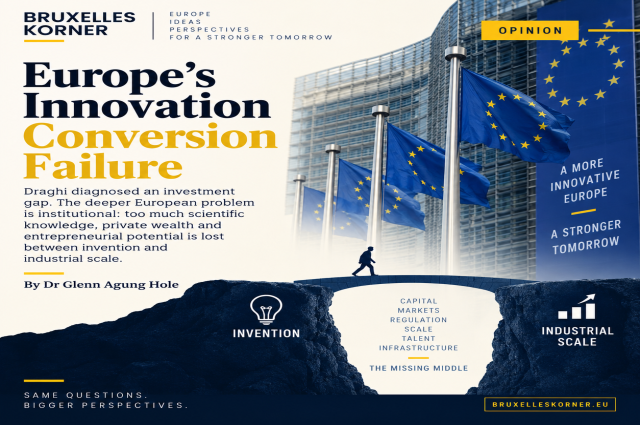
Europe’s Innovation Conversion Failure
Draghi diagnosed an investment gap. The deeper European problem is institutional: too much scientific knowledge, private wealth and entrepreneurial potential is lost between invention and industrial scale.
By Dr Glenn Agung Hole
Europe’s competitiveness debate has acquired an unusual degree of consensus. Productivity growth is too weak. The continent is under-represented in the technologies likely to shape the next economic era. Young firms struggle to scale. Capital markets remain fragmented. Energy costs weaken industrial competitiveness, while geopolitical instability has made technological dependence a strategic concern. Mario Draghi’s 2024 report brought these problems together with unusual force and estimated that meeting Europe’s existing ambitions would require an additional €750–800 billion of investment every year, equivalent to roughly 4.4–4.7 per cent of EU GDP (Draghi, 2024).
Yet the most important question raised by Draghi is not whether Europe can find another €800 billion. It is why an economy that already possesses exceptional scientific institutions, one of the world’s largest markets and enormous pools of private savings has allowed such a large investment and innovation gap to emerge in the first place.
This distinction is fundamental. If Europe’s principal problem were scarcity, the solution would be primarily financial. More public expenditure, larger research programmes and greater investment incentives would gradually close the gap. But Europe’s difficulty is more structural. It repeatedly generates the inputs associated with innovation without converting enough of them into the outputs that determine economic power: scalable firms, productivity growth, technological ownership and industrial capacity.
I describe this as Europe’s innovation conversion failure. The problem is not that Europe does not invent. It is that too much economic potential is dissipated between invention and scale.
The analytical implications are significant. Scientific excellence is not equivalent to innovation. Savings are not equivalent to productive capital. A legally integrated Single Market is not necessarily a commercially integrated market for a young firm attempting to expand across 27 jurisdictions. Nor should the sophistication of a regulatory system be confused with institutional capacity if that system cannot deliver investment, infrastructure and commercial scale at the speed required by technological competition.
Europe’s challenge is therefore less about producing another layer of innovation policy than about repairing the institutional chain through which knowledge becomes economic capacity.
The missing middle between knowledge and scale
Innovation policy in Europe has traditionally placed considerable weight on research intensity, scientific excellence and public support for knowledge creation. These remain indispensable. But a frontier economy cannot sustain prosperity through knowledge production alone. As economies approach the technological frontier, growth increasingly depends upon experimentation, entrepreneurship, reallocation and the commercial diffusion of new technologies. Institutions that are effective at supporting incremental improvement may therefore be insufficient when economic leadership depends on producing and scaling entirely new firms and business models (Aghion, Acemoglu, & Zilibotti, 2006).
This is where the European weakness becomes visible. The continent possesses an excellent research base and a substantial population of innovative start-ups, yet the financing gap widens as successful firms grow. European Investment Bank research finds that by their tenth year of operation, EU scale-ups have raised about 50 per cent less capital than comparable firms in San Francisco. More revealingly, 82 per cent of EU scale-up financing deals in the EIB sample involved a foreign lead or sole investor, compared with only 14 per cent in San Francisco (European Investment Bank, 2024).
These are not merely venture-capital statistics. They describe the institutional geography of future corporate power.
The point at which a firm moves from start-up to scale-up is precisely when capital requirements become larger, managerial complexity increases and access to international markets becomes strategically important. The lead investor does more than supply finance. It contributes networks, specialised knowledge, recruitment capacity, credibility and access to subsequent funding rounds. When the most important financial relationships of European technology firms are increasingly anchored outside Europe at the moment those firms begin to scale, the economic consequences extend well beyond ownership.
Innovation ecosystems are cumulative. Successful founders become investors. Experienced executives move into younger firms. Large technology companies become demanding customers and acquisition partners. Specialist lawyers, engineers and financiers cluster around successful sectors. One generation of corporate success therefore improves the institutional environment for the next. Conversely, when promising European companies relocate, list abroad or are acquired before achieving global scale, Europe loses part of this cumulative process. It may retain the university that produced the science while losing the corporate ecosystem created by its commercialisation.
That is why describing the problem as an ‘innovation gap’ is too imprecise. Europe can remain innovative in the scientific sense while losing ground economically. The decisive question is not how many ideas are generated, but how many survive the institutional journey from laboratory to market, from market to scale, and from scale to durable European industrial capability.
The distinction also explains why additional research spending, although necessary, cannot by itself solve the problem. If the institutional bottleneck lies downstream of discovery, increasing the flow of discoveries into the same constrained system may raise scientific output without proportionately increasing commercial outcomes. Innovation policy must therefore be designed as a conversion architecture rather than a research budget.

A Single Market that does not yet deliver single-market scale
The second conversion failure lies inside Europe’s greatest economic achievement: the Single Market. In formal terms, the European Union offers innovative firms access to a continental economy. In practice, the experience of scaling across Europe remains far more fragmented than the legal concept of a single market suggests.
The European Investment Bank’s 2025/26 Investment Report provides unusually direct evidence. Sixty-two per cent of EU firms report difficulty exporting to other EU countries because of fragmented rules and regulations. The EIB estimates that removing remaining barriers could raise firms’ investment-to-assets ratio by around 10 per cent, with even stronger effects on intangible investment, the form of investment most closely associated with knowledge-intensive growth (European Investment Bank, 2026a).
This matters because market size is itself an innovation institution. A firm that can address a large home market under one coherent commercial framework can spread fixed costs across more customers, accumulate data more rapidly, attract larger financing rounds and justify greater investment in technology. Scale is therefore not something that occurs after innovation; it changes the economics of innovation from the beginning.
The European paradox is that a technology company may be legally located inside one Single Market while commercially confronting multiple systems of taxation, company law, labour regulation, insolvency, financing and administration. For established multinationals, these frictions are costly but manageable. For a young company with limited managerial capacity, they can be decisive.
The Commission’s EU Inc. proposal, presented in March 2026 as part of a broader 28th regime, should be understood in this context. The proposal would create a harmonised European corporate form with digital procedures intended to make it substantially easier for innovative companies to establish themselves and operate across the Union (European Commission, 2026a). The proposal is directionally important. But its very necessity is also diagnostic. Europe would not need a new supranational company form if the existing institutional environment already allowed young companies to experience the Single Market as economically single.
The same issue appears in capital formation. The European Commission estimates that around 70 per cent of EU household savings, worth approximately €10 trillion, are held as bank deposits (European Commission, 2025a). There is nothing inherently problematic about households preferring safe and liquid savings. Nor should Europe seek to reproduce the American financial system wholesale. But innovative, intangible-intensive companies often require forms of risk-bearing capital that traditional bank intermediation is structurally less suited to provide.
The contradiction is therefore striking. Europe simultaneously possesses enormous financial wealth and a persistent shortage of growth capital for precisely the firms expected to generate future productivity. Draghi’s investment gap and Europe’s large stock of private savings are not opposing facts. Together they identify an intermediation problem: the institutions connecting wealth to productive risk are too shallow, too fragmented or too conservative relative to the scale of technological change.
This is the deeper meaning of the proposed Savings and Investments Union. The objective should not merely be to move household savings from deposits into securities. It should be to create institutional pathways through which European savings can finance European experimentation, including the possibility of failure. Innovation cannot be financed exclusively through instruments designed around predictable cash flows, collateral and low variance. A political economy that wants technological leadership must possess institutions capable of financing uncertainty.
Draghi’s diagnosis is about institutional conversion, not simply investment
The Draghi report is frequently reduced to its €750–800 billion headline. That risks obscuring its more important intellectual contribution. The report described an economy in which productive investment is too weak despite ample private savings, technological diffusion is insufficient, scale-up financing is inadequate and the Single Market remains incomplete in precisely the sectors where future growth will be determined (Draghi, 2024).
The investment number is therefore an outcome of a wider institutional structure.
This becomes clearer if one asks what Europe must actually convert over the next decade. It must convert scientific capability into commercial technology; household wealth into productive risk capital; digital regulation into a functioning market for digital enterprise; climate ambition into competitive energy systems; and strategic-autonomy rhetoric into domestic technological and industrial capacity. None of these conversions occurs automatically.
North’s institutional economics remains relevant here because formal institutions matter principally through the incentives and transaction costs they create (North, 1990). Europe has highly developed formal institutions, but high institutional sophistication does not guarantee high institutional adaptability. Rules can provide certainty while also accumulating complexity. Regulatory coordination can protect the Single Market while simultaneously slowing experimentation. Institutions built to minimise economic and political risk can become less effective when strategic competition requires speed, concentration of resources and tolerance for uncertain technological outcomes.
This is the uncomfortable dimension of Europe’s competitiveness problem. The weakness does not lie outside the European model. It arises partly from tensions within its own institutional strengths.
Europe has built a political economy exceptionally good at stability, consumer protection, incremental coordination and social risk-sharing. These achievements should not be discarded. But technological competition places greater weight on another set of institutional capabilities: rapid capital reallocation, commercial experimentation, high-risk financing, infrastructure delivery and the ability to scale successful firms across a genuinely continental market.
The policy challenge is therefore not deregulation in the simplistic sense. It is institutional redesign. Europe needs to distinguish between rules that protect essential public goods and frictions that merely protect fragmentation, incumbency or administrative routine. The relevant criterion should be whether institutions improve the economy’s capacity to convert knowledge and capital into productive outcomes without sacrificing the legal and social foundations on which European legitimacy rests.
This also changes how Brussels should evaluate policy success. The production of strategies, funding programmes and legislative initiatives is not equivalent to the production of capacity. A new programme can be administratively successful while leaving the underlying conversion rate unchanged. Europe should therefore judge its innovation architecture by measurable transitions: how rapidly university research is commercialised; how many firms survive the scale-up phase without relocating; how much late-stage capital is supplied by European investors; how quickly companies can expand across Member States; and how much new technological capability becomes embedded in European industrial ecosystems.
Brussels has moved. The test is whether the economy moves with it.
The European response since Draghi should not be dismissed. The Competitiveness Compass adopted in January 2025 explicitly placed closing the innovation gap at the centre of the Commission’s economic strategy, alongside decarbonisation and the reduction of strategic dependencies (European Commission, 2025b). The EU Startup and Scaleup Strategy acknowledges that too many firms struggle to move from laboratory to market and to grow at scale inside Europe (European Commission, 2025c). The Savings and Investments Union addresses the financial side of the same problem. EU Inc. attempts to reduce corporate fragmentation. The EIB Group’s TechEU programme is designed to provide €70 billion of financing and mobilise €250 billion of investment by 2027 across innovative and strategic technologies (European Investment Bank, 2025).
Europe has also recognised that innovation increasingly depends upon physical infrastructure. The AI Continent Action Plan seeks to mobilise €200 billion for artificial-intelligence development, including €20 billion for up to five AI gigafactories, alongside a wider network of AI factories (European Commission, 2026b). This is important because the digital economy is not immaterial. Frontier AI requires electricity, computing infrastructure, data, semiconductors, skilled labour and extremely large pools of capital.
These initiatives demonstrate that Brussels has understood much of the diagnosis. The danger is now implementation through institutional layering rather than institutional transformation.
Europe has a recurring tendency to respond to structural problems by adding instruments to an already complex architecture. Each instrument may be individually rational. Collectively, however, they can reproduce the very fragmentation they are intended to overcome if firms must navigate multiple programmes, agencies, national interpretations and eligibility systems before capital becomes usable.
The essential test of TechEU is therefore not whether €250 billion can be announced or mobilised in accounting terms. It is whether European firms experience capital as more available, faster and capable of remaining with them through successive stages of growth. The test of EU Inc. is not whether a new legal category exists, but whether a founder can expand across Europe with materially less friction. The test of the AI strategy is not the number of facilities designated, but whether European firms obtain sufficient compute, energy and financing to create globally competitive technologies and deploy them across the industrial economy.
Policy production must become capacity production.
This is where the Brussels debate should become more demanding. A continent cannot regulate itself into technological sovereignty, but neither can it subsidise its way there if the institutions governing scale remain fragmented. Public investment can de-risk new technologies, yet private capital must subsequently be willing and able to finance winners. Research grants can create knowledge, but universities need stronger interfaces with entrepreneurship and industry. Strategic procurement can create early markets, but only if purchasing institutions are prepared to adopt new solutions rather than systematically favouring established suppliers.
The central problem is therefore coordination across the entire innovation chain. Europe does not lack individual components. It lacks sufficiently powerful mechanisms for connecting them.
Innovation has become geo-economic capacity
The consequences extend beyond economic growth. The innovation conversion failure is becoming a geopolitical vulnerability because technological ownership increasingly shapes the range of choices available to states.
Europe can be a sophisticated adopter of technologies developed elsewhere and still improve productivity. But adoption is not equivalent to technological sovereignty. An economy dependent on external providers for frontier computing, cloud infrastructure, semiconductors or foundational digital platforms may remain prosperous while simultaneously losing strategic optionality. The issue is not autarky; no advanced economy can or should reproduce every technology domestically. The issue is whether dependence becomes concentrated in areas whose interruption or political manipulation would impose unacceptable costs.
This is why technological competitiveness, capital-market development and strategic autonomy can no longer be treated as separate policy domains. A region that cannot finance its own high-growth firms eventually becomes dependent upon foreign pools of risk capital. A region that cannot scale digital companies becomes dependent upon foreign platforms. A region unable to deploy energy and computing infrastructure at sufficient speed may retain excellent AI researchers while losing the industrial activity generated by their work.
The future distribution of economic power will therefore depend less on who produces the largest number of policy documents or even who possesses the largest current stock of wealth than on which political economies can convert resources into new capabilities fastest.
Europe still begins this competition with formidable advantages. Its Single Market generates around 17 per cent of global GDP; its households possess extraordinary savings; its universities, firms and research organisations retain world-class capabilities; and its institutional stability remains attractive to capital and talent (European Commission, 2025b). There is no structural law requiring European decline.
But accumulated advantages should not be mistaken for self-reproducing advantages.
The economic history of technological leadership is characterised by repeated shifts in which regions that once dominated particular industries fail to capture subsequent technological waves. The reason is rarely a sudden disappearance of intelligence or capital. More often, existing institutions, incumbent interests and financial structures become poorly matched to new technologies and new forms of organisation.
Europe’s central task is therefore institutional adaptation at the technological frontier. It must preserve what is valuable about the European model while becoming significantly more capable of reallocating capital, tolerating entrepreneurial risk, commercialising science and producing scale.
This is why the European competitiveness debate should move beyond the language of an innovation gap. A gap implies that Europe simply needs more of something: more research, more investment, more venture capital or more digital infrastructure. Europe needs all of these, but the deeper question is the system through which they are connected.
Draghi diagnosed the investment requirement. The next stage of the debate must diagnose the institutional architecture that created it.
Europe’s competitive crisis begins when scientific excellence is mistaken for innovation, regulatory sophistication for institutional capacity, household wealth for productive capital, and the legal existence of the Single Market for the economic reality of continental scale. None of these equivalences holds.
Economic power emerges only when knowledge, capital, infrastructure and entrepreneurship can be converted into productive capacity.
Europe still possesses the ingredients.
Its future will depend on whether it can improve the conversion.
References
Aghion, P., Acemoglu, D., & Zilibotti, F. (2006). Distance to frontier, selection, and economic growth. American Economic Review, 96(1), 37–74. https://doi.org/10.1257/000282806776157740
Draghi, M. (2024). The future of European competitiveness: A competitiveness strategy for Europe, Part A. European Commission. https://commission.europa.eu/document/download/97e481fd-2dc3-412d-be4c-f152a8232961_en
European Commission. (2025a, March 19). Savings and investments union: Better financial opportunities for EU citizens and businesses. https://commission.europa.eu/news-and-media/news/savings-and-investments-union-better-financial-opportunities-eu-citizens-and-businesses-2025-03-19_en
European Commission. (2025b). Competitiveness Compass. https://commission.europa.eu/topics/competitiveness/competitiveness-compass_en
European Commission. (2025c, May 28). Choose Europe for your startup and scaleup. https://commission.europa.eu/news-and-media/news/choose-europe-your-startup-and-scaleup-2025-05-28_en
European Commission. (2026a, March 18). EU Inc. – making business easier in the European Union. https://commission.europa.eu/news-and-media/news/eu-inc-making-business-easier-european-union-2026-03-18_en
European Commission. (2026b). AI Continent Action Plan. https://commission.europa.eu/topics/competitiveness/ai-continent_en
European Investment Bank. (2024). The scale-up gap: Financial market constraints holding back innovative firms in the European Union. https://www.eib.org/en/publications/online/all/the-scale-up-gap
European Investment Bank. (2025, August 25). Europe’s innovative companies get boost as EIB Group launches TechEU Platform to simplify financing. https://www.eib.org/en/press/all/2025-314-europe-s-innovative-companies-get-boost-as-eib-group-launches-techeu-platform-to-simplify-financing
European Investment Bank. (2026a). Investment Report 2025/26: Capitalising on Europe’s strengths – Executive summary. https://www.eib.org/en/publications/20250379-investment-report-2025-executive-summary
North, D. C. (1990). Institutions, institutional change and economic performance. Cambridge University Press. https://doi.org/10.1017/CBO9780511808678















































Yorum Yazın
Facebook Yorum