




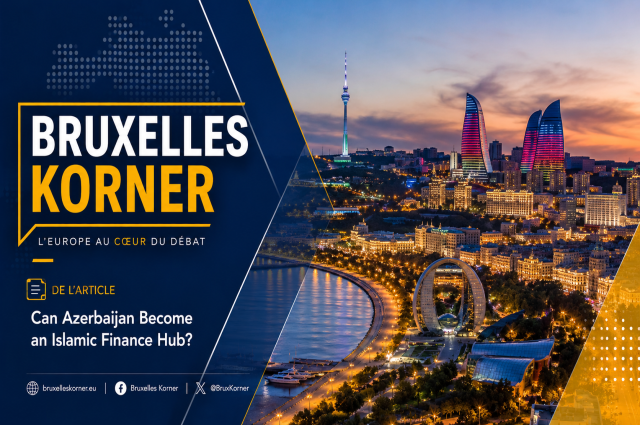
Can Azerbaijan Become an Islamic Finance Hub?
By Abdulhamid Hamid Al-Kba
Opinion Writer Specializing in Central Asian and Azerbaijani Affairs

One of the key messages from the 14th Private Sector Forum of the Islamic Development Bank Group in Baku is that Islamic finance is no longer just a tool for funding projects. It has become a broader platform for enhancing regional integration, connecting investments, and supporting sustainable development.
Hosting the forum in Baku for the second time since 2010 is no coincidence. It clearly reflects Azerbaijan’s growing role as a genuine bridge between the Gulf, Central Asia, and Europe. Thanks to its strategic location on the Middle Corridor and major investments in infrastructure and logistics, the country is seriously aiming to become a regional hub for trade and investment.
The report Rise of Azerbaijan: Economic and Investment Outlook, issued by ICCD Holding, presented encouraging figures. GDP grew from around $47.1 billion in 2018 to more than $76 billion in 2025. More importantly, the non-oil sector’s contribution reached 63%, compared to 52% seven years ago. This indicates tangible progress in economic diversification, even though the road ahead remains long.
Additionally, investments in fixed assets reached approximately $12.5 billion in 2025, while investments in the first quarter of 2026 rose by 14.9%. Positive expectations are focused on sectors such as logistics, agriculture, information technology, and tourism — precisely the areas that align with Azerbaijan’s vision of becoming a multi-dimensional regional center.
The partnership with the Islamic Development Bank is deep and ongoing. Since 1992, around $1.8 billion has been financed across 84 projects. On the sidelines of the forum, important agreements were signed, including the rehabilitation of the irrigation canal in Karabakh and a memorandum for a multi-year partnership strategy.
A noteworthy report by the IsDB Institute (IsDBI) and the International Islamic Trade Finance Corporation (ITFC) highlighted that GCC countries are the most likely source of foreign direct investment in Azerbaijan’s emerging Islamic banking and finance sector. This is not only due to the massive size of Islamic assets exceeding one trillion dollars, but also due to strategic factors: growing economic ties, Azerbaijan’s position on the Middle Corridor, and the increasing need for Sharia-compliant trade finance tools.
From an analytical perspective, if Azerbaijan succeeds in attracting a significant portion of these investments, the impact will not be limited to the financial sector. It could transform the country into a regional hub for Islamic finance, linking the Gulf, Central Asia, and the South Caucasus, adding a new financial and geo-economic dimension to its diversification efforts.
At the broader level, IsDB Group financing approvals reached $16 billion in 2025. A significant number, no doubt. However, the real challenge lies not in the volume of financing but in the ability to turn these figures into real projects on the ground that create jobs and generate tangible impact.
The launch of the Global Islamic Economists Program (GIEP) in Baku reflects an important realization: finance alone is not enough; building human capacities and connecting knowledge with practical policies are equally essential for sustainable development.
In this context, Azerbaijan is increasingly seen as having growing potential to play a pivotal role in regional cooperation in trade, investment, and sustainable development, especially amid declining financial flows from developed economies to the Global South.
Furthermore, the launch of a new platform for financing Sharia-compliant SMEs is an important step. It focuses on institutional capacity building, expanding the use of the national currency, and developing risk-sharing mechanisms. This reflects the evolution of Islamic finance toward more integrated models that support the productive sector.
No one can deny that Azerbaijan’s political and economic stability remains one of the strongest factors enhancing its attractiveness to foreign investment. In a region often affected by geopolitical uncertainty, this stability has enabled the country to develop modern infrastructure, implement investment-friendly policies, and strengthen its position as a reliable destination for regional and international capital.
Ultimately, the significance of the Baku 2026 Forum extends beyond the agreements signed during its sessions. It reflects Azerbaijan’s broader ambition to position itself at the intersection of trade corridors, investment flows, and emerging Islamic financial markets. Whether this ambition translates into long-term influence will depend on the country’s ability to convert its strategic advantages into sustainable economic partnerships that connect the Gulf, Central Asia, and the South Caucasus.














































Yorum Yazın
Facebook Yorum