




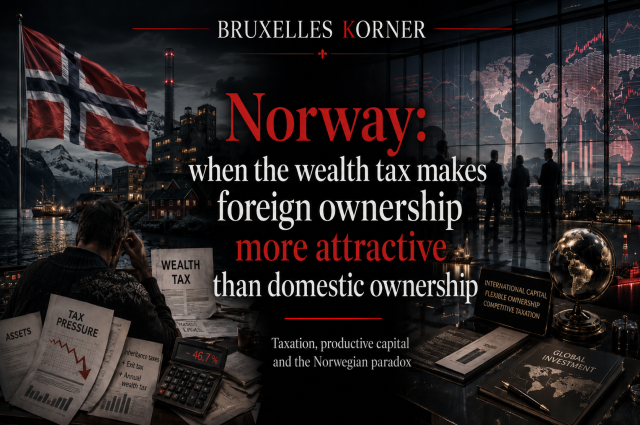
Norway Wants Domestic Ownership. Its Wealth Tax Rewards the Opposite
By Glenn Agung Hole
Institutional Economist and Associate Professor
In the Norwegian furniture town of Sykkylven, two companies expose one of the most uncomfortable contradictions in Norway’s economic model.
One is Ekornes, one of Norway’s best-known industrial companies and the producer behind brands such as Stressless. Since 2018, the company has been controlled through a structure ultimately dominated by China’s Qumei Home Furnishings Group. Ekornes itself reports that Qumei owns 94.12 per cent of Qumei Runto, which in turn owns the Norwegian holding company controlling Ekornes.

There is nothing inherently problematic about this. Norway needs foreign capital. Open economies depend on international investment, and foreign ownership can contribute technology, market access, capital and competence.
The problem emerges when Ekornes is compared with another furniture manufacturer in the same small Norwegian industrial community.
Brunstad Møbelfabrikk remains locally owned. Its principal owner, Olaug Strand Brunstad, has continued to support the family business through an exceptionally difficult period. The company accumulated losses of approximately NOK 23 million between 2022 and 2024. Yet those losses did not eliminate Brunstad’s personal wealth-tax liability. In August 2026, she told Aftenposten that, among the resources she had been forced to use to pay the tax, was the inheritance from her deceased son.
Consider what this means.
In one Norwegian municipality, a foreign-controlled owner can hold productive Norwegian industrial assets without the foreign shareholder, merely by virtue of that shareholding, generally becoming liable for Norwegian personal wealth tax. Meanwhile, a Norwegian resident owner of another local industrial company can face annual wealth taxation even when the underlying business has accumulated millions of kroner in losses.
The factories are in Norway. The workers are in Norway. The machinery is in Norway. The companies rely on the same roads, energy system, legal institutions, educational system and social infrastructure.
Yet the tax treatment of ownership can be fundamentally different.
This is not an argument that foreign investors should be taxed more heavily. Nor should the issue be carelessly described as straightforward nationality discrimination. Tax residence, legal ownership structures and nationality are different concepts, and international tax law is considerably more complex than political slogans suggest.
The institutional problem is nevertheless real.
Norway has created a system in which being a Norwegian tax resident can make private ownership of Norwegian productive capital more expensive than owning comparable Norwegian assets from abroad.
That is the Norwegian ownership paradox.
Norwegian residents are generally subject to taxation on their worldwide income and wealth. Persons who are not Norwegian tax residents normally have only limited Norwegian tax liability, covering specified Norwegian-source income and assets rather than a general liability for share wealth.
A foreign owner may, of course, face taxes in another jurisdiction. Any intellectually serious comparison must acknowledge this. Different countries tax capital, dividends, gains, inheritance and wealth in different ways.
But that does not remove the Norwegian policy question.
Why should Norway itself impose a recurrent ownership cost on its resident private owners that it does not generally impose on the foreign owner of the same category of Norwegian shares?
This matters because taxation does not merely collect revenue. It alters incentives, valuations and behaviour.
The Norwegian debate has too often reduced the wealth tax to an argument about whether “the rich” should contribute more. That framing may be politically effective, but institutionally it is shallow. A sophisticated tax system cannot be evaluated solely by asking how much revenue it raises from those who currently possess capital. It must also be judged by how it affects the processes through which capital is created, retained, reinvested and transferred across generations.
The central weakness of the Norwegian wealth tax is that the liability is not necessarily connected to realised income or available liquidity.
A privately owned industrial company may have substantial taxable value while its economic resources are tied up in machinery, buildings, inventory, employees, working capital and technology. The business can experience falling margins or outright losses without the taxable value of the owner’s shares disappearing accordingly.
The state sees taxable wealth.
The entrepreneur may see machines, payroll obligations, unsold inventory and a factory struggling through a downturn.
That difference is not semantic. It goes to the heart of ability to pay.
When a profitable company distributes sufficient dividends, an owner may finance wealth tax from current cash flow. When the company is losing money, the calculation changes. Tax must then be financed from somewhere else: personal savings, borrowing, the disposal of private assets, salary, dividends extracted from capital the company might otherwise retain—or, in an extreme case such as the one Brunstad describes, inherited family wealth.
At that point, the debate is no longer simply about whether a rate should be 0.8, 1.0 or 1.1 per cent.
A more fundamental question arises:
What exactly is being taxed when the tax itself must be financed by consuming capital outside the income generated by the asset being taxed?
That question explains why the Brunstad case has moved beyond ordinary tax politics and into the realm of property rights.
Brunstad and other business owners have argued in Norwegian legal proceedings that the cumulative, rather than merely annual, effect of wealth taxation can become confiscatory in their individual circumstances. Their pleadings explicitly state that they are not claiming that wealth taxation as such is universally incompatible with the Norwegian Constitution or the European Convention on Human Rights. Their argument is narrower and therefore considerably more serious: that, over time and in particular circumstances, its cumulative effects may amount to unlawful confiscation.
After their attempt to obtain substantive adjudication through the Norwegian system, Olaug Strand Brunstad and Lars Oscar Fossen Øvstegård brought the issue to the European Court of Human Rights in Strasbourg in June 2026. Their complaint concerns whether the accumulated burden of wealth taxation on productive capital can constitute a disproportionate interference with the protection of property under the European Convention.
The word confiscation needs to be treated with considerable care.
A tax is not confiscatory simply because taxpayers dislike it. Nor does a high tax automatically constitute an unlawful deprivation of property. Democratic states enjoy broad discretion to design fiscal systems, and the European human-rights framework recognises a wide governmental margin in taxation.
The relevant question is therefore not whether Norwegian wealth taxation is inherently confiscatory.
It is whether a recurrent tax that becomes persistently disconnected from income, liquidity and economic capacity to pay can, in an individual case, create a cumulative burden that approaches confiscation.
That is a legitimate legal question.
It is also an important institutional one.
The distinction matters because the rule of law is not concerned only with whether the state possesses formal authority to act. It is also concerned with proportionality, predictability and the relationship between public objectives and burdens imposed on individuals.
A mature state should therefore not formulate economic policy merely by asking where courts will eventually draw the outer legal boundary.
Good institutions should perform better than the minimum required to avoid losing in Strasbourg.
The Brunstad case is powerful precisely because it makes an abstract problem tangible. A company lost NOK 23 million across three years. Its owner nevertheless faced wealth-tax obligations and says she ultimately had to use inheritance from her deceased son to meet the burden.
Whether one supports or opposes wealth taxation, that should make us ask whether accounting wealth and economic capacity to pay have drifted too far apart.
It also raises a deeper question about domestic ownership.
Norway is rightly constrained in how it treats foreign investors. As part of the European Economic Area and an open international economy, it operates within rules governing capital movement, market access and non-discrimination.
Yet the resulting domestic structure contains a remarkable irony.
Norway cannot simply disadvantage foreign capital because it is foreign.
But through its own residence-based wealth tax, Norway can create conditions under which its own resident owners bear a tax cost that foreign ownership does not ordinarily incur in Norway.
This is not protection of domestic ownership.
It is almost the reverse.
The consequences may already be visible in migration patterns.
A 2026 NRK investigation identified 163 Norwegian business owners who had relocated to Switzerland since 2020. Before leaving, they had collectively paid approximately NOK 343 million in wealth tax based on the comparison used in the investigation.
Critics of the capital-flight argument have made a legitimate counterpoint: NOK 343 million represented only about two per cent of total Norwegian wealth-tax receipts in the comparison year, and the large majority of wealthy Norwegians have not left. Moreover, many of those who relocated still own Norwegian businesses, and only a small number had sold out completely.
These facts matter.
But they do not settle the question.
They reveal why a static fiscal perspective is insufficient.
The institutional significance of an owner cannot be measured solely by last year’s wealth-tax payment.
Capital is not just money. It is also knowledge, judgement, networks, investment capacity, relationships, entrepreneurial experience and control over future decisions.
When an owner moves abroad, a factory may remain in Norway.
The workers may remain.
The machines may remain.
For years, almost nothing visible may change.
But where will the next investment be made?
Where will the next holding company be located?
Where will the owner’s children establish their economic lives?
Where will the next generation of accumulated capital reside?
Where will the entrepreneur deploy new risk capital?
Where will the next company be founded?
These effects develop slowly, and this makes them difficult to capture in fiscal statistics.
A government can count people who leave.
It cannot count companies that were never established.
It can calculate foregone tax from an identifiable emigrant.
It cannot easily calculate the value of an investment that a mobile entrepreneur decides to make in Zurich, London, Dubai or Singapore rather than Norway ten years from now.
This distinction is familiar from institutional economics.
Albert O. Hirschman’s framework of exit, voice and loyalty reminds us that departure is not merely a private act. It is also information about the institution from which someone departs.
When internationally mobile owners leave, the appropriate response is therefore not automatically to celebrate them, condemn them or treat every departure as proof that taxation has failed.
It is to ask what the behaviour tells us.
Institutions create incentives.
People respond to incentives.
Strong institutions learn from those responses.
Norway has instead increasingly attempted to constrain the economics of departure through a tougher exit-tax regime. There may be legitimate fiscal reasons for doing so, particularly where large unrealised gains were accumulated while taxpayers benefited from Norwegian institutions.
But exit taxation cannot resolve the underlying institutional question.
There is an enormous difference between making it expensive to leave and making it attractive to stay.
The first is a barrier.
The second is institutional competitiveness.
The greatest long-term threat is therefore probably not the wealthy individual who has already created a fortune and moves to Switzerland.
It is the entrepreneur who has not yet created one.
A young founder can decide where to establish a company, raise capital, locate intellectual property, build a holding structure and ultimately reside long before a large taxable fortune exists.
If future entrepreneurs increasingly conclude that Norway is a good place in which to operate businesses but a comparatively poor place in which to accumulate long-term private ownership, the country may face a much deeper problem than billionaire migration.
There will be no dramatic exit.
The capital will simply never be built in Norway in the first place.
This is where the wealth-tax debate becomes a question of institutional capital.
Norway’s prosperity is not merely the product of natural resources or accumulated financial wealth. It is founded on institutions: trust, rule of law, predictable administration, skilled labour, functioning infrastructure, entrepreneurial competence and the long-term ability to coordinate capital and knowledge.
These assets have been accumulated over generations.
But institutional capital must be maintained and reproduced.
Prosperity is not inherited. It is reproduced.
The same is true of domestic industrial ownership.
A multigenerational family business represents more than the market or tax value of its shares. It contains tacit knowledge, supplier relationships, local legitimacy, organisational memory, patient capital and a willingness to continue through periods when a purely financial investor might rationally exit.
That does not make domestic family ownership inherently superior to foreign ownership.
It does mean it has institutional characteristics that public policy should understand before systematically increasing its relative cost.
This brings us back to Sykkylven.
The lesson is not that Chinese-controlled Ekornes should pay a Norwegian personal wealth tax equivalent to that of a local individual owner. That would miss the point entirely.
The question is why Norway has chosen to impose a recurrent ownership burden on its own tax-resident private owners that it does not generally impose on foreign holders of the same category of Norwegian productive assets.
One company can be foreign controlled and operate normally within Norwegian industry.
Another can remain locally owned, suffer NOK 23 million in accumulated losses and still leave its owner personally searching for liquidity to meet wealth taxation.
That comparison should trouble anyone concerned with the future structure of Norwegian ownership.
And when the owner says that paying the tax required her to draw on the inheritance of her deceased son, the debate should no longer be dismissed with the phrase “the rich must contribute”.
They should contribute.
The issue is not contribution.
The issue is institutional design.
A sustainable tax system must be capable of raising legitimate revenue without progressively undermining the productive capital, ownership incentives and long-term tax base on which the welfare state itself depends.
The ultimate question is therefore not how much wealth Norway can extract from existing owners today.
It is whether Norway’s institutions are capable of reproducing owners, entrepreneurs, investments and productive capital tomorrow.
Norway should welcome foreign capital.
But a country that wants strong domestic ownership should not design its institutions so that owning Norway from abroad can become more attractive than remaining an owner in Norway.
And a state should compete by giving productive owners reasons to stay—not by relying increasingly on the cost of leaving.
That is the difference between taxing prosperity and consuming the institutional foundations that create it.













































Yorum Yazın
Facebook Yorum