




Bruxelles Korner
Central Asia’s Blueprint for Moderate Islam and Institutional Reforms: Supreme Mufti of Kazakhstan
- Astana’s strategic alliance with Cairo and Al-Azhar Al-Sharif reinforces global efforts against radicalization
- Kazakhstan’s state policy of religious moderation stands as a pillar of regional stability and interfaith peaceful coexistence.

Amr YehiaAstana, Kazakhstan
In an era where Western Europe actively monitors models of secular governance, social cohesion, and moderate religious reform in Eurasia, Kazakhstan offers a compelling case study. The Central Asian nation has systematically cultivated a policy of Islamic moderation, state neutrality, and robust interfaith dialogue. Central to Astana's strategy is ensuring that religious education and fatwa issuing are grounded in systematic academic scholarship rather than radical fringe narratives—an effort strengthened through strategic cooperation with Egypt's historic Al-Azhar Al-Sharif.
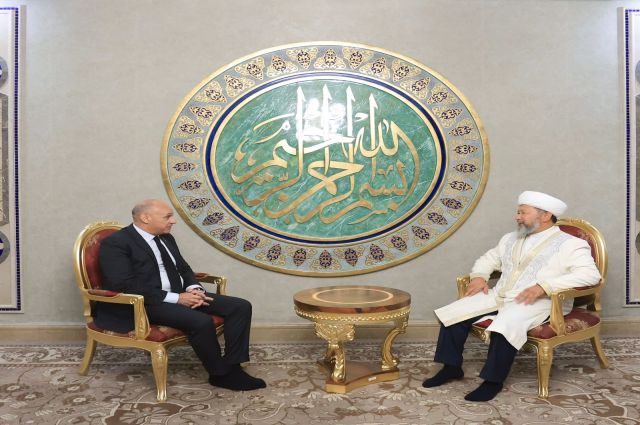
In an interview with Bruxelles Korner, Supreme Mufti Nauryzbay Kazhy Taganuly discusses Kazakhstan's moderate Islamic framework, democratic reforms under the 2026 Constitution, digital innovation in religious affairs, and institutional collaboration with Egyptian religious authorities.
Bruxelles Korner: A rich historical inheritance forms the bedrock of ties between Kazakhstan and Egypt. How does the Spiritual Administration of Muslims of Kazakhstan view this shared legacy today?
Supreme Mufti Nauryzbay Kazhy Taganuly: Ties between Kazakhstan and Egypt are rooted in centuries of spiritual continuity, most vividly embodied by Sultan Al-Zahir Baibars. As an extraordinary commander and statesman, his birth in the Kipchak steppe and subsequent rule in Egypt created a symbolic bridge between our peoples.
Today, Kazakhstan views Sultan Baibars’ legacy as a shared spiritual value. This bond is demonstrated through the joint restoration of his mosque in Cairo, executed across several phases by both nations. When introducing Baibars to youth, we emphasize his commitment to education, discipline, state-building, and justice. Beyond Baibars, our shared heritage encompasses Islamic jurisprudence, Hadith studies, theology, Arabic language, and philosophy. To transmit this to future generations, the optimal path lies in joint academic conferences, exhibitions, documentaries, and historical research expeditions.
.jpeg)
Bruxelles Korner: How do you evaluate current cooperation between Al-Azhar Al-Sharif and Kazakh institutions—particularly Nur-Mubarak University in Almaty—in promoting moderation and protecting youth from extremism?
Supreme Mufti Taganuly: We evaluate this cooperation as a vital pillar of religious education in Kazakhstan. Al-Azhar Al-Sharif maintains a centuries-old tradition based on the Quran, Sunnah, classical jurisprudence, rigorous scholarly analysis, and social stability. This expertise is crucial for Kazakhstan as we train specialists who combine authentic Islamic sciences with modern educational methodologies.
Nur-Mubarak University serves as a central bridge in this framework. We are currently discussing concrete proposals to elevate the university's international standing and expand its reach to leading scientific centers in Egypt. Extremist ideology arises from superficial readings of religious texts and a lack of systematic scholarship; sound religious education is our most effective preventive measure. Our ultimate goal is to nurture a generation possessing authentic religious awareness, civic responsibility, respect for law, and critical thinking against radical ideologies.
Bruxelles Korner: How do Al-Azhar graduates returning home enrich Kazakhstan’s religious and social fabric?

Supreme Mufti Taganuly: Kazakh youth studying in Egypt, particularly at Al-Azhar, represent a core spiritual link between our nations. During my official visit to Cairo, I met with our students, emphasizing their responsibility to utilize knowledge in service of their religion and homeland.
Upon returning, Al-Azhar graduates serve as imams, teachers, scholars, and researchers. Many assume key roles within the Spiritual Administration of Muslims of Kazakhstan, significantly raising public religious literacy. Their competitive edge lies in mastering classical Islamic sciences directly from original Arabic sources alongside exposure to diverse intellectual traditions. The Muslim community in Kazakhstan values Al-Azhar not merely as an educational institution, but as an irreplaceable historic school maintaining the continuity of Islamic knowledge.
Bruxelles Korner: Following your recent consultations with the Grand Mufti of Egypt in Cairo, what practical steps are being taken to harmonize fatwa methodologies to counter extremist narratives and address contemporary issues?
Supreme Mufti Taganuly: Our discussions in Cairo focused on enhancing cooperation in fatwa issuance and formulating unified, well-grounded scholarly positions on contemporary challenges. International cooperation in issuing fatwas has become critical, as modern issues transcend national borders.
In Kazakhstan, fatwas are issued systematically through our Sharia and Fatwa Department and Council of Scholars, ensuring alignment with Quranic texts, jurisprudence, and local Kazakh customs. In our collaboration with Egypt, five key areas take priority: regular scholarly consultations, joint academic seminars on contemporary issues, exchanges in fatwa methodology, academic materials refuting extremist arguments, and enhancing the quality of digital religious content. Our goal is not to force identical text across different societies, but to align methodology while respecting each community's unique context.
.jpeg)
Bruxelles Korner: Amid current global challenges, how do you evaluate bilateral cooperation within the Organisation of Islamic Cooperation (OIC) to advance peace and solidarity?
Supreme Mufti Taganuly: Kazakhstan and Egypt hold distinct positions in the Islamic world. Despite different geographical contexts, we share foundational values: peace, stability, religious tolerance, and inter-civilizational dialogue. The OIC provides a vital platform to project these shared values globally.
The Islamic world faces conflicts, humanitarian crises, extremism, Islamophobia, misinformation, and youth unemployment. The OIC’s role must extend beyond political dialogue to harness its intellectual, religious, and humanitarian potential. Kazakhstan’s experience in hosting the Congress of Leaders of World and Traditional Religions demonstrates our commitment to peace. Combined with Al-Azhar’s scholarly authority, our two nations can jointly advance religious awareness across the OIC framework. We advocate strengthening three core axes: peaceful diplomacy to prevent conflicts from assuming religious dimensions, youth education to shield young people from radicalization, and religious diplomacy among leading scholars.
Bruxelles Korner: As Kazakhstan undergoes constitutional and parliamentary shifts ahead of the Kurultai elections, how do you view these democratic reforms from a religious perspective?
Supreme Mufti Taganuly: Consultation (Shura) is a core Islamic principle of governance, alongside trust, justice, and social responsibility. Evaluating current constitutional reforms requires respecting the civil and legal nature of the state. While religion provides moral and human values, state institutions operate under the rule of law. Under the 2026 Constitution, the single-chamber Kurultai (Parliament) stands as the supreme legislative body of Kazakhstan.
The ultimate objective of any reform must be serving the public interest. Public office is a responsibility and a trust (Amanah), not a privilege; public trust is the highest asset for any state institution. When rule of law, integrity, and mutual respect take root, state stability and strength are naturally reinforced.
Bruxelles Korner: Kazakhstan hosts the global Congress of Leaders of World and Traditional Religions. How does the Spiritual Administration champion global interfaith dialogue?
Supreme Mufti Taganuly: Preserving Islamic identity and fostering interfaith dialogue are mutually reinforcing. An individual who deeply understands their faith is inherently inclined to respect the beliefs of others. Our support for the Astana Congress reflects Islam’s values of peace, mercy, justice, and human dignity.
Interfaith dialogue does not mean blurring theological boundaries; it establishes a culture of mutual respect despite differences. The Spiritual Administration enhances dialogue skills among imams, fosters peaceful relations with other confessions, and cultivates tolerance among youth. Islamic identity should manifest through moral conduct, integrity, family values, and service to the homeland. Vast opportunities exist to combine Al-Azhar’s expertise in interfaith dialogue with Kazakhstan’s domestic model of inter-ethnic harmony.
Bruxelles Korner: As Kazakhstan prepares to open Central Asia’s first Prophet’s Seerah Museum in Astana, how can this initiative advance cultural diplomacy and joint exhibitions with Egypt?
.jpeg)
Supreme Mufti Taganuly: The biography of Prophet Muhammad (PBUH) is a unifying spiritual heritage for the Islamic world. Establishing a dedicated museum in Astana is a strategic project presenting the spiritual values of Islamic civilization through an academic, historical, and educational lens.
This project opens promising horizons for cultural exchange with Egypt. Al-Azhar’s intellectual heritage and Cairo’s Islamic architecture provide a strong foundation for future joint exhibitions. Beyond housing artifacts, the museum will operate as an active research center. Inviting Egyptian museum experts and scholars to Kazakhstan while sending Kazakh researchers to Cairo will serve as an effective mechanism of soft-power cultural diplomacy, establishing a shared platform for Central Asia and the wider Islamic world.





















Yorum Yazın
Facebook Yorum