




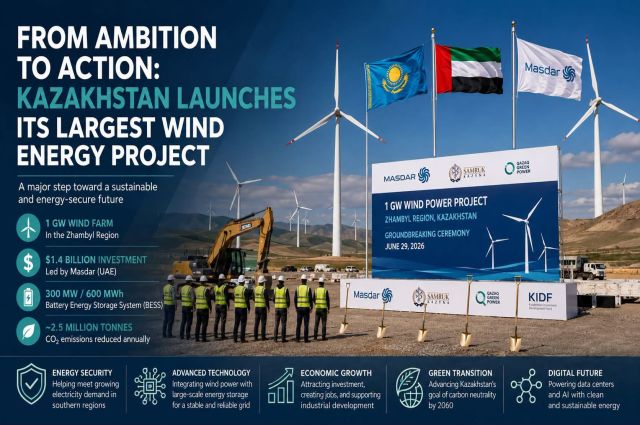
From Ambition to Action: Kazakhstan Launches Its Largest Wind Energy Project
By Abdul Hamid Hamid Al-Kaba
Opinion writer specializing in Central Asia and Azerbaijan affairs

For years, I have closely followed the transformations taking place in Central Asia, observing how the countries of the region are striving to move beyond their traditional dependence on fossil fuels toward a more sustainable energy future.
In this context, Kazakhstan stands out today as the most ambitious and one of the most advanced countries in the region. According to data from the International Renewable Energy Agency (IRENA), Central Asian countries achieved notable progress between 2015 and 2024, although fossil fuels continue to dominate their energy mix. By 2023, the region’s installed renewable energy capacity had exceeded 17.3 gigawatts, representing significant growth.
Kazakhstan has distinguished itself by setting the goal of achieving carbon neutrality by 2060 while successfully attracting substantial investments in solar and wind energy. According to the Ministry of Energy, electricity generated from renewable sources accounted for 6.43% of the country’s total electricity production by the end of 2024, compared with just 3% in 2020, reflecting steady and sustained growth. Installed renewable energy capacity has increased more than seventeenfold over the past decade, reaching approximately 3,082 megawatts.
The Kazakh government aims to increase the share of renewable electricity generation to 15% by 2030 through dozens of new projects.
On the sidelines of the Regional Environmental Summit (RES-2026) in Astana, Torar Alimzhan, Director of the Renewable Energy Sources Department at the Ministry of Energy, announced plans for a 500 MW wind farm in the Karaganda Region with Chinese investment, scheduled to become operational before 2029. He also revealed that feasibility studies are underway for an even larger 1 GW project in the Pavlodar Region. However, these initiatives now appear to have been only a prelude to a far more significant development.
On June 29, 2026, Kazakhstan officially launched construction of the largest wind farm in its history: a 1 GW facility in the southern Zhambyl Region with an investment of $1.4 billion, led by the UAE-based renewable energy company Masdar.
The Kazakh Ministry of Energy announced the launch following an official groundbreaking ceremony conducted via video conference between Astana and the project site in Zhambyl.
The ceremony was attended by Deputy Minister of Energy Sungat Yesimkhanov, Chairman of the Board of Samruk-Kazyna Nurlan Zakupov, and Masdar CEO Mohamed Jameel Al Ramahi. Bringing together senior representatives from both Kazakhstan and the United Arab Emirates, the virtual ceremony reflected the strategic depth of the partnership and demonstrated the strong level of coordination between both sides throughout the project’s implementation.

According to the Ministry of Energy, the $1.4 billion investment is expected to help alleviate electricity shortages in Kazakhstan’s southern regions, accelerate the development of renewable energy, and support the country’s long-term carbon neutrality strategy.
Deputy Minister Yesimkhanov stated:
“The partnership with Masdar contributes to the development of renewable energy and advances Kazakhstan’s progress toward carbon neutrality. This project will strengthen regional energy security and introduce advanced technologies to the renewable energy sector. We highly appreciate our partners’ commitment to investing in the country’s sustainable development, and we will provide all the necessary support to ensure the successful implementation of every stage of the project.”
One of the project’s most notable technological features is the integration of wind power generation with a large-scale Battery Energy Storage System (BESS) featuring 300 MW of power capacity and 600 MWh of storage capacity. This system is expected to improve grid reliability, stabilize electricity supplies despite fluctuations in wind generation, and better manage electricity demand during evening peak hours.
The investment consortium consists of Masdar (40%), W Solar (40%), Kazakhstan’s Qazaq Green Power—affiliated with the Samruk-Kazyna Sovereign Wealth Fund—(18%), and the Kazakhstan Investment Development Fund (KIDF) (2%).
On the same day, Masdar also signed a roadmap agreement with Kazakhstan’s Ministry of Digital Development to explore clean energy solutions for powering data centers and supporting artificial intelligence infrastructure.
This is where the broader strategic dimension of the partnership becomes evident. Kazakhstan seeks to build a modern digital economy powered by reliable and sustainable energy. Masdar, whose global renewable energy portfolio exceeds 65 GW and is expected to reach 100 GW by 2030, brings both international expertise and long-term investment capacity to support Astana’s ambitions.
As someone who closely follows developments across Central Asia, I view this project as a bold and commendable step. Nevertheless, it also presents challenges that should not be overlooked.
On the positive side, the project strengthens Kazakhstan’s energy security, facilitates the transfer of advanced technologies, and creates opportunities for additional foreign investment. While Emirati and Chinese investments provide considerable financial resources and technical expertise, they also require prudent management to ensure that national interests remain protected over the long term.
The strategic location of the Zhambyl Region, near Kazakhstan’s southern borders, makes it particularly well suited to meeting growing regional electricity demand. More broadly, Kazakhstan’s vast territory, abundant wind resources, and extensive areas suitable for solar energy provide exceptional natural advantages that position renewable energy as a strategic pillar of the country’s future development. These assets not only help address electricity shortages but also contribute to economic diversification and reduce dependence on traditional energy resources.
Another factor strengthening investor confidence is the package of constitutional reforms approved through the constitutional referendum of March 15, 2026. These reforms represent an important step toward reinforcing political stability, institutional modernization, and good governance.
Today, Kazakhstan is widely regarded as the leading country in Central Asia in terms of policy consistency, institutional stability, and long-term strategic vision, sending positive signals to international investors seeking predictable investment environments.
Based on my observations of developments across the region, including Azerbaijan, I believe that the success of renewable energy projects depends not only on the scale of investment but also on a country’s ability to develop domestic expertise, build supporting industries, and modernize electricity transmission networks and energy storage infrastructure. Although Kazakhstan has made remarkable progress, renewable energy still represents a relatively modest share of total electricity production. Achieving the country’s 2030 targets will therefore require continued investment in infrastructure alongside the development of national technical capabilities.

From an environmental perspective, the Zhambyl wind farm is expected to reduce carbon dioxide emissions by approximately 2.5 million tonnes annually, making a substantial contribution to Kazakhstan’s climate objectives. Full commercial operation of the facility is scheduled to begin during the third quarter of 2029.
Despite the challenges ahead, the Zhambyl project and Kazakhstan’s partnership with Masdar represent a powerful indication of the country’s determination to pursue a genuine energy transition. Kazakhstan is working to build a development model that integrates clean energy, digital transformation, and environmental sustainability.
The road ahead will undoubtedly be long and demanding, but the objective is attainable if Astana succeeds in transforming its ambitions into concrete achievements that benefit both its citizens and the wider Central Asian region.
I continue to follow these developments with great interest because the success of this project would represent more than a national achievement for Kazakhstan. It could become a model for renewable energy transformation throughout Central Asia.
If Astana delivers the project according to the announced timetable, Kazakhstan will have successfully moved from the stage of ambition to the stage of implementation.
I also recommend changing the title slightly for a more natural newspaper style:
From Ambition to Action: Kazakhstan Launches Its Largest Wind Energy Project
or
From Vision to Reality: Kazakhstan Launches Its Largest Wind Energy Project
Both read more naturally in English while preserving the intended meaning.
































Yorum Yazın
Facebook Yorum