
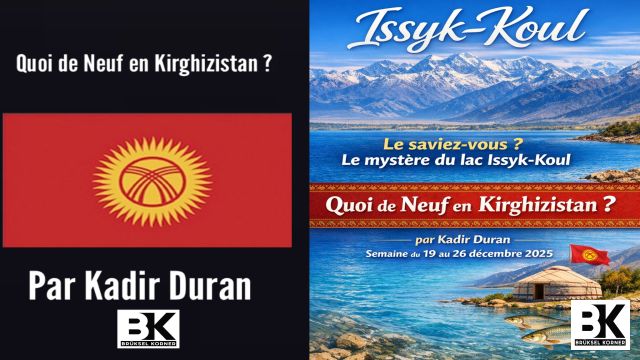




What’s New in Kyrgyzstan?
By Kadir Duran
Week of 19–26 December 2025
As 2025 draws to a close, Kyrgyzstan is marked by strengthened political dialogue, ambitious economic planning, a structured energy strategy, and regional sporting success. Here is an overview of the key developments of the week.

Society & Governance
The 4th Halk Kurultai Concludes Its Work in Bishkek
The 4th Halk Kurultai (People’s Assembly) officially concluded after two days of discussions at the T. Satylganov Philharmonic Hall in Bishkek. Nearly 700 delegates from across the country took part, in the presence of President Sadyr Japarov.
In total, 150 delegates addressed the assembly, presenting both oral and written proposals. These contributions, together with the President’s policy directions, were incorporated into the final resolution adopted at the end of the Kurultai.
According to Mambetkerim Chekirov, Chairman of the National Council of the Halk Kurultai, the Secretariat will now prepare a detailed action plan, to be transmitted via the Presidential Administration to relevant state bodies and local authorities.
The stated objective is to ensure concrete follow-up, strengthen civic participation, and firmly establish the Kurultai as a lasting platform for dialogue between the state and society.
Economy
A Record State Budget of USD 12.6 Billion for 2026
The Jogorku Kenesh, Kyrgyzstan’s Parliament, has approved the 2026 state budget, amounting to USD 12.6 billion, confirming the government’s growth-oriented trajectory.
Projected revenues: 551.2 billion soms
Projected expenditures: 550.8 billion soms
➡️ Expected surplus: 400 million soms (approximately USD 5 million)
Prime Minister Adylbek Kasymaliev emphasized that the budget reflects the results of consistent structural economic policies pursued in recent years.
Key indicators highlighted include:
GDP per capita, which reached USD 2,513 in 2024, an 86% increase compared to 2021;
a projection of over USD 2,800 in 2025;
a “B+” sovereign credit rating, reflecting increased credibility on international markets.
The mining sector remains a cornerstone of the economy. The nationalized Kumtor gold mine generated USD 397.4 million in profit in 2024, and USD 421.8 million during the first ten months of 2025.
A major social announcement accompanied the budget vote:
from 1 April 2026, salaries for teachers, doctors, social workers, cultural staff, sports professionals, and technical personnel will increase by at least 50%.
Looking Ahead to 2030
Under the National Development Program, the government aims for:
an average annual growth rate of 8%;
GDP per capita of USD 4,500;
a state budget of USD 30 billion by 2030.
⚡ Energy
Kyrgyzstan Targets Energy Independence
In a televised interview, Prime Minister Kasymaliev outlined the country’s energy challenges:
annual electricity consumption stands at 18.9 billion kWh, while domestic production is limited to 14 billion kWh, forcing Kyrgyzstan to import 4.3 billion kWh.
Currently, only about 10% of the country’s hydropower potential is being utilized. Several hydropower projects are underway, including the strategically important Kambar-Ata-1 dam, which also has regional significance for irrigation in neighboring countries.
The government is also investing heavily in renewable energy, particularly solar power:
more than 10 projects have been signed,
with a combined capacity exceeding 5,000 MW,
including the imminent launch of a 120-MW solar power plant in the Kemin region.
➡️ The stated goal: to achieve energy independence within the coming years.
Sports
Kyrgyz Women Win the CAVA Volleyball Cup
The Kyrgyzstan women’s national volleyball team won the Central Asian Volleyball Association (CAVA) Cup, held from 19 to 25 December in Malé, Maldives.
In the final, the Kyrgyz team defeated the host nation Maldives 3–1. The tournament, which also included Afghanistan and Bangladesh, confirmed the steady rise of women’s sports in Kyrgyzstan at the regional level.

Educational Spotlight
Did You Know? The Mystery of Lake Issyk-Kul
Located at an altitude of 1,607 meters, Lake Issyk-Kul is one of the few high-mountain lakes in the world that almost never freezes, even in winter.
This phenomenon is explained by several factors:
its slightly saline water,
its exceptional depth (up to 668 meters), which retains heat,
the absence of an outflowing river,
and a unique microclimate created by the surrounding Tian Shan mountains.
Issyk-Kul is also home to endemic fish species found nowhere else in the world, such as the Issyk-Kul marinka, chebak, and naked osman. Species introduced during the Soviet era, including trout and whitefish, now coexist with native fauna, which is officially protected.
In Kyrgyz, “Issyk-Kul” literally means “warm lake” a name that perfectly captures the essence of this natural jewel.
Conclusion
At the end of 2025, Kyrgyzstan is pursuing a clearly defined path:
institutional consolidation, assertive economic ambitions, accelerated energy transition, and growing regional visibility.
Together, these developments signal a Central Asian country determined to strengthen internal stability while asserting its place on the regional and international stage.
Kadir Duran
International columnist & analyst
Yorum Yazın