




Turkmenistan: 35 Years of Sovereignty
Derya Soysal
In 2026, Turkmenistan celebrates the 35th anniversary of its independence, a historic milestone that invites a deeper look at how a young state has sought stability, identity, and international relevance amid a shifting geopolitical landscape. The country declared independence in 1991 as the Soviet Union dissolved, immediately facing the dual challenge of state‑building at home and positioning abroad in a region bordered by new and old uncertainties—not least the civil conflict in neighboring Afghanistan and the global realignments following the Cold War. To consolidate its future, the country moved swiftly to stabilize governance and the economy, adopting policies designed to shield domestic development from external volatility and to anchor predictability for citizens and investors alike.

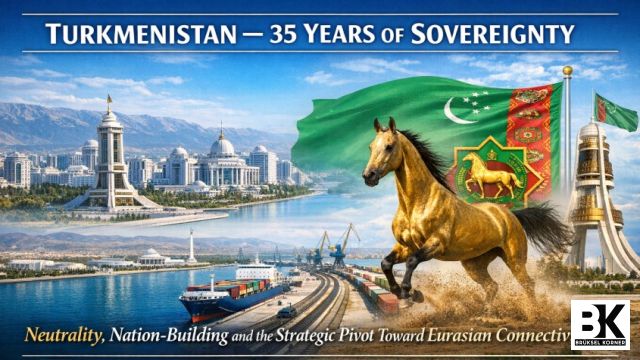
One emblematic step was the decision by the Mejlis (Parliament) to declare 2026 the Year of “Independent Neutral Turkmenistan – the Homeland of Purposeful Winged Horses.” Framed as both a tribute to sovereignty and to the iconic Akhal‑Teke horses, the designation underscores how nation‑building, cultural heritage, and economic strategy reinforce one another at a pivotal moment for the state.
The choice of motto is not merely ceremonial. It speaks to a broader policy architecture that Turkmenistan has refined over three and a half decades: permanent neutrality as international posture, nation‑building as internal compass, and connectivity as a practical route to prosperity—especially through the Middle Corridor (Trans‑Caspian International Transport Route) that links Central Asia to the South Caucasus, Türkiye, and Europe. Recent reporting, including Euronews’ analysis on Turkmenistan’s growing international engagement and openness—particularly around youth, education, and global partnerships—captures the way Ashgabat is reframing its image for long‑term collaboration.
Independence as the Core of State Policy
Independence is the strongest foundation of Turkmenistan’s state policy. This is more than a constitutional statement; it is a national sentiment. As Turkmen citizens often frame it, “independence is the most precious value”—a conviction expressed in the national anthem’s opening verses:
“My soul is a sacrifice to you, my beloved country,
The spirit of brave fathers is in my heart.
The light of a neutral and independent land,
Your flag is raised high before the world.”
Since 1991, Turkmenistan has aimed consistently at “new heights of development,” rolling out socioeconomic programs and public‑administration reforms to improve state capacity and public services. Official narratives stress that state policy—domestic and foreign—must first deliver for the people, a philosophy encapsulated in the principle “the state is for the people,” frequently associated with reform agendas over the past decades. A government commentary titled “Independence – a strong basis of the state policy of Turkmenistan” sets out this logic plainly, tying institutional reforms to rights protection and inclusive governance.
The main task of the domestic and foreign policy pursued by President Serdar Berdimuhamedov is to ensure the proper well‑being of Turkmen citizens. This is why, when you travel to Turkmenistan, you immediately notice that it is the only country in Central Asia where the visible remnants of the Soviet era are minimal, while national Turkmen brands dominate the public space. This reality reflects the results of the “state‑for‑the‑people” principle introduced through the reforms of Gurbanguly Berdimuhamedov.
Turkmenistan has placed strong emphasis on nation‑building, a process shaped by two main objectives: the unification of the various tribes and the gradual socio‑cultural de‑Russification of society, as highlighted in the academic research of Kuru, A. T. (2002).
As mentioned previously, Turkmenistan represents the most successful example of nation‑building in Central Asia, where one can truly feel the presence of a fully sovereign and culturally independent state. For instance, Turkmenistan was the first country in the region to establish its own national alphabet. The Cyrillic alphabet disappeared very quickly after independence, reflecting the country’s determination to consolidate a distinct national identity. Furthermore, since independence in 1991, the country has undergone significant transformation, including the development of a unique, largely closed political system and massive architectural projects in the capital, Ashgabat.
Nation‑Building and Historical Memory
The early phase of independence also entailed constructing a shared historical memory. In his writings, Saparmyrat Niyazov, Turkmenistan’s first president, anchored the identity of the new nation in centuries of Turkmen statecraft and heroism—invoking figures such as Atabegs, Sultan Alp Arslan, Prince Melik, and Melik Shah to present independence as both a return to roots and a project for the future. As the Ruhnama famously puts it:
“Our ancestors have always wished that the Turkmen people may lead a free, independent and peaceful life. Until their wishes came true, our people had to suffer many bloody wars in long periods. Hundreds of thousands of people sacrificed their lives for the fatherland and its independence.”
The thread linking historical sacrifice to modern sovereignty is not simply literary. It is deployed as a civic ethic, explaining why independence is defended so emphatically in public discourse and political rituals.
When Gurbanguly Berdimuhamedov came to power, his leadership focused on strengthening the sovereign state, often emphasizing the revival of national traditions and sustained economic growth. Indeed, under Berdimuhamedov’s strategy, Turkmenistan not only maintained a high level of energy independence but also demonstrated stable and consistent growth dynamics.
This objective of consolidating Turkmenistan’s independence and accelerating national development has continued to advance rapidly under the current president, Serdar Berdimuhamedov. For example, by the end of January–September 2025, the crude oil production plan was over-fulfilled by 109.7 percent, oil refining by 109.4 percent, and the output of the Ministry of Energy increased by 109.5 percent, according to DHA Press. President Serdar Berdimuhamedov has prioritized stability, infrastructure, and sectoral upgrades across energy, logistics, and manufacturing. Turkmenistan continues to strengthen its position as a key energy producer, with proven oil reserves reaching 600 million barrels as of January 1, 2025, according to the latest data from the U.S. Energy Information Administration (EIA).
Marking 35 Years of Independence: Culture, Cinema, and Diplomacy
The 35th anniversary has been widely celebrated at home and within diplomatic networks abroad. Embassies have hosted receptions themed around the 2026 national motto and the independence milestone, while cultural agencies have programmed a sequence of high‑visibility events. In Ankara, “Turkmenistan Film Days” (February 16–18, 2026), co‑organized with TURKSOY, spotlighted national cinema and cultural heritage—tying screenings and discussions to the year’s motto and to the centenary of “Türkmenfilm”.
Inside Turkmenistan, National Film Week in Ashgabat (February 16–22, 2026) was staged across major venues—the Ashgabat Cinema, the Turkmenistan and Watan cinema/concert centers, and the Mukam Palace—featuring restored classics and contemporary films produced during the independence era. Multiple outlets reported the program, including Orient, Zaman Türkmenistan and other cultural news platforms.
The Embassy of Turkmenistan in Tajikistan held an event dedicated to the 2026 motto and the 35th anniversary of Turkmenistan’s independence.
In February 4, the Embassy of Turkmenistan in Ukraine held a gala event in honor of the motto of the year and the anniversary of independence.
Country of Peace via Permanent Neutrality
One of the main achievements of Turkmenistan during the years of independence is its permanent neutrality, recognized by the UN in 1995 and reaffirmed by the UN General Assembly on March 21, 2025 (Resolution A/RES/79/274). The resolution highlights Turkmenistan’s contribution to regional dialogue, preventive diplomacy, and peacebuilding as well as its offer to host talks in support of Afghan reconciliation. This is demonstrated by the fact that the Resolution “On the Permanent Neutrality of Turkmenistan,” adopted on December 12, 1995, was incorporated into the country’s Constitution. Last year, Turkmenistan celebrated 30 years of permanent neutrality and declared it the Year of Peace and Trust, actively cooperating with the United Nations to promote peace throughout the world. As Shohrat W. and Bereket S. (2025) wrote in their academic research, “In an increasingly complex and interconnected world, where geopolitical tensions often dominate headlines, Turkmenistan stands as a beacon of stability and peaceful coexistence.”
Recent analyses elaborate how this stance supports economic outcomes. A 2025 policy brief produced for the Joint Chambers of Commerce (Switzerland–Eastern Europe, Central Asia, South Caucasus) argues that neutrality has directly supported domestic development by signaling stability and predictability, thereby crowding in long‑term investment and facilitating regional cooperation.
According to Iurie Moraru, Vice‑President of the Joint Chamber of Commerce Switzerland–Eastern Europe, Central Asia, South Caucasus (JCC), “International recognition of Turkmenistan’s neutrality gave the country a reputation for stability and peace. In fact, the nation’s permanently neutral status has proven very productive for its economic development, bolstering Turkmenistan’s role in regional stability and encouraging growth.”
Neutrality and the Middle Corridor: Why Turkmenistan Matters to Europe,
The independence of Turkmenistan holds significant importance for Europe. As a neutral country that promotes peace, Turkmenistan inspires confidence for long‑term partnerships. This is why Euronews writes in its article that: “Across Europe, interest in Central Asia is growing — from energy and transport cooperation to climate and connectivity. Turkmenistan, with its strategic location and neutral stance – non‑participation in armed conflicts or political alliances – is stepping up its international presence, positioning itself as a stable partner for the rest of the world.”
Turkmenistan’s geography and neutrality combine to make the country a credible connector across the Trans‑Caspian “Middle Corridor”, the multimodal route that extends from China and Central Asia through the Caspian Sea, Azerbaijan, Georgia, and Türkiye to Europe. European institutions have sharpened their focus on this corridor, commissioning a 2026 EU‑funded meta‑study that maps the investment needs to modernize transport, energy, and digital links from Central Asia to the South Caucasus and Türkiye—an explicit push to rebalance trade routes and scale infrastructure where it matters most.
The port of Turkmenbashi and the development of the connectivity
At the bilateral and sub‑regional level, momentum is tangible. Georgia and Turkmenistan have publicly discussed deeper transport and transit cooperation within the Middle Corridor framework, with officials pointing to competitiveness gains for the East–West route. Reports in late 2025 highlighted increased coordination and the economic upside of accelerated freight and port partnerships. Related coverage underscores strategic conversations between Tbilisi and Ashgabat, signaling alignment on logistics development and the Trans‑Caspian route’s potential.
The trade data also moves in the same direction. In 2024, Turkmenistan–Kazakhstan trade was reported at $555.7 million, with partner agencies noting notable increases in Turkmen exports to Kazakhstan, including natural gas volumes—evidence of deeper energy ties that underpin the corridor’s viability. With Türkiye, official and semi‑official sources note that the 2023 trade volume reached about $2.6 billion, with ambition to double to $5 billion; in 2024 the bilateral trade figure stood around $2.166 billion, reflecting a slight pullback but sustained cooperation on energy and logistics.
The practical anchor for Turkmenistan’s role is the modernized Turkmenbashi International Seaport on the Caspian Sea, designed to serve as a key multimodal node linking rail and road routes to the South Caucasus and onward to Europe. In effect, neutrality plus infrastructure plus pro‑connectivity diplomacy gives Turkmenistan a predictable profile for international investors and shippers seeking risk‑managed east‑west options. This is precisely the kind of strategic profile that Euronews identified when describing growing European interest in Central Asia’s connectivity, climate, and energy cooperation—with Turkmenistan “stepping up its international presence” from the vantage of a neutral, stable partner.
Independence in the National Soul: The Akhal‑Teke Horses
Independence and identity find perhaps their most powerful symbol in the Akhal‑Teke horse, celebrated in national imagery and depicted on the State Emblem of Turkmenistan. In 2026, the choice of yearly motto resonates even more strongly because it coincides with the Year of the Horse in the Eastern calendar—“purposeful winged horses” being a poetic title for the Akhal‑Teke’s endurance, elegance, and brilliance. In a milestone of international recognition, the “Art of Akhal‑Teke horse breeding and traditions of horses’ decoration” was inscribed by UNESCO in 2023 on the Representative List of the Intangible Cultural Heritage of Humanity.
UNESCO’s write‑up emphasizes the breed’s distinctive features—large size, intelligence, agility, strength, and a metallic sheen—as well as the customs around naming, beauty contests, wedding traditions, and equestrian games that are transmitted through both informal practice and formal education. In October 2024, UNESCO’s certificate award ceremony in Arkadag highlighted the inscription’s cultural and diplomatic significance, reflecting how equine heritage serves both identity and soft power.
Historical and ethnographic accounts have long observed the depth of the Turkmen bond with the horse. Renowned for their strength, elegance, and endurance, Akhal‑Teke horses occupy a central place in Turkmen history and are proudly depicted on the State Emblem of Turkmenistan. These “heavenly horses,” known for their distinctive metallic sheen and remarkable stamina, are a national symbol. During the Independence Day festivities, visitors can expect thrilling horse races and equestrian performances at the hippodromes. Riders, often performing complex acrobatic feats, showcase the deep historical bond between the Turkmen people and their horses, as noted by Rush, C. (2025, December 15). Today, the Akhal‑Teke is considered one of the rarest and most highly prized horse breeds in the world. Seen as a true cultural treasure, its image is featured on Turkmenistan’s national emblem as a symbol of freedom, according to Esenov Batyr.
The horse holds a fundamental place in Turkmen culture. French officer Henri de Couliboeuf de Blocqueville (2000: 70–71) observed:
“Turkmens constantly engage with their horses without tiring or resting. They care for their horses as carefully as for their own eyes and show extraordinary concern for their health. I once saw a Turkmen who had fallen from his horse and was badly injured. Despite his condition, he crawled with great effort to his horse and cut the veins in its forelegs so that the animal he loved like his own life would not fall into enemy hands.”
Moreover, the first President of Turkmenistan, Saparmyrat Niyazow, wrote in his book Ruhnama that Turkmen horses are a symbol of independence:
“The nomadic horse is a means of survival in the mortal world. It is the measure of freedom and independence, since no power can hold back or dominate a Turkmen riding it.”
We can therefore say with certainty that the horse has always been a measure of both material and spiritual values for the Turkmen people.

EU-Turkmenistan Business Forum
A recurring theme in Turkmen policy is that economic sovereignty reinforces political independence. Energy is central to this approach. In parallel, Turkmenistan will host the first EU-Turkmenistan Business Forum in March 2026. Turkmenistan is now a crucial partner not just for the EU but also for Asia, and the USA.
A few days ago, National Leader of the Turkmen people and Chairman of the Halk Maslahaty (People's Council), Gurbanguly Berdimuhamedov, began an official visit to the US, marking a significant step in strengthening bilateral relations between the two countries.
Conclusion
Thirty‑five years after independence, Turkmenistan presents itself as a stable, neutral, and culturally self‑confident state seeking pragmatic paths to prosperity. Under President Serdar Berdimuhamedov, the government has pursued a model of social consensus, economic modernization, and carefully curated international engagement, aligning neutrality with connectivity and nation‑building with economic openness.
For Europe and the wider region, Turkmenistan’s permanent neutrality and strategic geography make it a natural node in the Middle Corridor, a route that European institutions are now backing with plans, platforms, and (increasingly) capital. The combination of predictable governance, cultural cohesiveness, and multimodal infrastructure—symbolized in the gleam of the Akhal‑Teke, the “purposeful winged horse”—points to a durable niche for Turkmenistan: a trusted, non‑aligned connector between Central Asia and Europe that leverages peaceful posture into tangible economic opportunity.
Looking ahead, the imperative is clear. By continuing to translate neutrality into connectivity, and heritage into soft power, Turkmenistan can transform its 35‑year milestone into a multi‑decade strategy—one that secures prosperity at home while re‑drawing the maps of Eurasian trade in ways that benefit partners across the Caspian and beyond.
BIBLIOGRAPHY
Caspian Post. (2026, February 17). Turkmen People’s Council head arrives in US for key visit. https://caspianpost.com/turkmenistan/turkmen-people-s-council-head-arrives-in-us-for-key-visit
DHA Press. (n.d.). [Article on Turkmenistan’s strategy and regional cooperation]. https://www.dhapress.com/en/news/world/32950
EciEco. (2026, January 1). Turkmenistan declares 2026 as the Year of “Independent Neutral Turkmenistan – the Homeland of Purposeful Winged Horses”. https://www.ecieco.org/en/news/10743/Turkmenistan-Declares-2026-as-the-Year-of-Independent-Neutral-Turkmenistan-the-Homeland-of-Purposeful-Winged-Horses
Euronews. (2025, August 8). Turkmenistan at 30: A legacy of welcome, a future of progress. https://www.euronews.com/culture/2025/08/08/turkmenistan-at-30-a-legacy-of-welcome-a-future-of-progress
Esenov, B. (2025, April 28). The Akhal‑Teke horses – the golden heritage of Turkmenistan. Institute of International Relations of the MFA of Turkmenistan. https://iirmfa.edu.tm/en/sahypa/the-akhal-teke-horses-the-golden-heritage-of-turkmenistan_8703
International Diplomat. (n.d.). [Article n°774]. https://internationaldiplomat.com/archives/774
Isayev, K. (2025, November 23). Georgia, Turkmenistan strengthen cooperation on Middle Corridor. Caliber.Az. https://caliber.az/en/post/georgia-turkmenistan-strengthen-cooperation-on-middle-corridor
Kuru, A. T. (2002). Between the state and cultural zones: nation building in Turkmenistan. Central Asian Survey, 21(1), 71-90.
Ministry of Foreign Affairs of Turkmenistan. (2026, February 18). Turkmenistan Film Days held in Türkiye. https://www.mfa.gov.tm/en/news/5898
Moraru, I. (2025). Turkmenistan’s permanent neutrality: A foundation for economic growth and business cooperation [PDF]. Joint Chambers of Commerce. https://jointchambers.ch/wp-content/uploads/2025/06/Turkmenistans-Permanent-Neutrality-A-Foundation-for-Economic-Growth-and-Business-Cooperation.pdf
Rush, C. (2025, December 15). Turkmenistan Independence Day 2026: History & traditions. Remitly. https://www.remitly.com/blog/lifestyle-culture/turkmenistan-independence-day/
Shohrat, W., & Bereket, S. (2025). THREE DECADES OF PEACE: CELEBRATING THE 30TH ANNIVERSARY OF TURKMENISTAN'S PERMANENT NEUTRALITY. IN SITU, (6), 62-64.
Soysal,D . (n.d.). The role of permanent neutrality in Turkmenistan’s foreign policy. EUReflect https://www.eureflect.com/the-role-of-permanent-neutrality-in-turkmenistans-foreign-policy
Turkmenistan Info. (n.d.). В Туркменистане…
https://turkmenistaninfo.gov.tm/en/news/v-turkmenistane-proi-1
Turkmenistan Golden Age. (2026, February 14). The Embassy of Turkmenistan in Tajikistan held an event dedicated to the 2026 motto and the 35th anniversary of Turkmenistan’s independence. https://www.turkmenistan.gov.tm/en/post/103267/embassy-turkmenistan-tajikistan-held-event-dedicated-2026-motto-and-35th-anniversary-turkmenistans-independence
Turkmenistan Info. (n.d.). Posolstvo Turkmenistana… https://turkmenistaninfo.gov.tm/en/news/posolstvo-turkmenis
Turkmenistan State News Agency. (2023, September 11). Independence – a strong basis of the state policy of Turkmenistan. https://turkmenistan.gov.tm/en/post/75439/independence-strong-basis-state-policy-turkmenistan
Turkmenistan Altyn Asyr. (2021, July 2). Akhal-Teke horses – the soul of the Turkmens. https://turkmenistan.gov.tm/ru/post/55539/akhal-teke-horses-soul-turkmens
Trend News Agency. (2025, February 13). EIA confirms Turkmenistan’s rising oil reserves. World‑Energy. https://www.world-energy.org/article/49577.html
UNESCO. (2023). Art of Akhal‑Teke horse breeding and traditions of horses’ decoration (Intangible Cultural Heritage, Representative List). https://ich.unesco.org/en/RL/art-of-akhal-teke-horse-breeding-and-traditions-of-horses-decoration-01978
BIBLIOGRAPHY
Caspian Post. (2026, February 17). Turkmen People’s Council head arrives in US for key visit. https://caspianpost.com/turkmenistan/turkmen-people-s-council-head-arrives-in-us-for-key-visit
DHA Press. (n.d.). [Article on Turkmenistan’s strategy and regional cooperation]. https://www.dhapress.com/en/news/world/32950
EciEco. (2026, January 1). Turkmenistan declares 2026 as the Year of “Independent Neutral Turkmenistan – the Homeland of Purposeful Winged Horses”. https://www.ecieco.org/en/news/10743/Turkmenistan-Declares-2026-as-the-Year-of-Independent-Neutral-Turkmenistan-the-Homeland-of-Purposeful-Winged-Horses
Euronews. (2025, August 8). Turkmenistan at 30: A legacy of welcome, a future of progress. https://www.euronews.com/culture/2025/08/08/turkmenistan-at-30-a-legacy-of-welcome-a-future-of-progress
Esenov, B. (2025, April 28). The Akhal‑Teke horses – the golden heritage of Turkmenistan. Institute of International Relations of the MFA of Turkmenistan. https://iirmfa.edu.tm/en/sahypa/the-akhal-teke-horses-the-golden-heritage-of-turkmenistan_8703
International Diplomat. (n.d.). [Article n°774]. https://internationaldiplomat.com/archives/774
Isayev, K. (2025, November 23). Georgia, Turkmenistan strengthen cooperation on Middle Corridor. Caliber.Az. https://caliber.az/en/post/georgia-turkmenistan-strengthen-cooperation-on-middle-corridor
Kuru, A. T. (2002). Between the state and cultural zones: nation building in Turkmenistan. Central Asian Survey, 21(1), 71-90.
Ministry of Foreign Affairs of Turkmenistan. (2026, February 18). Turkmenistan Film Days held in Türkiye. https://www.mfa.gov.tm/en/news/5898
Moraru, I. (2025). Turkmenistan’s permanent neutrality: A foundation for economic growth and business cooperation [PDF]. Joint Chambers of Commerce. https://jointchambers.ch/wp-content/uploads/2025/06/Turkmenistans-Permanent-Neutrality-A-Foundation-for-Economic-Growth-and-Business-Cooperation.pdf
Rush, C. (2025, December 15). Turkmenistan Independence Day 2026: History & traditions. Remitly. https://www.remitly.com/blog/lifestyle-culture/turkmenistan-independence-day/
Shohrat, W., & Bereket, S. (2025). THREE DECADES OF PEACE: CELEBRATING THE 30TH ANNIVERSARY OF TURKMENISTAN'S PERMANENT NEUTRALITY. IN SITU, (6), 62-64.
Soysal,D . (n.d.). The role of permanent neutrality in Turkmenistan’s foreign policy. EUReflect https://www.eureflect.com/the-role-of-permanent-neutrality-in-turkmenistans-foreign-policy
Turkmenistan Info. (n.d.). В Туркменистане…
https://turkmenistaninfo.gov.tm/en/news/v-turkmenistane-proi-1
Turkmenistan Golden Age. (2026, February 14). The Embassy of Turkmenistan in Tajikistan held an event dedicated to the 2026 motto and the 35th anniversary of Turkmenistan’s independence. https://www.turkmenistan.gov.tm/en/post/103267/embassy-turkmenistan-tajikistan-held-event-dedicated-2026-motto-and-35th-anniversary-turkmenistans-independence
Turkmenistan Info. (n.d.). Posolstvo Turkmenistana…https://turkmenistaninfo.gov.tm/en/news/posolstvo-turkmenis
Turkmenistan State News Agency. (2023, September 11). Independence – a strong basis of the state policy of Turkmenistan. https://turkmenistan.gov.tm/en/post/75439/independence-strong-basis-state-policy-turkmenistan
Turkmenistan Altyn Asyr. (2021, July 2). Akhal-Teke horses – the soul of the Turkmens. https://turkmenistan.gov.tm/ru/post/55539/akhal-teke-horses-soul-turkmens
Trend News Agency. (2025, February 13). EIA confirms Turkmenistan’s rising oil reserves. World‑Energy. https://www.world-energy.org/article/49577.html
UNESCO. (2023). Art of Akhal‑Teke horse breeding and traditions of horses’ decoration (Intangible Cultural Heritage, Representative List). https://ich.unesco.org/en/RL/art-of-akhal-teke-horse-breeding-and-traditions-of-horses-decoration-01978
Yorum Yazın