





Tokayev Outlines Foreign Policy, Reform Agenda for 2026 in Interview
By Ayana Birbayeva in Editor’s Picks, International on 5 January 2026
ASTANA – In the second half of 2025, Kazakhstan’s foreign policy gained particular momentum, marked by President Kassym-Jomart Tokayev’s intensive schedule of high-level international engagements across Asia, Europe, the Middle East, and the United States. Tokayev said the pace and geography of these contacts reflect Kazakhstan’s growing international standing and demand as a responsible actor in global affairs.

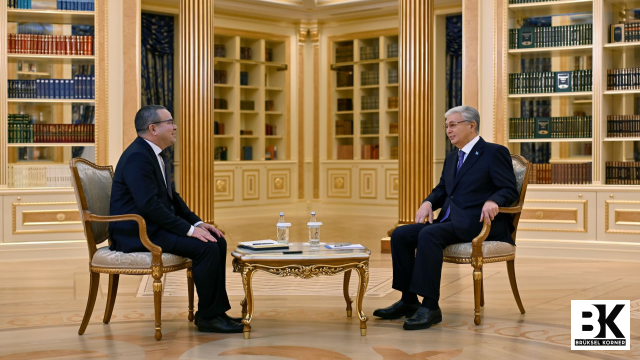
Tokayev emphasized balanced diplomacy in his recent interview with the Turkistan newspaper on Jan. 5. Photo credit: Akorda.
Summary – in English
In an interview with the Turkistan newspaper on January 5, 2026, Kazakh President Kassym-Jomart Tokayev outlined the key directions of Kazakhstan’s foreign policy, economic priorities, and reform agenda for the year ahead.
On the international front, Tokayev highlighted the significant acceleration of Kazakhstan’s diplomatic activity in the second half of 2025, marked by numerous high-level visits across Asia, Europe, the Middle East, and the United States, as well as regular meetings with foreign leaders in Astana. According to the president, this momentum reflects Kazakhstan’s growing credibility and demand as a responsible and constructive actor in global affairs. He reaffirmed the country’s commitment to a balanced, independent, and principled foreign policy, shaped by its strategic geographic position at the heart of Eurasia.
Tokayev stated that he has no ambition to act as an international mediator or to return to a role at the United Nations, despite receiving proposals from several countries. He nevertheless confirmed his participation in discreet, behind-the-scenes consultations with other leaders, stressing that such work is conducted without media exposure and far from any populist approach.
Transit and logistics were presented as a central pillar of Kazakhstan’s long-term strategy. Despite being landlocked, the country aims to leverage its central location by developing large-scale rail and road infrastructure and positioning itself as a major Eurasian transport hub. Tokayev noted that twelve international transport corridors cross Kazakhstan, carrying a significant share of overland trade between China and Europe. He emphasized Kazakhstan’s active involvement in the Belt and Road Initiative, the North–South corridor, and the Trans-Caspian International Transport Route, while welcoming China’s participation in the Middle Corridor, all while acknowledging intensifying geopolitical competition in the logistics sector.
On domestic politics, Tokayev dismissed speculation surrounding meetings between former President Nursultan Nazarbayev and Russian President Vladimir Putin, describing them as personal and informal. He reiterated his recognition of Nazarbayev as the founder of modern Kazakh statehood, while reaffirming that Kazakhstan’s current objective is to build a state based on justice, the rule of law, and fair institutional accountability.
Regarding political reforms, the president rejected claims that parliamentary changes are driven by personal political calculations. He stressed that all major reforms are submitted to nationwide referendums and confirmed that political reforms will continue. A major constitutional reform process is underway, with amendments of a scale comparable to the adoption of a new constitution already announced.
Looking ahead, Tokayev described the coming year as a defining moment for Kazakhstan. Reflecting on 35 years of independence, he stated that the country has overcome external skepticism to emerge as a stable state with a dynamic economy and growing international authority, while emphasizing that significant work remains ahead and will require the joint efforts of experienced professionals and younger generations.
En résumé – en français
Dans un entretien accordé au quotidien Turkistan le 5 janvier 2026, le président kazakh Kassym-Jomart Tokaïev dresse les grandes lignes de la politique étrangère, des priorités économiques et du calendrier des réformes du Kazakhstan pour l’année à venir.
Sur le plan international, Tokaïev souligne l’intensification notable de l’activité diplomatique kazakhe en 2025, marquée par de nombreux déplacements de haut niveau en Asie, en Europe, au Moyen-Orient et aux États-Unis, ainsi que par l’accueil de dirigeants étrangers à Astana. Cette dynamique reflète, selon lui, la montée en crédibilité du Kazakhstan comme acteur responsable et recherché sur la scène mondiale. Il insiste sur une diplomatie équilibrée, indépendante et pragmatique, adaptée à la position géographique stratégique du pays au cœur de l’Eurasie.
Le président précise ne nourrir aucune ambition personnelle de médiation internationale ou de retour aux Nations unies, malgré certaines sollicitations. Il indique toutefois participer régulièrement à des consultations discrètes entre dirigeants, loin de toute mise en scène médiatique, revendiquant une approche non populiste de la diplomatie.
Sur le plan économique et géostratégique, Tokaïev place le transit et la logistique au cœur de la stratégie nationale. Bien que dépourvu d’accès maritime, le Kazakhstan entend capitaliser sur sa position centrale en développant de vastes infrastructures ferroviaires et routières, et en s’affirmant comme un hub majeur entre la Chine et l’Europe. Le pays est aujourd’hui traversé par douze corridors de transport internationaux et participe activement aux grandes initiatives eurasiatiques, dont la Belt and Road Initiative, le corridor Nord-Sud et la route transcaspienne, tout en accueillant l’implication chinoise dans le corridor médian.
Sur le plan politique intérieur, Tokaïev rejette les spéculations autour des rencontres entre l’ancien président Noursoultan Nazarbaïev et Vladimir Poutine, qu’il qualifie de personnelles et informelles. Il reconnaît le rôle historique de Nazarbaïev dans la construction de l’État kazakh moderne, tout en réaffirmant la volonté actuelle de bâtir un État fondé sur la justice, le droit et l’évaluation équitable des responsabilités.
Concernant les réformes institutionnelles, le président dément toute manœuvre politique dissimulée derrière les réformes parlementaires et rappelle que les changements majeurs sont soumis à référendum national. Il confirme la poursuite des réformes politiques et annonce qu’un vaste chantier constitutionnel est engagé, d’une ampleur comparable à l’adoption d’une nouvelle Constitution.
Enfin, Tokaïev qualifie l’année à venir de décisive pour l’avenir du Kazakhstan. Revenant sur les 35 ans d’indépendance du pays, il affirme que le Kazakhstan a démenti les pronostics pessimistes pour s’imposer comme un État stable, économiquement dynamique et reconnu sur la scène internationale, tout en soulignant l’ampleur du travail restant à accomplir, notamment avec l’implication des jeunes générations.

In his Jan. 5 interview with the Turkistan newspaper, Tokayev noted that, in addition to outbound visits, Astana hosted leaders for talks consistently focused on economic cooperation, investment, and global coordination. As a result of these engagements, documents to develop Kazakhstan’s priority sectors were signed last year.
“I have no desire whatsoever to act as a mediator in international disputes, nor do I have any aspiration to return to work at the UN, despite approaches from several countries. However, I do take part in closed consultations and discussions, especially since heads of a number of states are interested in my opinion. I do not need media coverage of this important work, I am far from populism. It seems that for participants in behind-the-scenes consultations, this point is also important,” President Tokayev said.
Tokayev stressed that Kazakhstan’s geographic position obliges the country to pursue a balanced, independent, and principled foreign policy, including active participation in shaping global discussions. He recalled outlining Kazakhstan’s position on reforming the UN during the UN General Assembly’s 70th anniversary session.
Transit and logistics as a strategic priority
Tokayev described transit and logistics as a cornerstone of Kazakhstan’s long-term strategy, emphasizing the country’s unique position at the crossroads of major continental routes.
“For our country, strengthening its transit and logistics potential is a task of strategic importance. Despite having no direct access to the sea, Kazakhstan is located at the center of the Eurasian continent at the intersection of most transit corridors. This is a major advantage that we must skillfully use for the benefit of the country,” he said.
According to him, Kazakhstan aims to transform itself into a major transport hub of Eurasia, supported by large-scale rail and road infrastructure projects, including new railway lines and the Center–West highway, which will significantly shorten travel distances between regions.
Kazakhstan has also developed a transport system that extends beyond its borders, forming a network of cargo terminals stretching from the Yellow Sea to the Black Sea. Tokayev also emphasized that 12 international transport corridors pass through the country, handling the majority of land freight between China and Europe.
“Of course, all this does not mean that we can count on easy revenues. Competition in this sector is intensifying, since transport and logistics have become an integral part of geopolitics,” he said.
Tokayev highlighted that Kazakhstan remains actively engaged in developing the Belt and Road Initiative, the North–South corridor, and the Trans-Caspian International Transport Route, while welcoming China’s participation in the Middle Corridor.
Political continuity and reforms
Addressing public speculation surrounding meetings between Kazakhstan’s First President Nursultan Nazarbayev and Russian President Vladimir Putin, Tokayev said such encounters are informal and personal in nature. He reiterated his long-held assessment of Nazarbayev’s historical role while distancing himself from speculation about power transition scenarios.
“I am not interested in the content of such conversations and never ask questions about them. As for the personality of Nazarbayev, I have repeatedly spoken of him as the founder of modern Kazakh statehood. His merits in creating state institutions, market mechanisms in the economy, and building the new capital are obvious. We want to turn Kazakhstan into a territory of justice, law, and order. Therefore, the work of every citizen should be assessed fairly, without personal bias. This also applies to Nazarbayev, the First President of our country,” he said.
Tokayev rejected claims that parliamentary reform is designed to elevate the speaker’s role for personal political purposes, calling such assertions unfounded.
“The discussion of all reforms most important for the country is put to a nationwide referendum. There are no hidden meanings here. My position is well known – political reforms will continue. Some long-term plans, as always, will be announced soon,” he said.
A defining year ahead
Looking forward, Tokayev described the coming year as decisive, with major political developments expected to shape Kazakhstan’s trajectory for decades. He confirmed that a constitutional reform referendum has already been announced and that work is underway on extensive amendments on a scale comparable to adopting a new constitution.
Reflecting on Kazakhstan’s 35 years of independence, Tokayev said the country has overcome skepticism and external doubts through sustained state-building and reform.
“Reality has refuted those forecasts. Kazakhstan has emerged as a successful state with a dynamically developing economy and authoritative international positions. But ahead lies a colossal volume of work that must be carried out by both experienced professionals and young people,” he said.
The Turkistan newspaper has been in circulation for more than three decades and is one of Kazakhstan’s most influential print publications. In addition to covering current developments in the country, its journalists maintain a strong focus on Turkic-related themes.
Yorum Yazın