
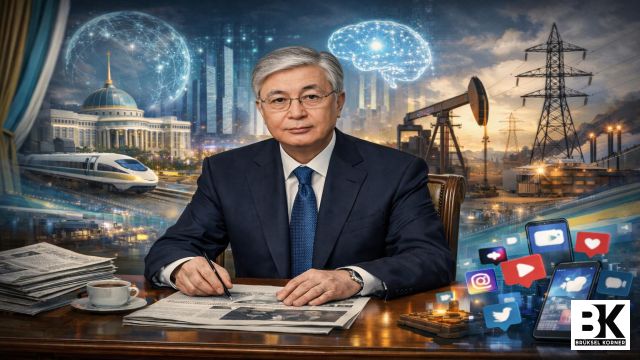





President of the Republic of Kazakhstan Kassym-Jomart Tokayev: KAZAKHSTAN HAS ENTERED A NEW STAGE OF MODERNISATION
5 January 2026

Summary in English – Interview with President Kassym-Jomart Tokayev (5 January 2026)
President of the Republic of Kazakhstan Kassym-Jomart Tokayev states that the country has entered a new, irreversible stage of modernisation, characterised by deep structural reforms, a stronger emphasis on social justice, and a clear strategic bet on digitalisation and artificial intelligence.
Economic results for 2025
The year 2025 is described as record-breaking: economic growth exceeded 6%, GDP surpassed USD 300 billion, and GDP per capita rose above USD 15,000. Nevertheless, President Tokayev stresses that inflation remains a key challenge, undermining household purchasing power. For 2026, the government’s priority is macroeconomic stabilisation and the strengthening of social foundations.
Tax and social reforms
The reform of the Tax Code is presented not as a punitive measure, but as a new social contract based on transparency, responsibility, and solidarity. The state aims to move from a logic of control to one of partnership between public authorities, businesses, and citizens.
Tokayev underlines the importance of combating fraud, improving tax literacy, and promoting tax compliance as a modern form of patriotism.
Energy, infrastructure and tariff justice
The President openly acknowledges the critical condition of parts of the energy and utilities infrastructure. Gradual tariff increases are framed as a matter of social justice, as artificially low prices have historically benefited large enterprises rather than low-income households.
A differentiated tariff system, including a social consumption threshold, has been introduced to protect vulnerable groups while ensuring investment in long-term modernisation.
Logistics, transit and geopolitics
Given its central position in Eurasia, Kazakhstan aims to become a strategic logistics and transit hub, notably through the Trans-Caspian Transport Route (Middle Corridor). Major investments in railways, highways and logistics hubs are planned, at a time when transport has become a core geopolitical issue.
Agriculture and rural development
Despite significant public subsidies, the effectiveness of agricultural support remains limited. President Tokayev advocates a return to agricultural cooperatives to improve productivity, reduce dependency on subsidies, and unlock the country’s potential—particularly in livestock production aimed at Asian markets.
Tourism
Kazakhstan’s international visibility as a турист destination is improving, yet the sector still lacks sufficient infrastructure and governance. The President calls for rapid professionalisation, diversification of tourism products (eco-tourism, mountain and urban tourism), and stronger investment in training and human capital.
Digitalisation and artificial intelligence
The year 2026 has been declared the Year of Digitalisation and Artificial Intelligence. Kazakhstan seeks to position itself as a regional digital power, supported by:
a dedicated AI law,
a specialised ministry,
national supercomputers,
a fast-growing start-up ecosystem,
and large-scale education programmes, with over 650,000 students already trained.
Nuclear energy, critical minerals and industry
President Tokayev defends the construction of nuclear power plants as a strategic necessity to support the energy-intensive digital economy. Kazakhstan also aims to become a key player in rare earths and critical raw materials, expanding cooperation with major global powers.
Oligopolies, corruption and asset recovery
More than 1.3 trillion tenge have been recovered from oligopolistic structures and reinvested into social and infrastructure projects. Anti-corruption policy remains a cornerstone of the state, with a stronger focus on prevention and dismantling large-scale schemes.
Politics, rule of law and institutional outlook
The President reiterates his commitment to a state based on law, order and accountability, and announces a major constitutional reform to be submitted to a national referendum. He firmly dismisses speculation about any imminent transfer of power.
Outlook for 2026
Tokayev concludes that 2026 will be a decisive year, combining political reform, digital transformation, economic discipline and civic mobilisation under the “Taza Qazaqstan” (Clean Kazakhstan) initiative, presented as a moral, social and national project.
Conclusion:
Kazakhstan positions itself as a pragmatic, reform-oriented and sovereign state—aware of its internal imbalances, yet determined to secure a durable place among countries capable of fully entering the technological and post-industrial era.
Résumé en français – Interview du président Kassym-Jomart Tokaïev (5 janvier 2026)
Le président de la République du Kazakhstan, Kassym-Jomart Tokaïev, affirme que le pays est entré dans une nouvelle phase irréversible de modernisation, marquée par des réformes structurelles profondes, un recentrage de l’État sur la justice sociale et un pari assumé sur le numérique et l’intelligence artificielle.
Bilan économique 2025
L’année 2025 est qualifiée de record : croissance économique supérieure à 6 %, PIB dépassant les 300 milliards de dollars et PIB par habitant au-delà de 15 000 dollars. Toutefois, le président souligne que l’inflation reste un défi majeur, érodant le pouvoir d’achat. La priorité du gouvernement pour 2026 est donc la stabilisation macroéconomique et le renforcement des fondations sociales.
Réformes fiscales et sociales
La réforme du Code fiscal n’est pas présentée comme une mesure punitive, mais comme un nouveau contrat social fondé sur la transparence, la responsabilité et la solidarité. L’État cherche à passer d’une logique de contrôle à une logique de partenariat entre administration, entreprises et citoyens.
Tokaïev insiste sur la nécessité de lutter contre la fraude, de renforcer la culture fiscale et de considérer l’impôt comme un acte de patriotisme moderne.
Énergie, infrastructures et justice tarifaire
Le président reconnaît l’état critique de certaines infrastructures énergétiques. La hausse progressive des tarifs est assumée comme une mesure de justice sociale, les bas prix ayant historiquement bénéficié aux grands acteurs économiques plutôt qu’aux ménages modestes.
Un système de tarification différenciée, incluant un seuil de consommation sociale, est mis en place afin de protéger les plus vulnérables tout en attirant les investissements nécessaires à la modernisation.
Logistique, transit et géopolitique
Situé au cœur de l’Eurasie, le Kazakhstan ambitionne de devenir un hub logistique stratégique, notamment via le corridor transcaspien (Middle Corridor). Des investissements massifs sont prévus dans le rail, les routes et les hubs multimodaux, dans un contexte où le transport est désormais un enjeu géopolitique majeur.
Agriculture et monde rural
Malgré des subventions importantes, l’efficacité du soutien public à l’agriculture reste limitée. Le président plaide pour un retour aux coopératives agricoles, afin d’améliorer la productivité, réduire la dépendance aux aides et permettre une montée en gamme, notamment dans l’élevage destiné aux marchés asiatiques.
Tourisme
Le Kazakhstan gagne en visibilité internationale, mais les infrastructures et la gouvernance du secteur restent insuffisantes. Tokaïev appelle à une professionnalisation rapide, à la diversification de l’offre (écotourisme, montagne, tourisme urbain) et à une meilleure formation des ressources humaines.
Numérisation et intelligence artificielle
L’année 2026 est proclamée Année de la digitalisation et de l’intelligence artificielle. Le Kazakhstan vise un statut de puissance numérique régionale, avec :
une loi sur l’IA,
un ministère dédié,
des supercalculateurs nationaux,
un écosystème de start-ups en forte croissance,
et une stratégie éducative de masse (plus de 650 000 étudiants formés).
Nucléaire, matières premières et industrie
Le président justifie la construction de centrales nucléaires comme une nécessité stratégique pour soutenir la transition technologique. Le Kazakhstan entend également se positionner comme acteur clé des terres rares, en coopération avec les grandes puissances mondiales.
Oligopoles, corruption et restitution des avoirs
Plus de 1 300 milliards de tenges ont été récupérés auprès d’oligopoles et réinvestis dans des projets sociaux. La lutte contre la corruption demeure une priorité, avec un recentrage sur la prévention et les grands réseaux criminels plutôt que sur les exécutants mineurs.
Politique, État de droit et avenir institutionnel
Tokaïev réaffirme son attachement à un État fondé sur le droit, l’ordre et la responsabilité, et annonce une réforme constitutionnelle majeure à venir, soumise à référendum. Il rejette toute spéculation sur une transition de pouvoir imminente.
Vision pour 2026
Le président conclut en soulignant que 2026 sera une année charnière, combinant réformes politiques, transformation numérique, discipline économique et mobilisation civique autour du concept de “Taza Qazaqstan” (Kazakhstan propre), conçu comme un projet moral, social et national.
Conclusion :
Le Kazakhstan se projette comme un État modernisateur, pragmatique et souverain, conscient de ses fragilités internes mais déterminé à s’inscrire durablement parmi les pays capables d’entrer pleinement dans l’ère technologique et post-industrielle.

– Dear Mr President, with your annual interviews for the print media, you have essentially established a new political tradition. We are therefore grateful to you for agreeing to our request for an interview with the Turkistan newspaper.
– The Turkistan newspaper has been in circulation for over 30 years. It is one of the most influential print publications in Kazakhstan. Its name speaks for itself. Alongside coverage of current events in the country, the newspaper’s journalists do not neglect Turkic-related topics, which is commendable.
I read with great interest articles about Kazakhs living abroad who are successfully working in various fields. I have awarded three of them for their contribution to the development of cooperation between Kazakhstan and their countries of residence.
Newspapers and magazines have entered a period of “renaissance,” as social media is causing serious harm to people’s cognitive abilities. Already, we are seeing forty-year-olds with the level of education and mentality of fifteen-year-old teenagers.
I will not hide the fact that since my youth I have had a fondness for reading periodicals, and I have maintained this habit to this day. In today’s reality, print media are seeking and finding their niche by focusing on reviews and analysis and by performing an educational function. Newspaper articles written by professional and conscientious journalists fulfil the important task of preserving traditional values. I often learn from newspapers about worthy people who work productively in all spheres of public life for the benefit of our Fatherland. The currently popular TikTok, Instagram, and Telegram channels, you will agree, are far removed from the fundamental interests of working people.
I would like our society not to live solely on sensational news and short video clips, but to value meaningful information. It is encouraging that my view is shared by a large number of young people who prefer to live in a world of knowledge rather than illusions, which often lead to a dead end in life. I am convinced that countries with a strong reading culture will remain at the forefront of global progress.
At the beginning of the interview, there is traditionally a question about the results of the past year. I understand that there were many events. But in your view, what was the main outcome of 2025?
– There were indeed many significant events. The year passed in an instant, so it is difficult to answer your question off the cuff.
For example, our economy grew by more than 6 per cent, GDP exceeded $300 billion, and GDP per capita surpassed $15,000. These are record figures not only for our country, but for the entire region. There is reason to be satisfied, but I constantly urge all civil servants not to relax or rest on their laurels. As Eastern wisdom says, “Even in the most favourable situation, danger lurks.” We must work hard and continue moving forward, especially since many unresolved issues remain.
First and foremost, this concerns high inflation, which is eroding all efforts to improve the welfare of our citizens. This year, the Government and local authorities face major tasks in strengthening the socio-economic foundations of the state.
Nevertheless, the main outcome of the year was the irreversibility of reforms. Kazakhstan took a major step forward on the path of modernisation and became a more civilized state. Society developed a stronger understanding of the exceptional importance of large-scale transformations for the well-being of future generations.
Under pressure from President Trump’s “common sense” strategy, globalization is receding into the background. In Kazakhstan, we are also building a society based on justice, the rule of law, order, and hard work – factors that are critically important for the future of our state. In the coming year, this work will continue with renewed vigour, with a focus on achieving long-term results.
– Last year, heated discussions unfolded around the new Tax Code. Many citizens of Kazakhstan had questions and concerns about it. Is it possible to find an optimal balance that, on the one hand, allows for much-needed economic reforms and, on the other, does not worsen the situation for citizens?
The issue of tax reform is certainly relevant, and discussions on this topic are entirely justified, but not to the extent that they provoke panic among citizens. Reforms of this kind are being implemented in many countries. For example, in Russia, VAT was recently increased to 22 percent.
Our reform is not simply another “fiscal campaign,” but a comprehensive overhaul of the tax system. Its primary objective is to ensure sustainable economic growth. The Government has been tasked with drafting a transparent and understandable Tax Code. Later this year, we will see how the Cabinet of Ministers has coped with this task.
The previous Government proposed raising VAT to 20 percent, recognising the urgent need for such a decision in light of mistakes made in fiscal policy. During the discussions, the current Government also proposed increasing VAT to 20 percent, but I instructed it to reduce this figure by four percentage points.
The new Tax Code is designed to shift the emphasis from control to partnership, where all participants in the process – the state, business, and citizens – conscientiously fulfil their obligations. In such a complementary system, taxes are no longer perceived as a burden. In essence, this represents a modern social contract: you pay taxes and, in return, receive services, infrastructure, security, and opportunities. I would go even further and say that it is a tool for the fair redistribution of the burden, a means of supporting those who are weaker and strengthening those who are at the “centre” of the economy.
Globally, the effectiveness of fiscal policy is determined both by the quality of administration and by the level of tax literacy and awareness among the public. This is how a culture of tax compliance is formed, transforming it from a formal obligation into a modern form of patriotism. This, in turn, is a direct path towards rejecting corruption. Conscientious taxpayers strongly resent it when their money ends up in the pockets of swindlers.
– Economic reforms are putting pressure on prices and tariffs, which is causing concern among citizens. You have instructed the Government to present a plan of specific measures to address this issue. Will this affect the quality and pace of reforms, and could it negate the results that people are so hopeful for as they await improvements in their well-being?
– Global experience shows that reforms very often encounter misunderstanding and rejection from society. Therefore, the role of a leader who takes full responsibility cannot be overstated. As Head of State, I assume this responsibility and am prepared to continue doing so in the future. Those who work with me know this well. At the same time, I fully understand that this is a difficult path, fraught with obstacles. History tends to treat conquerors and populists more favourably than reformers. But Kazakhstan has no alternative: we must implement reforms so that we do not stand still, but continue moving forward.
Administrative measures have been taken to temporarily suspend tariff increases during the winter period in order to avoid harm to citizens. At the same time, the Government has been tasked with ensuring the rational use of budgetary funds. It is not possible to flood the economy with money without provoking inflation. Strict budgetary discipline is essential. Financial resources must be directed exclusively towards projects that are truly necessary for the state. In November last year, the Government, the National Bank, and the Agency for Regulation and Development of the Financial Market adopted a three-year programme aimed at reducing inflation, which will ultimately improve citizens’ well-being.
International experts rightly note that Kazakhstan has fallen into the so-called “middle-income trap.” To be completely frank, this is not an abstract concept from economics textbooks, but a reality faced by many of our compatriots on a daily basis. There is income – sometimes quite substantial – but it is eroded by inflation and obligations such as mortgages, children’s education, and support for elderly parents. Any setback, whether illness or job loss, can undermine household stability.
At one point, I made the decision to allow citizens to use part of their pension savings to purchase housing, pay for their children’s education, or cover medical treatment. Many people took advantage of this opportunity and expressed their gratitude. However, as is often the case, swindlers emerged who, under the guise of dental services, stole more than 200 billion tenge from the pension fund. Law enforcement agencies are now dealing with them. We had to shut down this particular scheme, but other abuses followed, including attempts to use pension funds to pay for plastic surgery.
Business creates jobs and pays taxes honestly, yet expensive loans and limited working capital prevent companies from scaling up, entering new markets, and introducing modern technologies.
The structure of our economy is changing, but in my view, too slowly. As a result, according to assessments by international financial institutions and rating agencies, the country appears prosperous – indeed, even wealthy – which is true. At the same time, there are still internal imbalances in the economy that must be urgently addressed and corrected. We see this situation clearly and have no intention of concealing it. Many countries face similar challenges. We will certainly overcome these “growing pains.” A clear action plan is already in place.
– Last year, Kazakhstan launched the most ambitious reform of the energy and utilities sectors since Independence. Will this solve the problem of critical infrastructure wear and tear?
– Indeed, the Government has embarked on a large-scale modernisation of energy and utilities facilities. Hundreds of kilometres of engineering networks will be constructed, and power lines will be upgraded. The financial framework for this large-scale project is currently being developed.
The number of thermal power plants classified as being in the dangerous “red zone” has already been reduced from 19 to 10. The risk of accidents at these facilities has declined, and the results of the measures taken are clearly visible.
However, simply restoring infrastructure that is on its last legs is not enough; the very principles of how the system operates must be changed. Therefore, modernisation is intended to address the core issue: improving the investment attractiveness of the sector and creating genuine market mechanisms.
The Government’s emergency measures are dictated by the nature of the problem itself, because energy supply and housing and communal services form the foundation of any country’s life. If this foundation collapses, everything else will fall like a house of cards.
For decades, deep-rooted economic problems were glossed over. The infrastructure of towns and villages fell into disrepair, while energy facilities and utility networks became increasingly worn out.
Over time, these accumulated issues became tangled into a Gordian knot of problems, creating what might be called a “communal dragon” that had to be constantly fed with budget injections and appeased through emergency patchwork solutions. This situation came to be accepted as inevitable, and citizens gradually developed a sense of hopelessness.
Meanwhile, successive Governments were in no hurry to untangle this mess, because such a complex and unpopular task would not bring immediate political dividends. It was easier to report on the development of grandiose programmes, such as entering the top 30 most developed countries, and on their supposedly “successful” implementation. The pursuit of short-term results at the expense of reality has cost our state dearly.
If I were concerned primarily with my personal approval rating, I would have left these problems for the next generation of leaders. But for me, practical results matter far more than imaginary ones, even if this requires breaking away from familiar stereotypes.
Who benefited from cheap electricity? Not large families with low incomes – the main beneficiaries were major enterprises.
Who benefited from cheap petrol? Not students or pensioners, who generally rely on public transport, but entrepreneurs close to the authorities, now commonly referred to as oligarchs or oligopolies.
Who benefited from low utility tariffs? Certainly not conscientious citizens who pay their bills on time, but rather intermediary businessmen who built their fortunes in what can only be described as a “utility swamp.”
Prices and tariffs in Kazakhstan are among the lowest in the post-Soviet space. As a result, our country has inevitably become a shadow supplier of cheap fuel to neighbouring states, effectively subsidising their economies.
It is therefore time to dispel the myth that low tariffs benefit people with modest incomes. In reality, they represent a hidden subsidy for the wealthy.
To restore social justice, we must first change our overall approach to solving this problem. The state has a duty to support those who are genuinely in need – through targeted and specific measures, including direct compensation payments. Raising tariffs is therefore a long-awaited step towards a fair and honest economy, in which everyone pays in proportion to their consumption, while assistance is provided to those who truly need it. Tariffs must be fair: “the more you consume, the more you pay.” This is the task I have set for myself.
The first positive results have already been achieved. A differentiated payment system has been introduced, including a “social consumption norm” and minimum tariffs for those who consume only the basic minimum of water or electricity.
I am confident that these measures will allow us to transform the existing system into one based on the fair distribution of public goods, ensuring that the country’s resources serve all citizens rather than a select few. Only in this way can we build modern infrastructure, create an efficient energy sector, and give the economy a powerful impetus for qualitative growth.
– You often speak about the growing importance of transit and logistics for Kazakhstan and have identified this area as a priority. What has been done to develop this sector, and what are the plans going forward?
– Strengthening our country’s transit and logistics potential is a task of strategic importance. Although Kazakhstan does not have direct access to the sea, it is located at the centre of the Eurasian continent, at the crossroads of most major transit routes. This is a significant advantage that we must skilfully leverage for the benefit of the country. There is a clear vision and determination to turn Kazakhstan into a transport hub for Eurasia, which is the main focus of our forthcoming work in this sector.
In this context, I would like to highlight the importance of commissioning the new Dostyk–Moyinty railway line, which will increase freight traffic between China and Europe fivefold along this section. Our plans also include the commissioning of new railway lines – Moyinty–Kyzylzhar, Bakhty–Ayagoz, and Darbaza–Maktaaral. Overall, by 2030 we plan to build and modernise 5,000 kilometres of railways and repair a further 11,000 kilometres of existing lines.
The construction of the “Centre–West” highway is also of great importance, as it will shorten the distance from the capital to the western regions by more than 500 kilometres.
We have succeeded in creating an extensive transport system that goes beyond national borders. Despite being located far from major ocean shipping routes, Kazakhstan has nonetheless established a network of cargo terminals stretching from the Yellow Sea to the Black Sea. Twelve transport corridors pass through our territory – five railway corridors and seven highway corridors – which carry up to 85 percent of overland cargo traffic between China and Europe.
Of course, this does not mean that we can count on easy profits. Competition in this area is intensifying, as transport and logistics have become an integral part of geopolitics. This issue has firmly entered the agenda of high-level negotiations, which underscores its exceptional importance for Kazakhstan.
Our country is actively involved in the development of China’s mega-project “One Belt, One Road,” the “North–South” corridor, and the Trans-Caspian Transport Route, also known as the “Middle Corridor.” We consider transportation along the Russia–Kazakhstan–Turkmenistan–Iran route, with access to seaports, to be promising. We also welcome China’s participation in the Middle Corridor.
Overall, this sector has enormous potential. At the same time, the issue is not limited to infrastructure alone – this fundamental point applies to virtually all sectors of our economy. Accordingly, the Government has been tasked with building transport and logistics hubs equipped with modern engineering and service infrastructure, modernising and repairing seaports, airports, and railway stations, and creating an effective digital ecosystem.
– In recent years, the state has placed significant emphasis on the development of agriculture. All Governments have been involved in this effort, yet this vital sector has not fully overcome its problems. Each minister arrived with their own programme, and vast sums of money were spent. Will we finally be able to realise the sector’s full potential?
– In most countries, substantial public funds are allocated to agriculture, and Kazakhstan is no exception. In 2024, 580 billion tenge was allocated for preferential lending to farmers, and last year this figure reached one trillion tenge. These are impressive numbers. Over the past ten years, state support for farmers has increased tenfold, yet its effectiveness remains questionable. Gross agricultural output grew 2.5 times between 2015 and 2024, but it could have grown even more.
At the same time, positive results in crop production are encouraging. Exports of grain and flour have reached record levels, and the geography of supplies has expanded. This is the result of measures aimed at increasing yields and improving the efficiency of agricultural production.
We now need to intensify efforts in other areas, above all in livestock production. By 2035, global consumption of red meat is expected to reach 233 million tonnes, with imports rising to 27 million tonnes. Kazakhstan has the potential to become a major meat supplier, primarily to Asian markets. That is why the Second Farmers’ Forum, held last November, was dedicated to livestock farming.
The Government is doing a great deal to promote the qualitative development of agriculture. However, large investments do not always lead to the desired results, which means we must focus more closely on their effectiveness. I spoke about this during my recent visit to the city of Taraz.
None of our neighbouring countries provides such extensive state support to agriculture, and they are often surprised by the privileged position of their Kazakh counterparts, who have come to be referred to as “agricultural tycoons.” At the same time, owners of small farms are unable to secure sufficient subsidies. The Government has been instructed to pay close attention to this issue.
In general, subsidies are, of course, necessary, especially at the current stage, but they are also toxic in their own way, as they can foster dependency in rural areas, with all the associated risks for agriculture. For this reason, the Government is now considering a return to cooperatives and farmers’ associations. Cooperatives are capable of increasing labour productivity and the efficiency of agricultural production, bringing producers closer to markets and helping to build long-term relationships with consumers.
In developed countries, cooperation has proven its effectiveness, sometimes reaching the scale of large corporations. The prerequisites for successful cooperation exist in virtually every Kazakh village. Farmers can and should pool their efforts in areas such as summer grazing, and the collection and processing of milk, meat, hides, and wool. This is the path from survival to prosperity. Cooperation can also be viewed as an ideology of unity and creation.
However, cooperation will not emerge on its own. Considerable explanatory and organisational work lies ahead. Any form of campaigning involving pressure or coercion is out of the question.
– Another topic that is widely discussed in our country is tourism. Last year, a number of leading international media outlets named Kazakhstan among the best countries to visit. However, there are legitimate doubts as to whether our resorts and popular tourist routes are ready for a mass influx of visitors?
– These doubts are well founded. Following my remarks addressed to the Government, efforts to develop the tourism sector have intensified, yet a long and difficult road still lies ahead. Tourism is a complex field that brings together economics, culture, security, and business. It requires professionals who are dedicated to their work and, above all, patriots of Kazakhstan. Tourism is incompatible with laziness, indifference, greed, and rudeness.
Last year, millions of foreign visitors came to Kazakhstan, and domestic tourism also gained momentum. This is certainly encouraging.
Worldwide, in the competition for tourist flows, countries are creating favourable conditions to attract private investment. Kazakhstan has many beautiful and unique locations. Ecotourism, in particular, is in high demand globally. In this area, Kazakhstan should have no equal. Yet, due to subjective factors ranging from incompetence to indifference on the part of those responsible, this highly promising segment has yet to achieve large-scale development. Beyond presentations, little progress has been made.
Some damage to the tourism sector is caused by certain so-called “eco-activists” who launch protest campaigns against virtually every project under the pretext of protecting natural areas. Many of them have little genuine concern for nature itself; what they seek is publicity – or, as it is now commonly called, “hype” – to gain public visibility. At times, they are supported by businesspeople who have already entered the industry and are unwilling to face competition.
A similar situation exists in ski tourism. Globally, few resorts can compare with Shymbulak. Located just 30 minutes from downtown Almaty, it boasts a unique natural landscape. However, prolonged inaction has led to stagnation: the resort has fallen behind and become both physically and conceptually outdated. What is needed is a new development vision for this invaluable gift of nature. A Kazakhstani development company has taken on this task. The Government and the city administration are providing support, but the project remains at a preparatory, presentation stage. Meanwhile, in neighbouring countries, the construction of ski tourism infrastructure has already gathered momentum.
The Almaty mountain cluster has enormous potential. It should cater both to high-end visitors and to people with middle incomes. This means that tourism infrastructure must be diversified.
The industry also faces an acute shortage of qualified personnel. This is why the International University of Tourism and Hospitality was established in Turkistan. In 2024, its first graduates entered the labour market. However, this is not sufficient, and additional measures will be taken to address the workforce gap.
At the same time, there is no reason for excessive pessimism. If global media outlets are recommending Kazakhstan as a travel destination, then our efforts must be doubled. According to CNN Travel, Almaty was named the “new style capital” of Central Asia in 2025. I have instructed the akim (mayor) to transform Almaty into a city that, like New York, Moscow, or Paris, “never sleeps” and operates around the clock in the interests of its visitors. Much remains to be done, including improvements to infrastructure, urban amenities, and lighting.
– A question on the development of artificial intelligence. In your Address to the Nation, you set the goal of transforming Kazakhstan into a digital country within three years. In your New Year’s address, you also declared 2026 the Year of Digitalisation and Artificial Intelligence. What will be done to achieve these goals? Do you genuinely believe in the success of this initiative?
– Kazakhstan must become a digital power. This is a matter of our collective survival as a civilised nation in a new technological era. I am convinced that, mentally, our people are prepared for this kind of innovation. Moreover, well-known fintech companies operate successfully in Kazakhstan and have already significantly transformed the lifestyle and everyday habits of our citizens.
Intense global competition is unfolding between the United States and China, the two undeniable technological giants of the world. The U.S. President has announced the launch of a special programme aimed at strengthening American technological dominance, while China has no intention of retreating, viewing this competition as a matter of national dignity. There are already around five thousand companies in China working in the field of artificial intelligence. Other developed countries are also moving forward at a rapid pace.
Kazakhstan has likewise placed its bet on the introduction of artificial intelligence into the economy and public life. We have relatively strong starting conditions and tangible achievements in the digitalisation of public services, fintech, and several sectors of the economy. A full-fledged ecosystem supporting IT start-ups is operating effectively. The Astana Hub innovation cluster brings together two thousand companies. Total exports of IT services in 2025 amounted to approximately one billion US dollars. A pilot CryptoCity zone for digital assets is being established. Construction of the accelerated-development city of Alatau is beginning. Work is also gaining momentum on the accumulation and analysis of government data, which professionals rightly describe as the new gold of the coming era.
In May last year, the Artificial Intelligence Development Council began its work, bringing together leading international and domestic experts. In November, the Law “On Artificial Intelligence” was signed and will soon enter into force. A Ministry of Artificial Intelligence and Digital Development has been established. Two supercomputers – Alem.Cloud and Al-Farabium – have been launched in Kazakhstan. A separate digital platform has been created by the Astana city administration in cooperation with a well-known Emirati company.
To train specialised personnel, educational programmes are being implemented at both school and university levels. For example, more than 650,000 students have completed training under the AI-Sana programme. A specialised, research-focused AI university will be opened in the near future.
The emergence of artificial intelligence has created a clear dividing line between countries that will succeed in entering the future and those that will remain in the past. This is precisely why I have declared digital technologies and artificial intelligence a priority for Kazakhstan’s development. This year will be decisive. I firmly believe in the success of this exceptionally important endeavour.
Tokayev emphasized balanced diplomacy in his recent interview with the Turkistan newspaper on Jan. 5. Photo credit: Akorda.
– What role does nuclear energy play in your strategic plans?
– It must be understood that without a reliable base for energy generation, Kazakhstan will not be able to transition to a new technological model of the economy. Supercomputers, data centres, and automated industrial complexes require enormous amounts of energy. This is the reality of the new global technological paradigm.
The construction of energy facilities requires a skilled workforce. The CEO of NVIDIA, the world’s largest company with a market capitalisation of around USD 4.5 trillion, has predicted that “blue-collar workers” – that is, specialists in technical professions – will soon be joining the ranks of multimillionaires.
The construction of several nuclear power plants is, on the one hand, a correction of a historical absurdity: being a global leader in uranium production while having not built a single nuclear power plant. On the other hand, it is a matter of Kazakhstan’s national prestige. It should also be borne in mind that, through the construction of nuclear power plants, we will cultivate a new class of technical intelligentsia, which in turn will transform the very essence of our state policy.
Another critically important issue concerns rare earth metals. Demand for critical materials will continue to grow over the next five years and is expected to double. This opens up a new window of opportunity for Kazakhstan. It is quite possible that we will rank among the global leaders in terms of rare earth mineral reserves. To strengthen its position in this strategically vital area, Kazakhstan has begun expanding cooperation with the United States, China, Russia, South Korea, Japan, and several member states of the European Union.
– Now to another issue. There are topics that have long concerned our society. One of them is the lavish lifestyle of some major business figures. When will they learn to live in the interests of all citizens – both rich and poor?
– Business is the backbone of any country’s economy. We have come a long way toward building a public understanding of the inviolability of private property as an institution.
While holding senior positions within the system of state governance, I have consistently defended – both in word and in deed – the legitimate interests of the national business community. Above all, because I clearly understand the crucial role entrepreneurs play in economic development and in strengthening the social foundations of the state.
Of course, due to historical circumstances and the specifics of our national mentality, major business figures in our country are far removed from Protestant asceticism and emotional restraint. During my work in Switzerland, I met very large and well-known entrepreneurs whose frugal approach to personal spending and desire not to stand out from the general public genuinely astonished me. Owners of multi-billion-dollar fortunes stayed in single-room hotel accommodations and did not allow themselves to fly first class, let alone use private jets. But this is a behavioural code shaped over centuries.
The lifestyle customary among some of our entrepreneurs sometimes provokes public disapproval. This occurs in many other countries as well. That is precisely why philanthropy exists, as a form of social contract between business and society.
– Following the Republic Day awards ceremony, it is rumoured that you held a separate meeting with business leaders in which you candidly expressed your grievances. Could you share the essence of that discussion?
– The conversation centred on philanthropy and constructive patriotism. Our country needs a national bourgeoisie that recognises its responsibility to the people, the people whose support made their success possible. I reminded business leaders that contributing to the public good is a noble duty, not a burden imposed by the state.
I cited several major entrepreneurs who, despite achieving international success, remain deeply committed to their homeland as positive examples. These individuals are spearheading major initiatives, including the modernisation of urban infrastructure and the financing of museums, clinics, and schools.
While Kazakhstan has undergone profound changes in public consciousness and in its system of governance, the class of large-scale entrepreneurs has remained the most conservative and resistant to change. This reflects the state’s careful and protective approach toward them.
However, not all business leaders properly value state support, often taking it for granted. Some commit to large-scale projects only to later turn to the Government for bailouts. I asked them directly: who is running the business – them or the Government?
I also criticised those who have allowed themselves to be distracted by political manoeuvring. Business must focus on the economy. Even a prominent figure such as Elon Musk chose to step back from active political involvement.
On a positive note, Kazakh businesses did not stand aside during the unprecedented floods we faced. They provided vital financial assistance. To encourage this kind of social responsibility, I established the “Meirim” Order. This year, entrepreneurs who have distinguished themselves through philanthropy will receive this high honour, which will clearly mark their social standing.
– Another pressing issue is the ongoing legal proceedings against those involved in the January tragedy. Is the investigation still ongoing?
– The basic facts were established long ago. Law enforcement agencies worked closely with civil society, and several public commissions led by prominent human rights activists maintained an objective approach, shedding light on each incident. I am grateful to them for their civic responsibility and professionalism.
During parliamentary hearings in March 2022, the events and the ultimate goals of the criminals who sought to undermine the constitutional order were thoroughly assessed. While some trials are still ongoing, the search for the vast quantity of weapons stolen during the unrest continues. More than 3,000 weapons fell into the hands of criminals, but fortunately, most of these caches have since been recovered.
Public debate often becomes bogged down in secondary details that obscure the true scale and depth of the crisis. While emotions are understandable, they are poor guides in the search for truth. Much has been said about the chaos in Almaty, but it must be remembered that the unrest was not spontaneous. It was orchestrated, with coup plotters coordinating actions simultaneously across twelve cities, leading to the seizure of regional administrations and law enforcement buildings.
Guided by specialists in so-called “revolutions,” the instigators exploited the Government’s decision to raise fuel prices to provoke mass protests. This was followed by the deliberate spread of panic among the population and within state institutions. Regrettably, a significant portion of the security forces abandoned their posts, leaving behind classified documents and weapons. Several senior officials within the National Security Committee and the Ministry of Internal Affairs failed the ultimate test of professionalism and loyalty to their country.
This was most evident in Almaty, the primary target of the coup. The brutality directed against servicemen and civilians, as well as the looting and arson of administrative and commercial buildings, made emergency measures unavoidable. Today, some unscrupulous individuals maliciously circulate false narratives about those events, deliberately ignoring the fact that the state was saved from total civil collapse.
- Following the January tragedy, you intensified efforts to combat oligopolies and initiated the return of illegally acquired assets. However, the specialized committee was recently renamed the Committee for the Protection of Investors’ Rights. Does this mean the asset recovery process has concluded?
– Certainly not. I will cite data from the Prosecutor General’s Office. The Committee for the Recovery of Illegally Acquired Assets has recovered more than 1.3 trillion tenge from oligopolies. Of this amount, over one trillion tenge has been transferred to the state budget. Through the Special State Fund, 434 social and communal facilities worth 482 billion tenge have been completed or are currently under construction across the country. These include 227 water supply facilities, 183 healthcare facilities, 11 educational institutions, five sports facilities, and eight infrastructure projects, including the reconstruction of airports in Pavlodar, Arkalyk, and Balkhash.
This work has become a routine part of the activities of our authorised agencies and is based on principles of objectivity and justice. Centralized coordination is no longer required, as the mechanisms are fully operational. Our current priority is to protect investors’ rights and move forward.
Many owners of assets suspected of being “shady” have expressed a desire to invest in the country. We have signed agreements with them worth more than five trillion tenge. These funds will be directed toward investment and social projects, including initiatives in tourism, transport and logistics hubs, and the mining, metallurgical, and energy sectors. Particular attention will be given to education, healthcare, culture, and sports, as well as to financing rehabilitation and social integration programmes for those in need.
The Prosecutor General’s Office and the Government are responsible for implementing all plans and agreements. This is critically important work.
Restoring social justice through the return of illegally acquired assets is not a matter of expediency or political public relations, but a fundamental principle of the state. There can be no indulgences or backroom arrangements.
Kazakhstan is demonstrating to the international community that it is acting strictly within the framework of international law. However, some so-called “entrepreneurs” are attempting to manipulate public opinion. Abroad, they portray themselves as victims of a “political regime” and claim that their rights as “investors” have been violated. We are prepared for an honest dialogue within the legal framework, because we are confident in the correctness of our position. Kazakhstan will continue to strengthen its standing as an attractive destination for investment.
– Some commentators suggest that anti-corruption efforts are no longer a priority, citing recent structural changes within the Anti-Corruption Service as evidence. What is the logic behind these reforms?
– Such claims are either ill-informed or deliberately misleading. While the Anti-Corruption Service performed its duties effectively, there was a duplication of functions with the National Security Committee. Having two agencies operating in the same space was counterproductive.
The fight against corruption at all levels remains a cornerstone of state policy. This reform allows us to focus on the architects and organisers of criminal schemes rather than merely on low-level participants.
We are shifting our emphasis toward prevention and education. A culture of “zero tolerance” for corruption must be instilled from an early age, through schools, non-governmental organisations, and families. Our specialized services will now concentrate on targeted, high-quality enforcement. This will give honest civil servants the confidence to make decisions and perform their duties without fear of excessive or unjustified law enforcement pressure.
— In your Address, you spoke quite harshly about inflated social benefits that have fostered dependency and fraud. People are also interested in your position on immigration…
– Kazakhstan is a social state. All obligations relating to healthcare, social security, science, and culture will be fulfilled in full. External observers, including ordinary citizens of neighbouring countries, note with surprise and even envy how developed our social services are. These include a wide range of benefits for citizens, such as a guaranteed volume of free medical care. Kazakhstan has even come to be described as a country where “communism has triumphed”.
Take, for example, the secondary education system, in which even private school owners receive substantial government subsidies. All regions are required to allocate large sums of money to support private schools, kindergartens, educational centres, and extracurricular clubs under the principle of “per capita funding”. At the same time, budget funds are also directed to elite schools owned by wealthy entrepreneurs, where parents pay high tuition fees for their children’s education.
The system of state funding in this sector itself requires reform. The current distorted model, introduced by former ministry leaders, will inevitably lead to chaos, as there are no longer sufficient funds to sustain it.
The same applies to private healthcare. Previously privatised medical institutions often fail to purchase advanced equipment and instead refer patients to public clinics for diagnostic services. More importantly, budget funding is allocated on the basis of the number of “registered” patients rather than actual patients – again under the so-called “per capita funding” model. Patient registration and accounting are carried out in a haphazard manner, with little accuracy. Everything must be transparent, and all processes in this sector must be fully digitalised.
Overall, these are serious issues that require close attention from the Government. I am surprised that officials not only tolerated this situation, but also became its “architects”, to the detriment of the state’s interests.
In short, the very essence of private enterprise in the fields of education and healthcare has been distorted by misguided decisions taken by the relevant authorities. The situation must be corrected. I understand that social facilities cannot survive without budgetary support, but private business cannot be placed almost entirely on the shoulders of the state.
At the same time, it is encouraging that Astana and a number of other cities have become popular destinations for medical tourism. Citizens not only from neighbouring countries, but also from the United States and several European countries, come to Kazakhstan to undergo examinations and receive high-quality treatment.
The state has provided strong support to school teachers and healthcare workers, increasing their salaries several times over, which has strengthened their social status. This was a correct and timely decision.
However, fraud cannot be tolerated. Social benefits are still being received by so-called “veterans” of various local military conflicts from the Soviet period. As I stated in my Address, the Soviet Union ceased to exist more than thirty years ago, yet the number of such “veterans” continues to grow and, strangely enough, they are becoming younger.
Another example: according to statistics, more than 740,000 persons with disabilities live in Kazakhstan. You must agree that this is a very high figure for a population of 20 million, particularly given that our country is not involved in any military conflicts. In practice, it has emerged that, in the past, employees of the relevant departments registered their relatives, for example, those diagnosed with hypertension, as persons with disabilities in order to receive state assistance. There are many such illegal cases. For this reason, the Government and law enforcement agencies have been instructed to restore order.
As for the Kandas (ethnic Kazakhs returning to their historical homeland), I naturally support their return. However, we must also address the issue of their integration into our society. Last year, more than 16,000 Kandas arrived in Kazakhstan, and only 15 per cent of those of working age have higher education qualifications. As a result, many encounter difficulties adapting to the country’s socio-economic realities. Their primary areas of settlement are densely populated districts and settlements in the Almaty region and the city of Zhanaozen in the Mangystau region. Central and local authorities, including law enforcement agencies, are therefore compelled to pay close attention to this situation.
In last year’s interview, I stated that everyone in Kazakhstan is equal before the law, there should be no exceptions and, even more so, no privileges. We are building a civilised and just state. This goal can only be achieved on the basis of the rule of law, quality education, high standards of behaviour, hard work, discipline, and respect for state symbols. The future of the country belongs to talented, enterprising, and patriotic young people. I speak about this constantly because, as Head of State, I am convinced of their special mission.
– We all understand the importance of issues such as the country’s defence capability. However, the prestige of military service and the authority of the Armed Forces are undermined by the deaths of soldiers. How do you assess the current situation in our army?
– I take a very negative view of the deaths and injuries of conscripted soldiers; this is unacceptable in peacetime. I spoke about this at a recent meeting attended by the heads of all law enforcement agencies. I criticised the leadership of the Ministry of Defence for not paying sufficient attention to educational and moral work. The army must support, educate, and nurture worthy citizens of our country. Commanders are obliged to set a personal example for military personnel. There can and will be no place in the army for hazing, hooliganism, tribalism, or regionalism. I will personally monitor this matter.
I have ordered urgent measures to be taken to rectify the situation. At the same time, it must be noted that the tragic incidents that have occurred are not characteristic of all army units.
Inspections have shown that, overall, order and discipline are maintained within the Armed Forces. Some bloggers, in their pursuit of popularity, present a picture that is far removed from reality, as if soldiers were dying almost daily as a result of criminal actions.
In reality, military service provides young people with new opportunities for self-realisation. Demobilised soldiers are entitled to free education at universities and colleges. During their service, conscripts acquire in-demand specialities. Contract soldiers and officers enjoy solid social protection.
The army is an institution in which strict discipline and order must prevail. The words of the military oath – “to endure the hardships and privations of military service with fortitude” – reflect the harsh but formative school of life that the army represents.
Enhancing the prestige of military service and strengthening the country’s defence capability are national priorities. The technological modernisation of the Armed Forces is gaining momentum. Last year’s military parade marking the 80th anniversary of the Great Victory was highly praised by foreign politicians and military leaders. It clearly demonstrated that our army is equipped with modern weapons and military hardware, including equipment manufactured in Kazakhstan, as well as the high level of training of our military personnel. Military units regularly demonstrate strong results in domestic and international exercises. Kazakhstan has established a national military education system with a full cycle of academic and scientific institutions, from colleges to universities.
Recently, I visited a specialised military school in Taraz where children from socially vulnerable families are educated. This is a commendable initiative. I have decided to name the school after the legendary warrior Bauyrzhan Momyshuly and have instructed that similar schools be opened in all regional centres. I am confident that these institutions will train the future elite of the army – generals who will be a source of pride for the entire nation.
– Another pressing issue is the high accident rate on the country’s roads, which, unfortunately, claims the lives of thousands of our fellow citizens every year. You raised this issue in your Address, calling for order to be restored. Have there been any positive developments?
– This issue is relevant for many countries. One of the main reasons is the growing motorisation of society. Last year alone, the number of cars in Kazakhstan increased by 300,000, and over the past five years by 1.7 million. In addition, almost three million transit vehicles pass through our territory. The more vehicles there are on the roads, the higher the risk of accidents.
The Ministry of Internal Affairs has stepped up efforts to detect and suppress traffic violations. Infrastructure is being improved and oversight is being strengthened. The decision to increase fines is driven primarily by the need to ensure road safety.
As a result, positive trends have been recorded, with road accident fatalities reduced by 9.4 per cent. However, no measures will produce the desired effect if society itself remains indifferent to violations. The most tragic accidents occur when drivers fail to comply with basic but vital rules, either through ignorance or through deliberate disregard of traffic regulations. It is precisely such reckless behaviour that leads to accidents with fatal consequences.
In a number of developed countries, a new approach to accident prevention is being introduced. Its core principle is that every road user complies with traffic rules out of concern for their own safety and the safety of others, rather than out of fear of being penalised by the police.
At the same time, modern technologies, including artificial intelligence, must be more widely deployed. We will develop uninterrupted traffic corridors. Particular attention will be paid to the safety of public transport, as the number of accidents involving buses is not declining and, in some cases, is increasing.
–The second half of 2025 proved to be a landmark period for Kazakhstan’s foreign policy. You are among the few world leaders who, within a short period, visited Beijing, Washington, Moscow, Ankara, Abu Dhabi, Tashkent, Dushanbe, Bishkek, Ashgabat, and Tokyo. There is speculation that you are being engaged as a mediator in major international conflicts. What can you say about this?
– A busy schedule of high-level foreign policy engagements reflects Kazakhstan’s growing authority and the increasing demand for it as a subject of international law. In addition to visits abroad, Astana was visited by leaders of influential states from Asia, Europe, and the Middle East.
Behind every negotiation lie substantive issues of economic and investment cooperation, as well as interaction on the global stage. Over the past year, agreements totalling more than 70 billion US dollars have been signed, aimed at developing priority sectors of our economy.
Located at the very centre of Eurasia, Kazakhstan cannot remain a detached observer – especially in today’s turbulent environment. We must have our own viewpoint and pursue a balanced position on key international issues. For this reason, at the jubilee session of the United Nations General Assembly, I set out Kazakhstan’s position on reforming this universal international organisation in detail.
I have no desire to act as a mediator in international conflicts, just as I have no intention of returning to work at the United Nations, despite informal approaches from a number of countries. However, I do participate in closed consultations and discussions, particularly as the leaders of several states are interested in my views. I do not seek media attention for this work; I am far removed from populism. It appears that this discretion is also valued by participants in such behind-the-scenes consultations.
– On the eve of the New Year, the Kremlin hosted another meeting between the First President, Nursultan Nazarbayev, and the President of Russia. Kremlin media widely covered this meeting. There are many opinions and rumours surrounding it, including claims that a transfer of power in Kazakhstan in 2029 was discussed, and that Nazarbayev allegedly wishes to play a key role – naturally, with Vladimir Putin’s personal support. In a recent interview, you explained the First President’s frequent visits to Moscow as nostalgia for the city where he spent much time as a senior party official. And yet many citizens are interested in your genuine attitude towards such “summits”.
– These meetings, which have become regular, are informal in nature. This point has been emphasised by the Russian President himself, including during a recent meeting in Saint Petersburg. Vladimir Putin told me that he received Nursultan Nazarbayev at his insistent request.
The Russian President is known for his friendly and considerate attitude towards friends and colleagues. On a Saturday, despite an extremely heavy workload, he nevertheless found time for an unhurried conversation with the First President of Kazakhstan. He values him as an experienced statesman who stood at the origins of Eurasian integration, in which Russia plays a leading role. This meeting speaks to Vladimir Putin’s strong personal qualities.
I am not interested in the content of such conversations; I never ask questions about them.
As for the personality of Nursultan Nazarbayev, I have repeatedly spoken of him as the founder of modern Kazakh statehood. His merits in establishing state institutions, introducing market mechanisms in the economy, and building the new capital are evident. As you know, we aim to transform Kazakhstan into a state of Justice, Law, and Order. Therefore, the work of every citizen must be assessed fairly, without personal bias. This principle also applies to Nursultan Nazarbayev, the First President of our country.
– And what about the transfer of power?
– It is too early to speak about that; several years of hard work still lie ahead.
–Some experts believe that the forthcoming parliamentary reform is being initiated with a single aim: to make the post of Speaker of Parliament the key position in the system of public administration and that you are preparing this post for yourself…
– That is fantasy. Such reasoning contradicts my political principles. I have repeatedly stated that Kazakhstan is a state with a presidential form of governance. Eight years ago, when I came to Akorda, I articulated the concept of “A Strong President – An Influential Parliament – An Accountable Government”. To change the entire system of governance to suit personal interests would be, in the highest degree, irresponsible – indeed, I would say, improper.
All reforms of fundamental importance to the country are submitted to a nationwide referendum. There are no hidden meanings here. My position is well known: political reforms will continue. As always, part of our long-term plans will be made public in the near future.
–Can you say what to expect politically in the coming year?
– I can say this already: the year ahead will be pivotal for our country. Very important events will take place that will determine Kazakhstan’s development trajectory for many years to come. I have already announced a referendum on constitutional reform. At present, together with a group of experts, I am reviewing proposals for amendments to the Basic Law. It is planned to introduce such a large number of changes that, taken together, they will be comparable to the adoption of a new Constitution.
– It is said that within the “presidential club” your ability is well known: to approach complex issues with humour, to convey context through instructive historical and diplomatic precedents, and that you often speak about notable figures from the past. Does this help you as a statesman at the highest level?
– In high-level politics, a sense of humour and knowledge of history are also valued. I am not a professional historian and therefore rarely speak publicly about distant historical periods. However, I am interested in history and read books and articles on the subject. At the same time, I clearly understand that historical facts must not be manipulated to serve contemporary political interests.
The well-known playwright and writer Eduard Radzinsky once recalled that, at the beginning of the 1980s, he set out to write a monumental research book on Stalin. His friends, widely known as the “foremen of perestroika,” encouraged him, saying: “We need your Stalin!” “No, no,” he replied, “the era of glasnost and democracy has arrived; Stalinism has exhausted itself.” To this, the writer responded: “By the time I finish this work, processions of people carrying portraits of Stalin will take to the streets.” And that is exactly what happened.
History teaches us a great deal. Yesterday’s outcasts become great figures, while leaders – Lenin, for example – turn into objects of ridicule, with people no longer remembering his famous phrases. Stalin, whom Trotsky in his memoirs called “the most outstanding mediocrity of our party”, is now praised – and even deified – including for such sayings as “Cadres decide everything”, “Children are not responsible for their fathers”, “Life has become better, life has become more cheerful”, “Dizziness from success”, “Hitlers come and go, but the German people remain”, and others. We, too, are not immune to such historical paradoxes.
– What do you mean?
– I mean that in our history – as in the history of other countries – there exist many different, sometimes contradictory narratives and mythologised heroes. I oppose the distortion of historical episodes and the glorification of individuals whose merits before the nation are highly questionable, especially when such claims are not supported by evidence or documentary sources.
In recent years, history has become a popular topic in Kazakhstan. Numerous podcasts, films, articles, and books are being produced. Broad public interest in historical issues is entirely understandable and can be welcomed.
However, unfortunately, this wave has also brought with it pseudo-historians who mass-produce fabrications and disinformation to satisfy popular demand, who accuse other peoples of our nation’s misfortunes without considering the consequences for the state. People begin to believe this nonsense, read charlatans, and venerate so-called “heroes” of past eras. There is nothing positive in this – it is a road into a kingdom of distorting mirrors.
As a future-oriented society and a united nation, we must know our history and accept it as it truly was. We do not need myths; they only harm our self-awareness. History should serve as a force that consolidates society, rather than a source of endless disputes and hostility. Our real – not contrived – history must enrich us with the experience of the past, teach us to work persistently on our shortcomings, and help us move forward with confidence.
That is why we must turn first and foremost to the figure of Abai. He spoke openly about the problems of society, without embellishment, and pointed to the correct path of self-improvement – Tolyk adam, the concept of the “complete person”. As a priceless legacy, he left us the Book of Words, which remains relevant to this day.
Abai wished to see our people industrious, enlightened, and moral. At the same time, Abai’s teaching also gave rise to a circle of public figures who offered the younger generation little practical guidance beyond lengthy debates. These discussions were relevant in their time – especially during periods of political upheaval – but they produced no tangible results.
– A resonant event of last year was your signing of the Decree “On Approving the Main Principles, Values, and Directions of the Internal Policy of the Republic of Kazakhstan”. Much is said about ideology and patriotism. How do you define patriotism?
– True patriotism, in my view, does not lie in loud words or ostentatious actions. Patriots do not shout, beat their chests, give endless interviews, or shed public tears. Patriotism is not expressed through verbal window-dressing or theatrical behaviour. To be a patriot means to work conscientiously for the benefit of the country and one’s family. Cleaning litter, planting a tree, protecting nature, respecting elders, and setting an example for the younger generation – this, too, is patriotism.
During my travels across the country, I meet engineers, workers, teachers, doctors, farmers, military personnel, and cultural figures. They are the true patriots of our Fatherland. The Motherland is, first and foremost, your home, your yard, and your street – places that must be kept clean and orderly.
The world has witnessed a clash between supporters of multiculturalism, ethnic and confessional tolerance, and representatives of radical nationalism who claim to be the only “true” patriots. In my view, both sides are mistaken, because Asia has long possessed a formula for peaceful coexistence – “exquisite harmony”, grounded in law and order.
Earlier, I articulated a fundamental principle of social development – “Unity in Diversity” – which implies mutual respect, restraint, and self-discipline. I will repeat: for Kazakhstan, the principle of law and order and the inevitability of punishment for crimes are critically important. Without this foundation, we will not be able to realise our plans and objectives.
– This year, Kazakhstan will mark a landmark date – the 35th anniversary of Independence. By historical standards, this is a brief moment, but for individual states and, of course, for people, it is a significant period. How do you assess the path Kazakhstan has taken, and where are we heading?
– As a direct witness to and participant in the process of nation-building, I can say that an enormous amount of work has been carried out over these years for the benefit of Independent Kazakhstan. Yes, alongside our successes, there were mistakes – how could there not be? It was a difficult and uncharted path. Kazakhstan had many supporters around the world, but it also faced no shortage of ill-wishers. In the early 1990s, there was a widespread view abroad that Kazakhstan would not succeed, given the demographic situation and the heavy legacy of the Soviet political and economic system.
Reality has refuted those forecasts. Kazakhstan has emerged as a successful state with a dynamically developing economy and a respected position in international affairs. At the same time, a colossal amount of work still lies ahead, which must be carried out jointly by experienced professionals and the younger generation.
– I must admit, I was surprised that our youth on social media, who are quite demanding and discerning, are saying that Kazakhstan has entered a certain “Prime Era.” What do you think about this?
– Our youth are a generation full of hope, energy, and optimism, with a heightened sense of civic identity. They are patriots whose thoughts are focused on the future. It is precisely this positive mindset that will help the country overcome the many challenges and difficulties that lie ahead.
The enthusiasm of young people may sometimes seem excessive or even radical, but their opinions should be taken into account. They wish well for their Motherland, which reflects the creative psychology of our society.
At the same time, it is important that young people do not confuse aspiration with reality. They should live in the real world rather than the virtual one and accustom themselves to labour and discipline, without expecting quick and easy victories.
– What do you expect from 2026 regarding Kazakhstan’s development? What important events await us, and what goals would you like to achieve?
– As I have already said, the coming year will involve a great deal of work. A new stage of large-scale political transformation is beginning, and economic reforms will continue to deepen.
The modernisation of the country must become truly irreversible, fundamentally changing the essence and appearance of our society. Our citizens will have to adapt to the realities of a new era. This is no easy task. But our people, especially the youth, are capable of great things. I am firmly convinced of this.
I have declared this year the Year of Digitalisation and Artificial Intelligence. This represents a historic opportunity for our country. Digital transformation and the introduction of artificial intelligence open up new prospects for economic development and for many other areas of life, from public administration to education and healthcare.
The 35th anniversary of Independence is a landmark date. It provides an opportunity to critically assess the path we have travelled and to formulate new plans. It is important not to turn this anniversary into a mere campaign of celebrations; it must become a symbol of Kazakhstan’s progress.
As President, I will personally engage in the “Taza Qazaqstan” (Clean Kazakhstan) initiative. This work is of immense importance. It is about conserving resources, purity of thought, rejecting idleness, valuing self-development, shared responsibility, kindness, and charity. At Kazakhstan’s initiative, the United Nations has declared this year the International Year of Volunteers, which aligns perfectly with the spirit of “Taza Qazaqstan”.
I view this nationwide movement as an extremely important ideological endeavour, because cleanliness carries a deep and multifaceted meaning. Cleanliness is the semantic opposite of “ruin”, both in the human mind and on the ground. Cleanliness must become a cornerstone of our national mentality.
– People are also interested in your personality. It seems you do not like to put your private life on display. For example, it is said that you are very attentive to the written word and remarkably persistent. To put it more broadly, who are you in spirit and character?
– Last year marked fifty years of my public service. In September 1975, I first crossed the threshold of the Ministry of Foreign Affairs of the USSR. My initial specialisation was Sinology, which requires a particular kind of perseverance. Indeed, I am skilled in working with texts. I cannot tolerate poor style, and especially typographical errors. Everyone in the administration knows that I personally work on all speeches, including State of the Nation Addresses, articles, and even letters to colleagues.
My conscious life has been closely connected with public service, which demands self-discipline, responsibility, and a systematic approach. This has shaped my character and worldview. Therefore, in response to your question, “Who are you?”, I will answer briefly: a statesman.
– Recently, President Trump published information about his health. You are a private person, yet various rumours circulate about your health. Some say you have lost weight and look better, while others claim the opposite. Can you comment on this?
– I have no complaints about my health. My blood pressure remains consistently normal. I have developed a habit of practising yoga daily, although without meditation. A couple of times a week, I play table tennis with a former professional player. I have indeed lost nine kilograms, which has had a positive effect on my overall well-being.
– And which of your CIS colleagues would you describe as being similarly athletic?
– At a recent informal event in Bishkek, Putin performed a throw against a young judoka, defending the honour of the older generation. Aliyev is also physically strong; he trains regularly and with expertise. Zhaparov plays football. Mirziyoyev is in good physical condition and trains at the gym. Pashinyan is a cyclist. Lukashenko, as it turns out, still plays ice hockey. Rahmon also reports no health issues, displaying the endurance of a naval sailor. In short, all my colleagues are in excellent shape.
– Mr President, we have discussed a wide range of issues concerning Kazakhstan and its citizens. Thank you once again for finding the time for this interview.
– I always keep my finger on the pulse of public sentiment and the aspirations of our citizens. I speak about problems and plans directly and openly. We face many tasks aimed at strengthening Kazakhstan’s potential. I am confident that together we will achieve all our ambitious goals in the interests of the people. I wish your newspaper every success. Please convey my best wishes to your editorial team.
– I will certainly do so!
Interviewed by
Bauyrzhan BABAZHANULY
Turkistan Newspaper, 5 January 2026, No. 1 (1638)
Yorum Yazın