
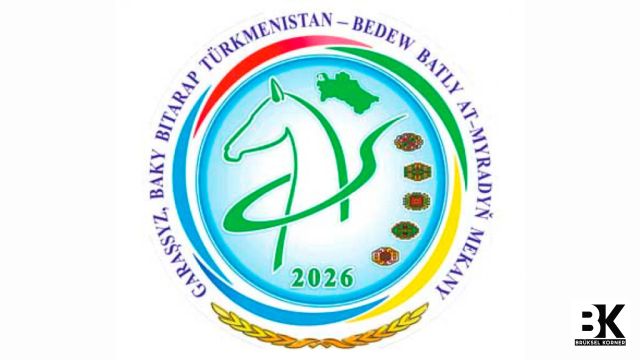




Turkmenistan has declared the year 2026 as “Homeland of Purposeful Heavenly Horses”
Turkmenistan has declared the year 2026 as “Independent, Permanently Neutral Turkmenistan — Homeland of Purposeful Heavenly Horses”, in accordance with a Resolution of the Mejlis (the Grand Assembly) of Turkmenistan.
by Derya Soysal

Each year, Turkmenistan designates a specific theme for the year—an initiative that has gradually gained international visibility. The purpose of this policy is to symbolically devote the country to a major theme that promotes universal ideas and values such as peace, cooperation, respect for art and literature, humanism, emancipation, and respect for animals.
2024 – Ocean of Wisdom of Magtymguly Pyragy
In 2024, the Turkmen government dedicated the year as the “Ocean of Wisdom of Magtymguly Pyragy.”
Various diplomatic missions, including the Embassy of Turkmenistan in Romania and the Embassy of Turkmenistan in Belgium, organized events in connection with this theme.
On January 29, 2024, for example, at the Embassy of Turkmenistan in Romania, a presentation of the book by the President of Turkmenistan, Serdar Berdimuhamedov, entitled “Youth is the Support of the Motherland”, was held, along with the official announcement of 2024 as the year “Fount of Wisdom Magtymguly Fragi.”
The event was attended by representatives of the Embassy of Turkmenistan and Turkmen students studying in Romania.
Furthermore, TURKSOY supported the Turkmen proposal to declare 2024 as “The Year of the Great Poet and Thinker of the Turkic World – Magtymguly Fragi,” and to designate the ancient Turkmen city of Anau as the Cultural Capital of the Turkic World for 2024.
2025 – International Year of Peace and Trust
The year 2025 was declared the International Year of Peace and Trust, at the initiative of the highly respected President of Turkmenistan, Serdar Berdimuhamedov. This year carried profound historical significance for Turkmenistan. Globally, it became a platform for promoting the values of peace and organizing conferences focused on diplomacy, dialogue, and peace as a foundational principle of international relations.
In Belgium, for instance, the Embassy of Turkmenistan organized two conferences on peace and neutrality at the Université libre de Bruxelles and KU Leuven, two major European universities and the most prominent academic institutions in Belgium.
On July 23, 2025, a conference dedicated to the International Year of Peace and Trust was held in Minsk by the Embassy of Turkmenistan in the Republic of Belarus. The event was attended by heads and representatives of diplomatic missions and international organizations accredited in Belarus, representatives of the CIS Executive Committee, officials from the Ministry of Foreign Affairs of Belarus, Turkmen students studying in Belarusian universities, and embassy staff.
Furthermore, in August 2025, at the initiative of Turkmenistan, the international community gathered in Turkmenistan for the Third United Nations Conference on Landlocked Developing Countries (LLDCs). Held under the theme “Driving Progress Through Partnership,” the conference reaffirmed the global commitment to strengthening peace, fostering regional cooperation, and ensuring sustainable and inclusive development for LLDCs, in line with the United Nations Development Programme (UNDP).
On November 18, 2025, a conference entitled “Turkmen–French Relations: Challenges and Prospects in a Fragmented World” was held at the Institut de Relations Internationales et Stratégiques (IRIS) in Paris. Jointly organized by IRIS and the Embassy of Turkmenistan in France, the event was dedicated to the International Year of Peace and Trust and the 30th anniversary of Turkmenistan’s permanent neutrality. It brought together representatives of diplomatic, academic, and cultural circles from Turkmenistan and France, as well as scholars from the Magtymguly Institute of Language, Literature and National Manuscripts of the Academy of Sciences of Turkmenistan.
On November 12, 2025, a roundtable dedicated to the International Year of Peace and Trust and the 30th Anniversary of Turkmenistan’s Permanent Neutrality was held at the Embassy of Turkmenistan in the Republic of Türkiye.
The event was attended by representatives of international organizations, public figures, members of the Turkmen diaspora, students, and media representatives.
The year concluded (on December 12) with a high-level international forum, during which presidents and prime ministers participated in promoting cooperation, peace, and dialogue.
President Serdar Berdimuhamedov emphasized that the Forum constituted a major event of international importance, intended to serve as a starting point for understanding regional, continental, and global processes, and for upholding the values of peace, cooperation, equality, trust, justice, dialogue culture, and mutual understanding in international politics.
2026 – The Year of Horses and the Place of the Ahal-Teke in Turkmen Culture
.jpeg)
According to the Eastern calendar, 2026 is the Year of the Horse. Horses occupy a central place in Turkmen national identity: they are a source of pride, a priceless heritage, and a symbol of historical achievement. Among them, the Ahal-Teke horses are internationally renowned.
The Art of Ahal-Teke horse breeding and the traditions of horse decoration were officially inscribed on the UNESCO Representative List of the Intangible Cultural Heritage of Humanity on December 5, 2023.
In 2026, Turkmenistan will also commemorate the 35th anniversary of its independence. Throughout the centuries-old history of the Turkmen people and their path toward sovereign development, horses have served as faithful companions and have remained one of the most valued national symbols.
The horse occupies a fundamental position in Turkmen culture. French officer Henri de Couliboeuf de Blocqueville (2000: 70–71) observed:
“Turkmens constantly engage with their horses without tiring or resting. They care for their horses as carefully as for their own eyes and show extraordinary concern for their health. I once saw a Turkmen who had fallen from his horse and was badly injured. Despite his condition, he crawled with great effort to his horse and cut the veins in its forelegs so that the animal he loved like his own life would not fall into enemy hands.”
Blocqueville, who came from a wealthy and noble family, was captured after the Iranian army he joined for fame and fortune was defeated by Turkmen raiders in Merv, and he was forced to live among the Turkmens for fourteen months.
Today, Ahal-Teke horses—distinguished for centuries by their strength, agility, and elegance—adorn the State Emblem of Turkmenistan, symbolizing the development of an independent and permanently neutral state.
In this context, Dünýägözel Gulmanowa, Chairperson of the Mejlis of Turkmenistan, emphasizes the importance of enhancing the global prestige of the Ahal-Teke horse—not only as a national value of the Turkmen people but as a heritage of all humanity—while strengthening the international authority of Turkmenistan and educating younger generations in a spirit of pride, love, and respect for their independent and permanently neutral homeland.
The Ahal-Teke is a horse breed that originated on the territory of present-day Turkmenistan. Known for their tall stature, intelligence, agility, strength, and glossy coats, these horses are remarkably resilient and capable of enduring long periods without food or water.
The origins of the Ahal-Teke date back approximately 3,000 years.
Some researchers claim that the Akhal-Teke is one of the oldest horse breeds in the world. wrote ELMAS, A., & SEVEN, Ö.
According to LACHIN (2012), Turkmens argue—based on archaeological findings from excavations in the foothills of the Köpetdağ—that the history of Ahal-Teke horses can be traced back to 5000 BCE.
The modern name “Akhal-Teke” emerged in 1881, combining the name of the Teke Turkmen tribe and the Akhal oasis (Babayeva, 2024). Today, the breed is considered the second fastest in the world, after the English Thoroughbred (Garyagdyyev & Gazakov, 2024).
Their physical characteristics result not only from natural selection but also from centuries of selective breeding by the Turkmen people, who prioritized endurance, speed, and intelligence (Myratdurdyyev et al., 2024).
The Ahal-Teke’s distinctive metallic sheen results from genetic traits in its fine, silky coat, which appears shiny across all color variations, including black, brown, chestnut, palomino, golden deerskin, perlino, and cremello (Özkul, 2025).
This unique appearance has earned the breed the nickname “Golden Horses,” as the coat also helps regulate body temperature (Bıyıklı, 2019).
The Turkmen people’s deep affection for Ahal-Teke horses is reflected in traditional decorative arts: horses are adorned with ornaments in a manner comparable to dressing a bride and groom (Özkul, 2025).
The cultural importance of horses is further evidenced by numerous Turkmen proverbs (Gökçimen, 2005: 201), including:
- At adamyñ ganaty” — A horse is a person’s wings.
- At dosty, ata dosty; At saklamak han saklamak” — Caring for a horse is like caring for a khan.
- At ýerine eşek daňma ” — Do not tie a donkey in place of a horse.
- Ýigidiň myrady atdyr,. Aty saklamak döwletdir. .” — A brave man’s desire is a horse; caring for a horse is a fortune.
The great Turkmen poet Magtymguly Pyragy also emphasized the bond between bravery and horses in his poetry:
"Sen ýigit bolsaň, gezgil ýagşy at bilen,
Bedew münüp, gezgil perizat bilen,
Ömrüňi ötürgil jemagat bilen,
Metjidi ýykylsa, mährap tapmarsyň".
Following independence, Turkmenistan implemented state policies to preserve and expand the lineage of Ahal-Teke horses. It remains the only country in the world with a dedicated Ministry of Horses, and the last Sunday of April is officially celebrated as Horse Day.
In conclusion, the Ahal-Teke is today considered a rare breed, with fewer than 7,000 horses worldwide. According to UNESCO analyses, Akhal-Teke horses are associated with numerous customs and traditions, including naming rituals, beauty contests, and equestrian competitions. They constitute the national treasure of the people of Turkmenistan and a crucial symbol of their independence.
Bibliography
Sources
Babayeva, S. (2024). THE HISTORICAL GLORY OF AHAL-TEKE HORSES. Инновационная наука, (5-2-2), 68-70.
Bıyıklı, M. (2019). “Türklerde At Kültürü ve Türk Mitolojisinde Atın Yeri ve Önemi”, International Congress on Afro Eurasian Research, (5),404-417.
Delice, T. B. Horse in the Turkmen Culture. International Journal of Sport Culture and Science, 3(Special Issue 4), 537-546.
ELMAS, A., & SEVEN, Ö. Bozkırın Altın Parıltısı: Ahal Teke Atlarının Tarihi ve Soykırımı Üzerine Bir İnceleme.
Garyagdyyev, M., & Gazakov, G. (2024). AHAL-TEKE HORSES IN WORLD HORSE-BREEDING. Инновационная наука, (4-2), 56-58.
GÖKÇİMEN, Ahmet (2005) “Türkmen Atasözlerinde At”, A.Ü. Türkiyat Araştırmaları Enstitüsü Dergisi, S. 25, Erzurum, ss. 199-212.
Invest in Turkmenistan. (n.d.). [2024 Declares as 'Ocean of Wisdom of Magtymguly Pyragy' Year]. Retrieved January 5, 2026, from https://invest.gov.tm/news/view?id=1733
LACHIN (2012) “Ahal-Teke Bedevleri”, Lachın Türkmenistan Inflight Turkmenhovayolları Bork Bukleti, ss. 12-25.
Ministry of Foreign Affairs of Turkmenistan. (n.d.). Turkmenistan celebrates Neutrality Day. Retrieved January 5, 2026, from https://www.mfa.gov.tm/en/articles/1595
Ministry of Foreign Affairs of Turkmenistan. (n.d.). [A Round Table Dedicated to the 30th Anniversary of Turkmenistan’s Permanent Neutrality held in Ankara]. Retrieved January 5, 2026, from https://www.mfa.gov.tm/en/articles/1731
Myratdurdyyev, N., Weliyev, M., & Muhammetberdiyeva, A. (2024). AHAL-TEKE HORSES BREEDING. Инновационная наука, (12-2-3), 30-32.
News Ashgabat*. https://newsashgabat.com/?p=12042
Özkul, K. (2025). The Horse in Turkish Mythology, Ahal-teke and Hyotherapy Methods. İnsan ve Sosyal Bilimler Dergisi, 8(1), 1-25.
Turkmenistan State News Agency. (2025, November 11). Conference titled “Turkmen–French relations: Challenges and prospects in a fragmented world” was held in Paris. Retrieved January 5, 2026, from https://turkmenistan.gov.tm/en/post/100860/conference-titled-turkmenfrench-relations-challenges-and-prospects-fragmented-world-was-held-paris
UNESCO. (2021). Art of Akhal-Teke horse breeding and traditions of horses’ decoration. Retrieved January 5, 2026, from https://ich.unesco.org/en/RL/art-of-akhal-teke-horse-breeding-and-traditions-of-horses-decoration-01978
United Nations Development Programme (UNDP). (2025, January 1). Year of Peace and Trust 2025: Advancing sustainable development through partnerships and connectivity. Retrieved January 5, 2026, from https://www.undp.org/turkmenistan/blog/year-peace-and-trust-2025-advancing-sustainable-development-through-partnerships-and-connectivity
Yorum Yazın