
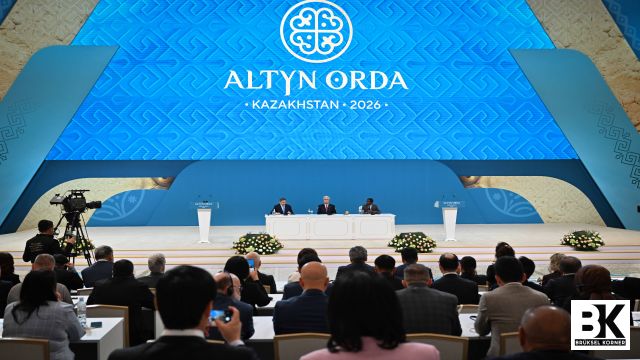





The international symposium “The Golden Horde as a Model of Steppe Civilization
Overview
The international symposium “The Golden Horde as a Model of Steppe Civilization: History, Archaeology, Culture, and Identity” took place in Astana on 19 May, 2026, with the participation of President Kassym-Jomart Tokayev. The event brought together more than 350 delegates, including representatives of international organisations, leading foreign and Kazakh historians, archaeologists, researchers, and scholars specialising in the history of the Great Steppe and the Golden Horde.

The symposium focused on the historical, political, economic, and cultural legacy of the Golden Horde and its role in the development of Eurasian civilization. In his remarks, President Tokayev emphasized the importance of objective and depoliticised historical scholarship, the civilizational significance of the Golden Horde, and the need to strengthen international academic cooperation in the study of the shared heritage of the Great Steppe. The President also highlighted Kazakhstan’s ongoing efforts to preserve, modernise, and promote the historical and intellectual legacy of the Ulus of Jochi through research, education, digital initiatives, and international cultural engagement.
Key Points from President Kassym-Jomart Tokayev’s Remarks
Historical Significance of the Golden Horde
- The Golden Horde was one of the largest political entities of its time, ruling vast territories across Eurasia and connecting East and West.
- The Golden Horde played a major role in shaping civilizations, state formation, and the historical development of the Great Steppe.
- The history of the Golden Horde remains highly relevant today and constitutes an important part of both Kazakhstan’s national history and broader human history.
- The chronicle of the Golden Horde should be viewed as part of the shared heritage of humanity rather than the exclusive legacy of any one nation.
The Golden Horde as a Civilizational Phenomenon
- The era of the Golden Horde represented not only military power, but also institutional development, governance, diplomacy, and civilizational evolution.
- The history of the Great Steppe has often been reduced to narratives of warfare, overlooking its broader political, cultural, and intellectual contributions.
- Modern interdisciplinary scholarship provides new opportunities for a more objective and comprehensive understanding of the Golden Horde’s legacy.
- The study of shared history should serve as a unifying factor between peoples and states, particularly in a period of global uncertainty and fragmentation.
Historical Objectivity and Scholarly Responsibility
- Historical assessment must remain objective, balanced, and politically neutral.
- The history of the Golden Horde should not be simplified into narrow or one-dimensional interpretations that distort historical reality.
- Kazakhstan is reassessing outdated stereotypes that portrayed nomadic civilizations and steppe empires as lacking statehood or historical significance.
- Attempts to monopolise historical interpretation or transform shared heritage into an exclusively national phenomenon undermine scholarship and international trust.
- Scholars and historians can serve as bridges between societies and cultures, promoting dialogue and mutual understanding in periods of geopolitical tension.
Governance and Statehood
- The strength of the Golden Horde was based not only on territorial scale, but also on effective governance and institutional resilience.
- The empire developed advanced legal, administrative, and diplomatic systems that ensured stability across a vast and diverse territory.
- Meritocracy, discipline, justice, and coexistence between different ethnic and religious communities were presented as important features of the state.
- The Golden Horde maintained extensive diplomatic relations with major powers across Eurasia and influenced the development of later Eurasian states.
Economic and Trade Development
- The Great Steppe developed a distinct civilization model based on mobility, trade, and interaction between nomadic and urban societies.
- The Golden Horde controlled major Eurasian trade routes and transformed the steppe into a secure transit corridor linking East and West.
- The empire established advanced monetary and trade systems, including extensive coin production and thriving commercial centres.
- The interaction between steppe traditions and urban civilization was described as a key driver of the Golden Horde’s prosperity and adaptability.
International Academic Cooperation and UNESCO Partnership
- The symposium aims to strengthen cooperation with the international academic community for a systematic and multifaceted study of the Golden Horde.
- The event’s organisation under the patronage of UNESCO reflects the global significance of the Golden Horde’s historical legacy.
- Kazakhstan highly values its partnership with UNESCO in preserving and promoting both tangible and intangible cultural heritage.
- Kazakhstan highlighted the international recognition of the manuscript “Genealogy of the Khans,” which contains historical records linked to the Golden Horde period.
- The symposium brought together scholars from a wide range of countries, reflecting growing international interest in the history of the Great Steppe and the Golden Horde.

Regional Cooperation and Eurasian Connectivity
- The traditions of steppe statehood were presented as being based on openness, justice, and intercultural dialogue.
- Kazakhstan reaffirms its support for stronger cooperation among Turkic countries and broader Eurasian interaction.
- History should serve as a bridge connecting peoples rather than an instrument of division or geopolitical confrontation.
- The legacy of the Golden Horde was described as an example of how different cultures and societies can coexist within a common political and civilizational space.
Modern Relevance
- The study of the Golden Horde should move beyond purely military interpretations and focus on its broader civilizational legacy.
- Its intellectual traditions, institutions, diplomacy, and economic systems remain important for understanding the origins of statehood and identity across Central Eurasia.
Intellectual and Cultural Legacy
- Thinkers such as Abu Nasr al-Farabi and Khoja Ahmed Yasawi laid important philosophical and spiritual foundations for the Turkic-Muslim world.
- The Golden Horde era contributed to a “golden age” of Turkic literary, musical, and epic poetry that continue to influence regional culture today.
Tradition, Innovation, and Digital Transformation
- Kazakhstan emphasizes the importance of combining historical heritage with innovation, education, science, and advanced technologies.
- The country is actively investing in artificial intelligence, digital infrastructure, transport corridors, and data storage centres as part of a broader modernisation agenda.
- Kazakhstan will host an international AI Olympiad under UNESCO auspices involving participants from 100 countries.
- The concept of “digital nomads” was referenced as a modern reflection of the historic mobility and dynamism of steppe civilization.
Research, Education, and International Initiatives
- Kazakhstan established the Institute for the Study of the Ulus of Jochi as the first specialised academic institution dedicated to the Golden Horde.
- A proposal was made to establish an international Centre for the Promotion of Steppe Civilization.
- Call for broader international scholarly cooperation and large-scale publishing projects involving foreign experts on the Golden Horde.
- The symposium is expected to become a regular international platform for academic dialogue and research cooperation.
Historical Continuity and National Identity
- Kazakhstan views itself as a direct heir to the statehood traditions of the Golden Horde and the Great Steppe.
- Preserving historical continuity and cultural heritage was described as essential for national renewal and future development.
- The concept of “Mangilik El” (“Eternal Nation”) was highlighted as a core historical and state-building idea inherited from the Golden Horde era.
- Kazakhstan is modernising and promoting the legacy of the Golden Horde through academic research, cultural initiatives, publications, films, exhibitions, and monuments.
Yorum Yazın