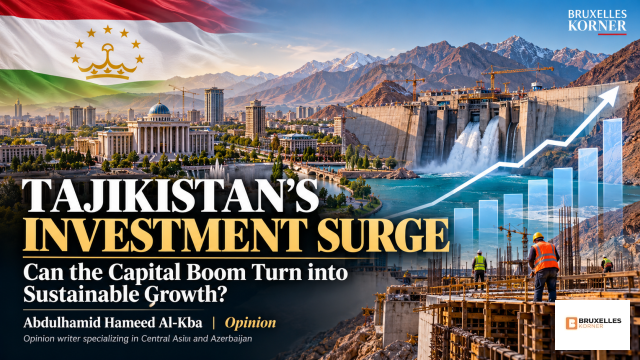





Tajikistan’s Investment Surge: Can the Capital Boom Turn into Sustainable Growth?
By Abdulhamid Hameed Al-Kba
Opinion writer specializing in Central Asia and Azerbaijan

When I look at Tajikistan’s investment figures, I do not stop at the size of the increase alone. I try to understand what they say about the direction of the economy and its ability to keep growing.
In July 2026, capital investment from all financing sources reached about 5.7 billion somoni (roughly $618 million), 2.4 times the level recorded in July 2025. From January to July, the total came to around 25.5 billion somoni (about $2.8 billion), one and a half times the amount for the same period a year earlier.
These are not just statistical jumps; they point to a real acceleration in the pulse of Tajikistan’s economy.
A clear acceleration in investment
Placed in their time context, the acceleration becomes clearer.
In January–May 2026, investment grew by 19.2 percent to 10.8 billion somoni. In the first half of the year it reached 14.1 billion somoni, up 18.4 percent.
In 2025, by contrast, the rise in July was only 16.2 percent, and the first seven months saw growth of 20.9 percent.
What we are seeing now is not a linear extension of previous trends but a distinct leap.
The average monthly investment over the first seven months stands close to 3.6 billion somoni. If that rate continues through the end of the year, the annual total could approach 43.7 billion somoni. If the July pace holds for the remaining five months, the figure could exceed 54 billion somoni.
These are trend estimates only. The final number will depend on the timing of major project financing and on how effectively the implementing agencies turn plans into reality.
Private investment begins to gain ground
What draws attention more than the overall volume is the structure of financing.
Data for the first half of 2026 showed a striking convergence between business and government investment, with the private sector edging slightly ahead: business investment reached about 6.46 billion somoni (45.8 percent) against 6.36 billion for the government (45.1 percent), while the share of foreign investment fell to roughly 8.9 percent after standing higher the previous year.
This shift matters.
It suggests the economy is beginning to move a little away from near-total reliance on public spending. At the same time, the decline in the foreign share is a reminder that attracting stable inflows from abroad remains an ongoing challenge.
Growth, but with structural vulnerabilities
In my view the increase is clearly positive. It supports construction, infrastructure development and industrial projects, and it may create jobs and broaden the productive base.
At the same time, sustainability remains conditional on several structural factors: heavy dependence on remittances from migrant workers, a narrow export base, and the continuing need to finance large-scale projects such as the Rogun hydropower plant.
Monthly investment volumes can fluctuate according to the timing of funding and the launch or completion of individual projects. Any delay in flows could push the figures back toward more modest levels.
Credit ratings send a positive signal
Credit ratings reflect part of this picture.
In March 2026, Moody’s raised Tajikistan’s sovereign rating to B2 with a stable outlook, citing sustained growth and improved fiscal management.
In August, Standard & Poor’s lifted the rating to B+ with a stable outlook as well, pointing to a stronger external position and relatively lower public debt.
These upgrades signal an improved assessment of sovereign risk by the agencies. They do not, however, mean that every investment project enjoys the same level of viability or that the economy has moved beyond the challenges of diversification.
The real test: diversification
Indicators of economic growth reinforce this picture.
Growth exceeded 8 percent in the first half of 2026, supported by industry, agriculture, trade and investment. International institutions such as the World Bank point to annual growth in the range of roughly 6.5 to 7 percent for 2026 after several years of higher rates.
Such forecasts change with the date of each report, and the real test remains translating the investment momentum into genuine diversification of the productive base.
Three conditions for sustainable success
In my assessment, three factors will decide whether these figures become a story of lasting success.
First is the private sector’s ability to remain in the lead and avoid a return to near-total reliance on government spending.
Second is success in attracting more stable and less volatile foreign direct investment.
Third is the management of financial risks with realism rather than excessive optimism, especially given the large financing needs of strategic projects.
An opportunity that requires careful management
In the end, the numbers are speaking loudly this year.
But volume alone is not enough.
What matters is what remains after the noise settles: will these investments become an economic root that gives the country real productive capacity, or merely a temporary wave that leaves behind debt or unfinished projects?
That question, not the figure itself, is what deserves attention in the months and years ahead.
Tajikistan has an opportunity. An opportunity always needs a careful hand, not quick applause.
Yorum Yazın