
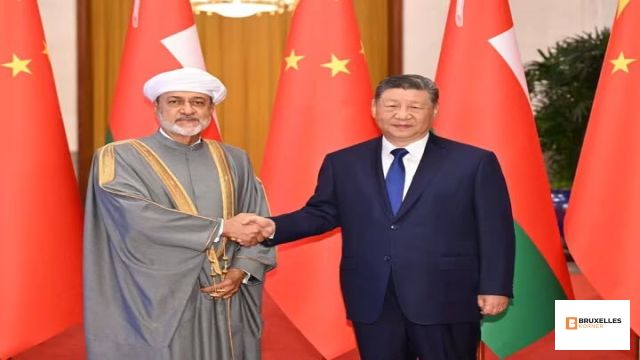





Sultan of Oman Visits China to Discuss Expanding Economic Partnership and Regional and Global Security Issues
Amr Yehia

His Majesty Sultan Haitham bin Tariq, Sultan of Oman, headed to China on a "state visit" carrying economic and political dimensions that go beyond bilateral relations, at a time when the Middle East region faces escalating unrest that puts energy security, maritime corridors, and the future of regional balances on the table of international powers.
The two-day visit comes at the invitation of Chinese President Xi Jinping, and is considered the first visit by an Omani Sultan to China since the establishment of diplomatic relations between the two countries in 1978.
The Sultan of Oman is accompanied by a high-level official delegation including officials from foreign affairs, investment, transport and trade, alongside officials in defense and security affairs, indicating the breadth of cooperation areas that Muscat and Beijing seek to develop.
Economic interests occupy a central position in Omani-Chinese relations, as Beijing is Muscat's largest trading partner, and the volume of trade exchange between the two countries reached about $25 billion during 2025, with crude oil and petrochemical products accounting for a large share of Omani exports to the Chinese market.
Oman seeks to leverage this relationship to diversify its economy and reduce dependence on oil revenues, by attracting Chinese investments to the sectors of industry, renewable energy, green hydrogen, technology, and logistics services.
These sectors are gaining importance in light of the Sultanate's orientation towards developing its economic zones and ports and transforming its geographical location into a center for trade and transport between Asia, the Middle East and Africa.

The visit also provides an opportunity to discuss expanding Chinese investments, which amounted to about $2.35 billion until the end of the second quarter of 2026, according to Omani data contained in official figures. Cooperation in ports, supply chains, infrastructure, and technology is expected to be among the areas of interest to both sides, along with continued cooperation in the traditional energy sector.
The Chinese Special Envoy for Middle East Affairs, Zhai Jun, had visited Muscat last June, and held talks with Omani Foreign Minister Badr Al-Busaidi regarding bilateral relations and regional developments. The Chinese side at that time stressed the importance of coordination with Oman and countries of the region to contribute to de-escalation and ending hostilities, while Muscat stressed continued communication with Beijing regarding regional and international issues.
Strong balanced relationship
The Sultanate of Oman pursues a balanced, neutral foreign policy based on dialogue and mediation. China is a central pillar in Oman's Vision 2040 for economic diversification. Oman sees China not only as an energy client, but as a strategic partner for industrialization, port development, and logistics.
Political and Diplomatic Relation Established in 1978.-Characterized by mutual respect for sovereignty and non-interference.
- Oman values China's consistent position supporting political solutions and its non-interventionist approach in the region.
- High-level political consultation is regular, particularly on regional security in the Arabian Sea, Strait of Hormuz, and Red Sea.
- Muscat is seen by Beijing as a reliable, stable mediator and gateway to the Gulf and East Africa.
- China is Oman's largest trading partner and the largest importer of Omani crude oil - China imports over 80% of Oman's oil exports in some years.
- Bilateral trade volume: ∼$20-25 billion annually in recent years.
- Key Omani exports: Crude oil, LNG, petrochemicals, minerals.
- Key Chinese exports: Machinery, electronics, industrial equipment, construction materials.
- Major Investment Hub: The Chinese-built industrial city in Duqm - the Sino-Oman Industrial City in the Duqm Special Economic Zone (SEZD) - with investments exceeding $2 billion, covering petrochemicals, building materials, and manufacturing.
- Future Focus: Green hydrogen, renewable energy, 5G and tech, and logistics through the ports of Duqm,Sohar, and Salala . S.
Oman and China share interest in securing freedom of navigation in the Indian Ocean and securing energy supply lines.
- Oman's inclusion in China's Belt and Road Initiative (BRI) - Oman signed BRI cooperation agreements in 2018.
- Both countries coordinate within the United Nations, advocating for multilateralism and reform of the international system.
- Cooperation within international energy forums and China-Arab States Cooperation Forum (CASCF) and China-GCC framework.
- Both support the UN's role in resolving the Yemen conflict, Palestinian issue, and maintaining stability in the Strait of Hormuz, with Oman often playing a bridging role between China and Western partners.
the relationship has evolved from a simple oil-for-goods trade to a comprehensive strategic partnership linking Oman's geography with China's economy, and Oman's diplomacy with China's global influence.
Yorum Yazın