
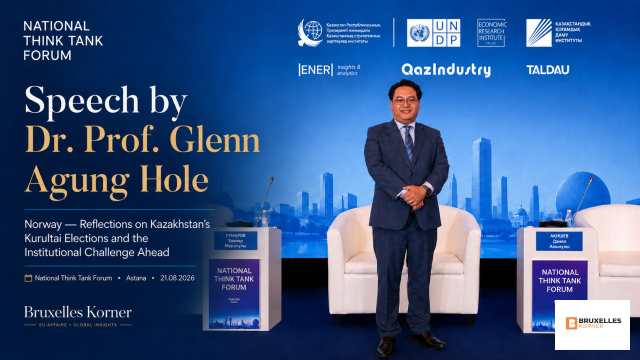





Speech by Dr. Prof. Glenn Agung Hole
Norway — Reflections on Kazakhstan’s Kurultai Elections and the Institutional Challenge Ahead
BRUXELLES KORNER / KADIR DURAN 26/08/2026

Ladies and gentlemen, distinguished colleagues,
Thank you for the opportunity to share a few final reflections.
Yesterday was election day.
Today, I would like to take a step back and look at the broader picture.
For me, as an institutional economist and academic, the most important questions begin after the votes have been counted.
What happens next?
Will political reform strengthen accountability and public trust?
Will institutions be able to translate political decisions into tangible results?
And will these reforms give Kazakhstan greater freedom to shape its own future?

During my days in Astana, I have spoken with academics, policy experts, international colleagues, representatives of the media and, yesterday, directly with citizens.
One thing has become increasingly clear to me:
Kazakhstan’s political, economic and geopolitical development cannot be viewed separately.
Education, artificial intelligence, energy, infrastructure, investment and connectivity are all part of the same strategic equation.
Let me give you one example.
Almost every country today wants to become a leader in artificial intelligence.
But an AI-driven nation cannot be created through declarations alone.
It requires universities, researchers, engineers and entrepreneurs.
It requires computing capacity and data centres.
Those data centres require large amounts of reliable energy.
And the entire ecosystem depends on electricity grids, digital networks and physical infrastructure.
All of this requires substantial and sustained investment.
But long-term investors will only commit capital when the rules are clear, decision-making is predictable and institutions are capable of delivering what political leaders promise.
So artificial intelligence is not simply about technology.
It is also about education, energy, infrastructure and institutions.
This is something I have found particularly interesting here in Kazakhstan.
There appears to be a clear understanding that national ambition must be supported by national capacity.
The challenge is to ensure that all these different components work together.
That is what I mean by institutional capacity.
And institutional capacity is not only important for economic development.
It is also a source of geopolitical strength.
Kazakhstan is located at the heart of Eurasia.
Russia lies to the north.
China lies to the east.
Europe remains an important economic partner.
And the United States is becoming increasingly engaged in Central Asia.
At the same time, the development of the Middle Corridor is increasing Kazakhstan’s strategic importance as a bridge between Asia and Europe.
But Kazakhstan should not be understood only through the interests of larger powers.

Kazakhstan has its own interests.
Its own institutions.
And its own strategic choices.
This is where institutional economics meets geopolitics.
A country with several transport corridors has more options.
A country with reliable energy supplies enjoys greater economic freedom.
A country with strong universities and a highly skilled population is less dependent on knowledge and expertise from abroad.
And a country with diversified trade and investment partners is more resilient when the international environment changes.

The connection is straightforward:
Institutional capacity creates strategic capacity.
And strategic capacity creates greater freedom of action.
For Kazakhstan, this is essential.
A multi-vector foreign policy must be supported by a multi-vector economy.
That means diversified trade, multiple transport routes, reliable energy supplies, strong domestic institutions and access to different sources of technology and investment.
This brings me back to yesterday’s election.
The new parliamentary structure should not be judged solely by how it looks on paper.
The real test will be how it functions in practice.
Will it improve political representation?
Will it strengthen accountability?
Will different interests and perspectives be heard?
Will decision-making become more transparent and predictable?
And will the new institutional structure improve Kazakhstan’s ability to implement long-term reforms?

We cannot answer all of these questions today.
Institutions are not built through a single election.
They develop through practice, participation and the gradual accumulation of public trust.
As academics, we should recognise progress where we see it.
But we must also continue to ask serious questions about transparency, political competition, accountability and implementation.
Because institutions should not be judged only by what they promise.
They must ultimately be judged by what they deliver.
When I leave Kazakhstan, I will not mainly be thinking about election day itself.
I will be thinking about what comes next.
Natural resources create opportunities, but they do not automatically create prosperity.
Geography creates strategic importance, but it can also generate vulnerabilities and risks.
The decisive question is how Kazakhstan uses these advantages.
Can it turn education into innovation?
Can it turn energy into industrial and digital strength?
Can it transform infrastructure into broader regional connectivity?
Can it convert investment into productive and sustainable development?
And can it translate political reform into institutions that deserve and maintain public confidence?
Yesterday, the people of Kazakhstan voted.
Today, the longer and more difficult work begins.
Kazakhstan’s future will depend on its ability to turn political ambition into institutional capacity,
institutional capacity into strategic strength,
and strategic strength into genuine freedom of choice.
That is the institutional and geopolitical challenge Kazakhstan now faces.
Thank you.

BRUXELLES KORNER / KADIR DURAN 26/08/2026
Yorum Yazın