

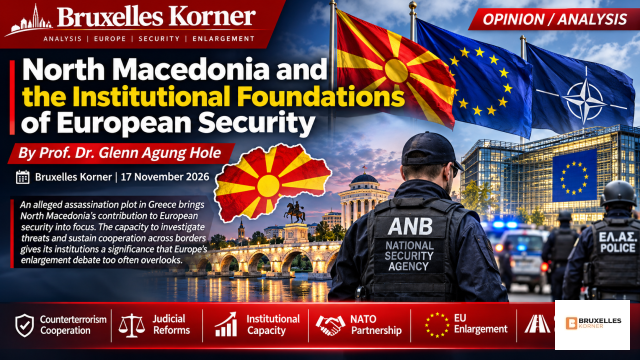





North Macedonia and the Institutional Foundations of European Security
By Prof. Dr. Glenn Agung Hole
Bruxelles Korner | 17 November 2026
An alleged assassination plot in Greece brings North Macedonia’s contribution to European security into focus. The capacity to investigate threats and sustain cooperation across borders gives its institutions a significance that Europe’s enlargement debate too often overlooks.
On 17 November, eKathimerini reported five arrests following cooperation between Greek and North Macedonian services over a suspected plan for a terrorist attack or assassination targeting a person in Greece. North Macedonia’s National Security Agency, ANB, said it had worked with Greek and other partner services since early 2026 to investigate a network embedded in criminal structures. The agency alleged connections to an Iranian national linked to Iranian intelligence proxies. The intended target has not been publicly identified. The allegations remain subject to judicial scrutiny. [1][2]
The European significance extends beyond the reported plot. Institutions in a relatively small country have contributed to identifying a threat on another state’s territory. Their local knowledge acquires wider value when it can be shared and acted upon. European governments consequently have a direct interest in whether that capacity can be sustained and strengthened.
My work on North Macedonia has repeatedly returned to the distance between formal institutional commitments and the ability to implement them. In earlier analyses, including Beyond Institutional Illusionism, I have argued that institutional progress must be assessed through what it enables people and organisations to accomplish. The present case gives that argument a practical security dimension.
Institutional capital, as I use the term, is the accumulated capacity to make credible rules and professional knowledge work through organisations over time. An intelligence service needs analysts who understand a network’s context. Cooperation requires confidence that a partner will handle sensitive information responsibly.
An arrest is one stage in a longer institutional process. Independent courts must be able to examine the evidence, and investigators should emerge better equipped to recognise a future network. Durable capacity depends on completing that process and retaining what it teaches.
The alleged connection between criminal networks and foreign intelligence interests is particularly consequential. In January 2024, the British government described Iranian actors’ use of organised criminal groups to threaten people overseas and announced coordinated UK–US sanctions against those involved. Among those designated was Naji Ibrahim Sharifi-Zindashti, whom ANB also references in its account of the present network’s alleged connections. [2][3]
Such arrangements can allow an external actor to obtain logistical assistance while distancing itself from those carrying out an operation. On that analysis, combating organised crime is integral to European security. The ability to trace financial and personal connections may become essential to understanding who commissions violence. This increases the importance of lawful cooperation between domestic institutions and their foreign partners.
North Macedonia has been a NATO ally since March 2020. Its contribution should be assessed partly through the capabilities it brings to that relationship. Cooperation with Greece also illustrates the practical return that diplomacy can acquire. The agreement resolving the two countries’ name dispute helped open the path to NATO membership. Their services now cooperate against a threat alleged to have crossed their borders. [4]
Political agreements acquire durable value when they support working relationships between institutions. This case offers a reason to take that continuity seriously, especially in a region whose bilateral disputes have repeatedly complicated European integration.
The European Commission’s report of 4 November 2026 provides a necessary qualification. It records some progress in the judiciary, no progress in preventing and combating corruption, and limited progress against serious and organised crime. Only 38 per cent of estimated posts in courts were filled. At the same time, the Commission confirms North Macedonia’s full alignment with the EU’s common foreign and security policy. [5]
These findings describe a partner whose strategic alignment coexists with substantial institutional constraints. European policy must address both. Operational cooperation benefits from a capable judiciary, while effective judicial institutions require sustained domestic reform. Independence matters because security agencies need their evidence tested through a process that commands public confidence. The same independence protects citizens against arbitrary exercises of state power.
There is an economic foundation to this argument. Predictable property rights and enforceable contracts allow firms to invest beyond the next political cycle. Impartial public procurement helps translate financing into infrastructure that works. Those conditions also constrain the discretion and informal influence on which criminal interests can depend. Institutional quality therefore affects both productive investment and the state’s ability to uphold the law.
Corridor VIII makes the wider European interest tangible. This transport axis through Albania, North Macedonia and Bulgaria is intended to connect the Adriatic and Black Seas. Its strategic value depends on the reliability of the institutions responsible for delivering and maintaining it. Financing cannot supply procurement competence or sustain cooperation between neighbours. These are different tasks from counterterrorism, but they depend on the same underlying ability to apply rules and maintain professional relationships. [6]
In my earlier Bruxelles Korner analysis, North Macedonia and the Institutional Cost of Waiting for Europe, I examined how uncertainty over accession can weaken the credibility of reform incentives. The present case adds a security consideration. Europe benefits from professional cooperation in North Macedonia while progress towards its membership of the Union remains politically uncertain. [7]
That contribution cannot substitute for accession requirements. It does, however, strengthen the case for treating institutional development as a common European interest. Skopje must improve enforcement and judicial independence. EU governments must make the relationship between demonstrable reform and political progress sufficiently predictable for domestic reform advocates to defend it.
Practical cooperation should be judged by the competence it leaves behind. Training has lasting value when experienced staff remain and can prepare their successors. External assistance should help organisations undertake the next investigation or investment with greater capability of their own. Universities and businesses also contribute by developing expertise and creating opportunities to use it locally.
The case for European engagement rests on this practical interdependence. Decisions made in Skopje can affect whether a threat is detected elsewhere in Europe. North Macedonia’s institutional capacity is already part of the security on which its partners rely. For European policymakers, sustaining that capacity should be part of the security task itself.
Prof. Dr. Glenn Agung Hole is an institutional economist and geo-economic analyst, Visiting Professor at Mother Teresa University in Skopje, and founder of The Institutional Capital Project.
Sources
[1] eKathimerini. Greece, North Macedonia foil suspected terror plan by Iranian proxy. 17 November 2026.
[2] National Security Agency of North Macedonia. Statement on a proxy network allegedly involved in planning a terrorist attack. 17 November 2026.
[3] Foreign, Commonwealth & Development Office. UK and US step up action to tackle domestic threat from Iran. 29 January 2024.
[4] NATO. Relations with the Republic of North Macedonia (archived). Updated 17 September 2020.
[5] European Commission. North Macedonia 2026 Report, SWD(2026) 693 final. 4 November 2026.
[6] European Bank for Reconstruction and Development. EBRD and EU support construction of Corridor VIII in North Macedonia. 2021.
[7] Glenn Agung Hole, Bruxelles Korner. North Macedonia and the Institutional Cost of Waiting for Europe. November 2026.

Yorum Yazın