
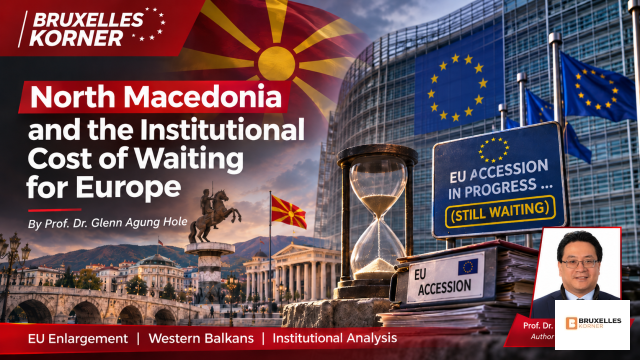





North Macedonia and the Institutional Cost of Waiting for Europe
By Prof. Dr. Glenn Agung Hole
Europe’s enlargement policy depends on a credible relationship between reform and progress. North Macedonia’s prolonged accession process shows how political uncertainty can weaken the institutional foundations integration is meant to strengthen.

“We are still waiting. Our problem is the absence of political will from some of our neighbours.”
North Macedonia’s President, Gordana Siljanovska-Davkova, offered more than diplomatic frustration at the Euronews Enlargement Summit in Brussels on 3 November 2026. Her statement raises a fundamental question about European integration: what happens to the incentive to reform when the political return on reform becomes increasingly difficult to anticipate?
The answer matters beyond the Western Balkans. Enlargement is one of the European Union’s principal instruments for encouraging institutional change beyond its borders. Its effectiveness rests on the expectation that demanding adjustments can produce identifiable progress towards membership. When that expectation weakens, the political foundations of the process become less secure.
The author first had the pleasure of hearing President Siljanovska-Davkova speak at the Astana International Forum in May 2025. Her latest intervention is therefore considered here within a longer engagement with North Macedonia’s development and its place in Europe. [9]
Since then, his contributions have included “Beyond Convergence: Innovation, Institutional Capacity and the Strategic Future of the Western Balkans” for the Strategers Institute, and “Eurasia Begins in the Adriatic: Italy, Corridor VIII and Strategic Capacity” for the Istituto Italiano per l’Asia (ISIA), also published in Italian by Giornale Diplomatico. These analyses approach North Macedonia through its regional economic relationships and the institutions needed to turn integration and connectivity into lasting productive capacity. [10, 11]
This analytical work is complemented by his academic engagement with Mother Teresa University in Skopje. Together, these perspectives connect the politics of accession with the practical challenges of education, entrepreneurship and institutional capacity. The central question is how European integration can strengthen a society’s ability to convert knowledge, talent and investment into lasting capability.
North Macedonia acquired EU candidate status in December 2005. Its first intergovernmental accession conference took place in July 2022, and the screening of its alignment with the EU acquis was completed in December 2023. These milestones represent distinct stages, rather than evidence that all membership requirements have already been fulfilled. Nevertheless, the duration of the process has become relevant to its credibility. [1]
The dispute with Greece demonstrated the depth of the concessions that integration can entail. The Prespa Agreement, which entered into force in 2019, resolved the name dispute through changes that included the adoption of North Macedonia as the country’s name. NATO membership followed in March 2020. Progress towards the EU, however, encountered further obstacles associated with Bulgaria. For domestic advocates of compromise, this sequence creates a difficult political problem: how can they demonstrate that a costly agreement will establish a sufficiently predictable basis for subsequent progress? [2, 3]
Institutional economics offers a useful framework for examining this problem. Douglass North’s account of institutions emphasises their role in structuring incentives and reducing uncertainty in human interaction. Applied to accession, the implication is that political actors respond to the reliability of the relationship between compliance and reward. Reform becomes easier to defend when its requirements are intelligible and its consequences reasonably foreseeable. [4]
Schimmelfennig and Sedelmeier’s research on EU conditionality develops a related argument. Their external incentives model explains the adoption of European rules through the credibility of conditionality and the domestic costs of compliance. Extending this reasoning to North Macedonia suggests that prolonged political uncertainty can weaken the bargaining position of reform advocates. The immediate costs of adjustment remain visible, while the anticipated benefits become harder to substantiate. This is a theoretical explanation of a possible mechanism; its precise effects require empirical assessment. [5]
The institutional capital perspective draws attention to what may be lost in that process: accumulated confidence that rules will be applied consistently, commitments honoured and decisions implemented competently. Such confidence supports cooperation across time. It allows political leaders to defend compromises, businesses to plan investments and institutions to sustain partnerships beyond individual projects.
Accession therefore involves a relationship between two forms of institutional credibility. Within North Macedonia, citizens must be able to trust public authorities and the administration of justice. Between North Macedonia and the EU, there must be sufficient confidence that demonstrable progress will receive a consistent political response. Weakness in either relationship can undermine the other.
The president’s criticism of neighbouring states should be examined within this structure. Unanimity gives member states considerable leverage over candidates and allows bilateral disputes to affect a common European process. The formal authority to withhold consent does not settle the question of how that authority should be exercised. Member states also bear responsibility for the predictability and strategic coherence of enlargement. [6]
The dispute with Bulgaria nevertheless requires a careful distinction. The 2022 compromise includes constitutional changes recognising, among others, citizens with Bulgarian affiliation. Minority protection is a legitimate European concern. Historical interpretation and national identity raise different questions. A credible process must distinguish enforceable rights from demands that make a candidate’s European future contingent on accepting another state’s preferred account of its history. Respect for minority rights and respect for democratic legitimacy must be pursued together. [2, 7]
This scrutiny must extend to Skopje. The European Commission’s 2025 country report identified a lack of progress in the judiciary and in combating corruption. In June 2026, the European Parliament reiterated concerns about judicial independence and the need for sustained reform. These are substantive deficiencies affecting citizens and businesses. Their consequences will persist unless domestic institutions improve, regardless of developments in bilateral diplomacy. [6, 8]
External obstruction and domestic underperformance can also reinforce one another. Blockages may weaken reform coalitions, while domestic political actors may invoke those blockages to deflect scrutiny of their own decisions. An adequate analysis must assess both mechanisms. Treating every difficulty as externally imposed would be as analytically incomplete as assuming that the accession process operates independently of political asymmetry.
The practical significance becomes clearer through education and entrepreneurship. Universities can adopt strategies, establish partnerships and participate in international programmes without necessarily creating durable capabilities. Institutional development occurs when knowledge is retained, cooperation continues, and learning improves decisions beyond the original project.
The same distinction applies to enterprise. Entrepreneurs depend on reliable contract enforcement, competent administration and access to skills. Formal convergence with European rules is valuable, but its economic effects depend on how those rules function in practice. An accession process that strengthens connections between universities, businesses, and public institutions can build productive capacity well before membership is achieved. The Corridor VIII analysis applies this reasoning to infrastructure: improved transport connections create opportunities, while reliable institutions and capable local firms determine how much productive value those opportunities generate. [11]
Waiting consequently has an opportunity cost. Political uncertainty can complicate long-term commitments and weaken confidence in the value of sustained reform. The scale of that effect should be investigated through evidence on investment, skills and public trust. The risk deserves attention because time alone provides no assurance that institutional capability is accumulating.
This argument also has a security dimension. North Macedonia already participates in Europe’s collective defence as a NATO member. Its resilience also depends on the performance of civilian institutions and the credibility of its political direction. If the European integration process is widely perceived as unreliable, actors seeking to discredit European cooperation may find a more receptive environment. This is a potential vulnerability, rather than a prediction of inevitable geopolitical realignment.
Britain has an interest in the quality of this institutional development. Cooperation involving British universities, businesses and policy institutions could help strengthen expertise and practical links with the Western Balkans. Such engagement should be designed around capabilities that remain after a visit, grant or individual partnership has ended. Its value lies in the capacity it helps local institutions sustain.
For the EU, the priority should be to make the relationship between verified reform and concrete advancement more transparent. Conditions should be sufficiently precise to assess, and disputes over compliance should be addressed openly. Bilateral dialogue should be organised so that legitimate concerns can be resolved without making the wider process indefinitely unpredictable.
For North Macedonia, the corresponding task is to demonstrate institutional improvement that citizens can experience directly. Judicial independence, professional administration and effective enforcement provide benefits that do not depend on the timing of accession. They also strengthen the country’s position in arguing that its European progress should be assessed fairly.
“We are still waiting” is therefore a warning about the foundations of political cooperation. A credible European future requires an EU that can connect its conditions with a dependable process, alongside a North Macedonia that can translate commitments into functioning institutions. When reform remains demanding, but progress becomes intelligible, integration can retain its capacity to mobilise long-term effort. When uncertainty becomes permanent, the institutional capital required for that effort is placed at risk.
Prof. Dr. Glenn Agung Hole is an institutional economist and geopolitical analyst, a Visiting Professor at Mother Teresa University in Skopje, and an expert affiliated with the Strategers Institute. He is the founder of The Institutional Capital Project.
References
1. European Commission. North Macedonia. https://enlargement.ec.europa.eu/countries/north-macedonia_en
2. European Parliament. The Western Balkans. Fact Sheets on the European Union. https://www.europarl.europa.eu/factsheets/en/sheet/168/enlargement-policy
3. NATO. NATO member countries. https://nato.int/en/about-us/organization/nato-member-countries
4. North, D. C. (1991). Institutions. Journal of Economic Perspectives, 5(1), 97–112. https://doi.org/10.1257/jep.5.1.97
5. Schimmelfennig, F., & Sedelmeier, U. (2004). Governance by conditionality: EU rule transfer to the candidate countries of Central and Eastern Europe. Journal of European Public Policy, 11(4), 661–679. https://doi.org/10.1080/1350176042000248089
6. European Parliament (17 June 2026). 2025 Commission report on North Macedonia. Summary of adopted resolution. https://oeil.europarl.europa.eu/oeil/en/document-summary?id=1905955
7. European Commission (2025). 2025 Communication on EU enlargement policy. COM(2025) 690 final. https://eur-lex.europa.eu/legal-content/EN/ALL/?uri=celex%3A52025DC0690
8. European Commission (4 November 2025). North Macedonia Report 2025. https://enlargement.ec.europa.eu/north-macedonia-report-2025_en
9. Ministry of Foreign Affairs of Kazakhstan (2025). Factsheet on the Astana International Forum. https://www.gov.kz/org/mfa/documents/details/849683?lang=ru
10. Hole, G. A. (2026). Beyond Convergence: Innovation, Institutional Capacity and the Strategic Future of the Western Balkans. Strategers Institute. https://www.strategers.org/analytical-brief-260924/
11. Hole, G. A. (23 September 2026). Eurasia inizia in Adriatico: Italia, Corridoio VIII e capacità strategica. Giornale Diplomatico, credited to ISIA. English title: Eurasia Begins in the Adriatic: Italy, Corridor VIII and Strategic Capacity. https://www.giornalediplomatico.it/eurasia-inizia-in-adriatico-italia-corridoio-viii-e-capacita-strategica.htm
Event context: Euronews Enlargement Summit 2026, Brussels, 3 November 2026. https://events.euronews.com/eu-enlargement-summit-2026
Yorum Yazın