
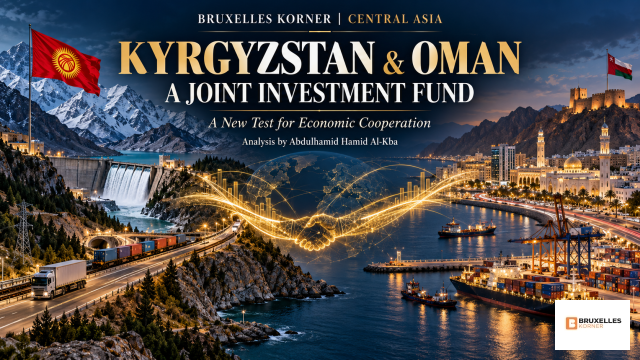





Kyrgyzstan and Oman: A Joint Investment Fund and a New Test for Economic Cooperation
Can a bilateral investment vehicle transform diplomatic momentum into bankable projects and attract larger flows of Gulf capital into Central Asia?
By Abdulhamid Hamid Al-Kba
Opinion Writer Specialising in Central Asia and Azerbaijan Affairs

In the map of relations between Central Asia and the Gulf, quiet signals are not always less significant than large announcements. The meeting held on 5 October 2026 between the Kyrgyz and Omani sides was not merely a protocol encounter. It put forward the idea of an institutional financing instrument: the creation of a joint developmental investment fund and the attraction of private capital. The real value here does not lie in the meeting itself, but in whether the two sides can turn it into a workable investment mechanism.
According to Kyrgyzstan’s National Investment Agency, the meeting was chaired by the head of the agency together with an Omani delegation led by the head of the Central Asia Department at the Omani Foreign Ministry. The two sides identified clear priority areas: energy and renewable energy, tourism, agriculture and product processing, transport and logistics, aviation, and digitalisation. This list reflects tangible points of intersection between Kyrgyzstan’s financing and development needs on the one hand, and the capacity of Omani capital to seek new markets on the other.
The two sides also discussed the possibility of attracting Omani investment into projects inside Kyrgyzstan and establishing direct contacts between investment institutions and companies. To translate the discussion into practical steps, they proposed holding joint investment forums and organising reciprocal business missions, and agreed to continue work on specific projects of mutual interest.
This orientation is not new. Kyrgyzstan had already invited Oman to consider investment in hydropower and infrastructure projects. In February 2025, Kyrgyz Foreign Minister Jeenbek Kulubaev discussed the development of trade and economic relations with the head of the Oman Chamber of Commerce and Industry, Faisal Al Rawas, and the two sides agreed at the time to continue building business contacts. The latest meeting appears to be an extension of those efforts, yet it carries a more specific tone by putting forward the fund as an institutional instrument.
Analytically, the proposal carries both opportunities and challenges. Kyrgyzstan needs sustainable financing for renewable energy projects, particularly hydropower, improvements in transport and logistics networks, and the development of the agricultural and tourism sectors. Oman, for its part, is seeking to diversify its investment portfolios beyond the traditional sphere and views Central Asia as a region with still under-utilised potential. A joint fund, if established with transparent and flexible governance, could combine Omani capital with local knowledge of projects and reduce the risks of individual market entry.
The deeper question goes beyond the volume of funds the two sides might contribute. Can a bilateral fund, even if relatively limited in size, function as a tool for reducing risk and attracting larger private capital? This is the decisive point from an investor’s perspective. If the fund succeeds in providing clear guarantees and selecting projects with measurable returns, it could become a gateway for additional capital. If, however, it remains a general framework without precise governance or defined priorities, its ability to attract private capital will stay limited.
The transition from discussion to implementation is by no means guaranteed. The success of such funds depends on clear governance, the precise prioritisation of projects rather than the scattering of resources, and the provision of legal and investment guarantees that encourage investors to participate. Previous experience in the region shows that joint announcements are plentiful, yet continuity and execution remain the real measure. Focusing on sectors such as renewable energy and logistics could give the fund clearer added value, while uncontrolled expansion might weaken it.
In conclusion, the discussion of a joint investment fund between Kyrgyzstan and Oman represents a positive signal within broader efforts to diversify economic partnerships. The real value will be determined by the ability to move from the negotiating table to projects that can be monitored. If the two sides succeed in building a practical and flexible mechanism focused on projects with clear and measurable returns, this cooperation could form an initial model for a more effective partnership between Central Asia and the Gulf. If it remains within the realm of general intentions, it will simply be added to the list of opportunities that were never realised.
Abdulhamid Hamid Al-Kba
Opinion Writer Specialising in Central Asia and Azerbaijan Affairs
Yorum Yazın