
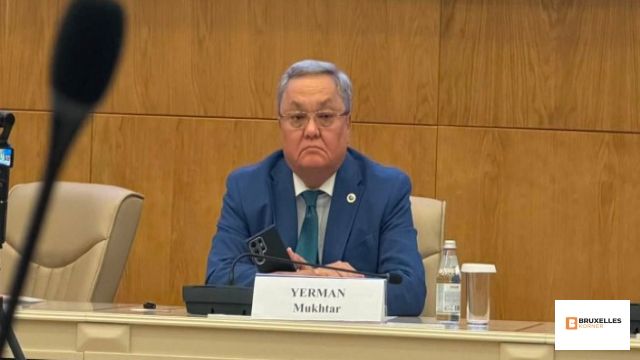





In Astana, the Central Election Commission Lifts the Veil on the First Kurultai Election
Just hours before polling stations opened, Mukhtar Yerman and Lyazzat Suyindik met with foreign media representatives to explain the organisation of Kazakhstan’s historic elections of 23 August 2026. Technical preparations, a low-key campaign, youth participation, accessibility, international observation and relations with Europe: the meeting provided an opportunity to confront the institutional narrative with the questions raised by journalists present in Kazakhstan.
Bruxelles Korner / Kadir Duran — Reporting from Astana

As part of my continuing mission in Kazakhstan, we were received in Astana at the headquarters of the Central Election Commission of the Republic of Kazakhstan, located at 4 Beibitshilik Street.
Organised on the eve of the 23 August 2026 elections, this briefing for foreign media was led by Mukhtar Yerman, Deputy Chairman of the Central Election Commission, and Lyazzat Suyindik, a member of the Commission.
For nearly an hour, the two officials presented the state of preparations and answered questions from international journalists about the first election being held to choose the 145 members of the new Kurultai.
This meeting was not limited to a technical presentation. It took place at a historic moment for Kazakhstan: only a few months after the constitutional referendum, voters were being called upon to give the country’s new institutional architecture its first parliamentary expression.
The Kurultai Replaces the Bicameral Parliament
The 2026 constitutional reform profoundly changed Kazakhstan’s institutional landscape.
The former Parliament, composed of the Senate and the Mazhilis, has been replaced by a unicameral assembly called the Kurultai. This new institution becomes the country’s main representative and legislative body.
The Kurultai consists of 145 deputies elected for five-year terms. All seats are allocated through proportional representation in a single nationwide constituency, on the basis of lists submitted by political parties.
Voting is based on the principles of universal, equal, direct and secret suffrage.
The reform therefore eliminates individual candidacies and the former territorial constituencies: the entire country now forms a single national electoral district.
Seven political parties are contesting the election, with a total of 545 candidates. According to the order determined by lottery, voters find the following parties on their ballots: Adilet, the Nationwide Social Democratic Party, the Baitaq Green Party, the People’s Party of Kazakhstan, Auyl, Ak Zhol and Respublica.
The campaign, officially launched on 1 July, lasted 54 days. It ended before the electoral silence period preceding voting day.
More Than 12.6 Million Voters
According to figures provided by the Central Election Commission, 12,605,788 citizens are registered to vote.
More than 10,400 polling stations have been prepared inside the country and abroad. Among them, 79 polling stations are expected to receive Kazakh citizens residing or temporarily staying in 61 countries.
Nearly 12,000 citizens are reportedly concerned by voting abroad. In some countries, particularly because of specific security or logistical conditions, opening a polling station was not possible.
The electoral machinery mobilises more than 71,000 members of election commissions throughout the country.
Between 4 and 17 August, Central Election Commission officials and teams carried out inspections across the regions in order to assess the readiness of polling stations, the knowledge of electoral rules among their members and the availability of the necessary equipment.
“Our team is always ready to play,” Mukhtar Yerman said, using a sporting metaphor in response to a question about the relatively short period between the referendum, the entry into force of the Constitution and the organisation of the elections.
According to him, the succession of presidential, parliamentary and referendum votes organised in recent years has enabled the electoral administration to acquire permanent operational experience.
Women, Young People and Persons with Disabilities: 43.9% of Candidates
The representation of women, young people and persons with disabilities occupied an important place in Lyazzat Suyindik’s presentation.
Electoral legislation requires each party to respect a collective minimum quota of 30% for these three categories within its list.
According to the Election Commission, women, young people and persons with disabilities together account for 43.9% of the 545 registered candidates.
This figure is presented as a sign of openness and renewal. It should nevertheless be interpreted cautiously: the proportion of candidates belonging to these categories does not guarantee equivalent representation among the future members of parliament.
The outcome will depend on the number of seats won by each party, but also on the order in which candidates are placed on the party lists.
Commission officials nevertheless say they are convinced that the future Kurultai will welcome new faces, younger candidates and parliamentarians carrying new ideas.
Accessibility at the Heart of Electoral Preparations
Lyazzat Suyindik, who heads the working group devoted to the electoral rights of persons with disabilities, detailed the measures adopted to make polling stations more accessible.
The group brings together representatives of public administrations, the Ministry of Labour and Social Protection, as well as national and regional organisations representing persons with disabilities.
Inspections were carried out in all regions. Whenever accessibility problems were identified, local authorities were asked to make the necessary corrections immediately.
A digital interactive map also allows voters to check accessibility conditions at their polling station.
Braille templates have been distributed for visually impaired voters. Audio devices have also been provided, as not all blind or visually impaired people necessarily know how to read Braille.
This focus on accessibility is one of the most concrete aspects of the preparations presented by the Commission.
An Artificial Intelligence-Based Electoral Assistant
Digitalisation occupies a central place in Kazakhstan’s electoral system.
The Commission has notably launched an assistant using artificial intelligence, available in Kazakh, Russian and English.
The tool is intended to enable citizens, journalists and observers to quickly obtain information about the new Constitution, electoral legislation, voting rules and the procedures required to cast a ballot.
Since 7 August, voters have also been able to check their registration and locate their polling station through government digital platforms.
Notifications have been sent through the eGov Mobile application, by SMS and through various electronic services. Call centres have been established within territorial commissions to answer citizens’ questions.
Members of local commissions have also distributed personalised invitations containing a QR code, providing access to key information about the election and the polling station assigned to each voter.
The Election Commission also uses its website, Telegram channel, YouTube, Facebook and Instagram to publish decisions and educational content.
The authorities therefore acknowledge that electoral communication is gradually shifting away from traditional posters towards mobile phones, applications and social media.
An Almost Invisible Campaign in the Streets of Astana
This digital evolution was precisely one of the main subjects of discussion during the meeting.
Several foreign journalists said they had been struck by the limited visibility of the campaign in the streets of Astana. There were few posters, few candidate portraits, few rallies and virtually none of the excitement traditionally observed in other capitals on the eve of a national election.
This observation is consistent with what we ourselves had noticed since arriving in Astana.
Mukhtar Yerman replied that the Commission had installed numerous information boards, particularly in railway stations, airports and public spaces. The authorities had also designated more than 8,000 locations for campaign materials and nearly 4,500 venues for meetings between parties and voters.
He nevertheless stressed that the Commission does not determine the communication strategies of political parties.
Its role is to monitor compliance with the law and the use of electoral funds, not to force political formations to organise rallies or install more posters.
“The global trend is shifting from outdoor advertising towards social networks and different platforms,” he explained.
The digital argument provides part of the explanation. It does not, however, entirely dispel the impression of a very calm, even distant, campaign in the public sphere.
This lack of visible excitement can be interpreted in several ways: changing communication habits, confidence in institutional continuity, limited political polarisation, or a lack of genuinely perceptible political competition.
Only the results, turnout and observer reports will allow this unusual atmosphere to be assessed more precisely.
Astana and Almaty: Two Different Electoral Sensibilities
A journalist who had covered several previous elections in Kazakhstan also highlighted the differences generally observed between voting patterns in Astana and those in Almaty, the former capital and the country’s largest metropolis.
Mukhtar Yerman acknowledged the existence of different political and social sensitivities.
Almaty has a distinct social and cultural identity. Its population is highly active on social media and within non-governmental organisations. The city also concentrates a significant part of the country’s intellectual, economic and cultural circles.
Astana, as the political and administrative capital, naturally maintains a different relationship with state institutions.
This contrast between the institutional capital and the economic metropolis should not be exaggerated, but it remains an important key to understanding Kazakh electoral behaviour.
“These Are Not Early Elections”
Mukhtar Yerman also returned to a terminological issue that has placed the Election Commission at odds with certain international organisations.
Several missions, including the OSCE/ODIHR, describe the 23 August vote as early parliamentary elections.
The Commission rejects this definition.
“These are not early elections. They are elections being held on schedule following the adoption of a new Constitution,” Mukhtar Yerman insisted.
According to this interpretation, the creation of the Kurultai made a new election necessary. It would therefore not amount to prematurely terminating the mandate of an institution that was supposed to continue operating, but rather to constituting an entirely new Parliament created by the Constitution.
The OSCE/ODIHR and several international media outlets nevertheless continue to use the expression “early elections,” considering that the mandate of the previous Parliament ended before its normal expiry date.
The difference is not merely semantic. It reveals two distinct ways of presenting the event: a normal constitutional transition for the Kazakh authorities; an accelerated parliamentary restructuring for some foreign observers.
Mukhtar Yerman recalled that Kazakhstan itself is a full member of the OSCE and respects the organisation’s work. He nevertheless called on international partners to assess the country across all dimensions of cooperation, rather than focusing solely on elections.
777 International Observers
The Central Election Commission has accredited 777 international observers from 42 countries and 30 international organisations.
Hundreds of domestic observers appointed by associations and non-profit organisations are also expected to monitor voting operations.
Six organisations have been authorised to conduct opinion polls.
Asked about the role of foreign observers, Mukhtar Yerman said their presence made it possible to examine the organisation of the election “from the other side of the door.”
According to him, objective observation conducted in accordance with the rules of “fair play” can help the Commission improve its practices.
The reports published after the election will be particularly important. They will make it possible to assess not only the material organisation of polling stations, but also equality between parties, campaign conditions, media freedom, transparency in the counting process and the handling of possible irregularities.
Is There a Genuine Opposition?
A Spanish journalist asked the most directly political question: how does the Commission respond to those who argue that there is no genuine opposition in Kazakhstan and that participating in elections is therefore pointless?
Mukhtar Yerman rejected this interpretation.
He stressed that seven political formations were presenting different programmes and candidates. According to him, only one authority can determine their true political weight: the voter.
“The only judge is the people,” he said.
This response reiterates the democratic principle of popular suffrage. It does not, however, put an end to the debate over the quality of political pluralism.
A competitive election does not depend solely on the number of registered parties. It also depends on their independence, their access to the media, their ability to criticise the executive and the possibility of genuine political alternation.
The future Kurultai will therefore be judged not only by its composition, but also by its capacity to debate, oversee the government and represent different political sensitivities.
The Future Vice-President and the Balance of Power
The new Constitution also reintroduces the office of Vice-President.
Asked about the timetable and procedure for the appointment, Mukhtar Yerman recalled that the choice falls within the prerogatives of the President of the Republic. The appointment must take place after the elections, in accordance with the procedures established by the Constitution.
The creation of this office naturally raises questions about the future organisation of power, political succession and the balance between the presidency, the government and the Kurultai.
A Hungarian journalist also asked whether the composition of the new assembly could alter the balance between Parliament and the President.
Commission officials replied that the role and powers of the Kurultai are determined by the Constitution and constitutional legislation. They hope that the presence of several parties will strengthen the quality of parliamentary work.
The essential question will be whether this formal diversity produces a genuine institutional counterweight.
The People’s Council, a New Space for Dialogue
The meeting also provided an opportunity to discuss the People’s Council, a new institution whose members are expected to represent different sectors of society, non-governmental organisations and religious communities.
Its members are appointed according to a procedure under the authority of the presidency. The Council notably has the ability to initiate legislative proposals.
According to Election Commission officials, the institution is intended to become a forum for discussion and the generation of ideas between society, the Kurultai and public authorities.
Its real influence will nevertheless depend on its autonomy, the diversity of its membership and the way in which its proposals are handled by Parliament.
Young People Want “To Be Heard”
In response to a question from a German journalist about youth participation, Lyazzat Suyindik referred to the 271 young voter clubs operating across the country.
These structures are located not only in major cities but also in rural regions.
They organise conferences, discussions, simulations and even theatrical or animated activities to explain how institutions function.
For the Commission, young Kazakhs are not necessarily indifferent to politics. They want to participate in society, understand public decisions and “be heard” by the authorities.
A national forum devoted to elections and the younger generation was also organised in May, bringing together representatives from all regions.
This effort to raise awareness is significant in a country with a relatively young population. It will nevertheless also need to be accompanied by spaces allowing free political expression, including when the opinions expressed do not correspond with official positions.
My Question on Relations with Europe
Speaking on behalf of a Brussels-based media outlet, I asked what impact the new Kurultai could have on relations between Kazakhstan and Europe.
Mukhtar Yerman expressed confidence.
A former member of the Mazhilis and former chairman of the Committee on International Affairs, Defence and Security, he has also participated in interparliamentary exchanges between Kazakhstan and the European Union.
He believes relations between the new Kurultai, the European Parliament, Kazakhstan and the European Union will continue to develop.
This question is central.
Kazakhstan occupies a strategic position between China, Russia, Central Asia and Europe. The country plays a growing role in energy, uranium, critical raw materials, transport, Trans-Caspian logistics and digital connectivity.
The European Union is seeking to diversify its supplies and trade corridors. Astana, for its part, wants to strengthen its diplomatic autonomy and attract more European investment.
The new Kurultai could become an important institutional partner for the European Parliament. But the depth of this relationship will also depend on the democratic credibility of the new assembly, its ability to oversee the executive and the genuine space afforded to political pluralism.

A Historic Transition, but One That Still Has to Prove Itself
The presentation by the Central Election Commission demonstrates a considerable degree of technical organisation: digitalised electoral registers, mobile services, personalised notifications, polling station accessibility, training of election officials, youth mobilisation and the presence of hundreds of international observers.
But democracy cannot be measured solely by the number of polling stations opened, SMS messages sent or observers accredited.
The real test will begin after the votes are counted.
How many parties will enter the Kurultai? Who will the new faces be? What place will women and young people occupy? Will deputies have genuine room to oversee the government? Will the People’s Council become a real forum for dialogue or remain essentially consultative? Will relations with the European Union be accompanied by progress in political pluralism and the rule of law?
In Astana, Election Commission officials say they are optimistic.
Mukhtar Yerman concluded the meeting by adapting Shakespeare’s famous phrase:
“To vote or not to vote is to be or not to be.”
The formula captures the symbolic importance of this day.
But beyond the right to vote, the future of Kazakhstan’s new political system will depend on the Kurultai’s ability to sustain genuine debate, truly represent society and transform the ballot placed in the box into effective political power.
23 August 2026 therefore clearly marks a historic milestone. The question now is whether this new institutional architecture will give rise to a genuinely renewed Parliament, or whether it will primarily change the institutional form without fundamentally transforming the balance of power.
Yorum Yazın