






Albania Must Turn Currency Inflows into Lasting Prosperity
The stronger lek makes productivity and institutional capacity central to economic convergence
By Prof. Dr. Glenn Agung Hole and Mr. Melsi Belsi
Albania’s stronger lek offers an opportunity to improve living standards. Lower import costs can ease pressure on household budgets and make machinery more affordable for businesses. Capturing those gains requires productive firms, competitive markets and institutions capable of implementing decisions. The exchange rate can adjust long before those capabilities improve.

This is the central challenge in Albania’s currency debate. Foreign-currency inflows can strengthen the lek faster than the economy develops the capacity to sustain higher wages and affordable essentials. We argue that policymakers should use the opportunity created by appreciation to accelerate that productive transition.
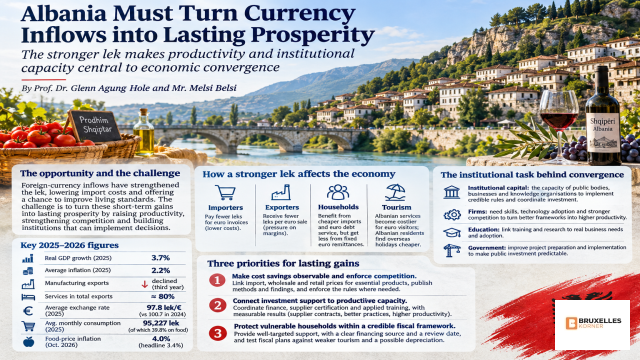
The European Commission’s Albania 2026 Report records real growth of 3.7% and average inflation of 2.2% in 2025. Yet manufacturing exports declined for a third consecutive year, while services, including travel, accounted for around 80% of total exports. [1] The Bank of Albania reports an annual average exchange rate of 97.8 lek per euro in 2025, compared with 100.7 in 2024. [2] These developments show why currency strength and the performance of productive sectors must be assessed together.
The household stakes are concrete. INSTAT’s 2025 Household Budget Survey records average monthly consumption expenditure of 95,227 lek, of which 37,859 lek, or 39.8%, went to food and non-alcoholic beverages. [3] In October 2026, annual food-price inflation reached 4.0%, against headline inflation of 3.4%. [4] When food absorbs close to two-fifths of consumption expenditure, its price matters directly to the room households have for other needs.
The distribution of currency gains
Appreciation redistributes opportunities and pressures. Importers need fewer leks to pay a given euro invoice; exporters receive fewer leks from a given euro sale. Imported inputs can offset part of an exporter’s loss, but domestic wages and rents do not automatically fall. Households earning lek may benefit from cheaper imports and euro debt service, while families receiving fixed euro remittances receive less in local currency.
Tourism experiences both sides of this adjustment. Services priced in lek become more expensive for euro-paying visitors if local prices remain unchanged. Hotels selling fixed euro packages may absorb the change through tighter margins. Albanian residents earning lek find overseas holidays cheaper. Future demand therefore depends on the quality of the visitor experience and competing destinations as well as the exchange rate.
The goods trade balance cannot explain the currency on its own. Tourism receipts, remittances, investment flows and currency preferences also matter. The IMF’s model-based analysis of Albania, published in 2025, attributes appreciation largely to fundamental developments and finds gradual transmission into consumer prices. [5] An unchanged merchandise import-to-export ratio gives no reason to expect an unchanged exchange rate.
Household disappointment also requires a distinction between inflation and affordability. Lower inflation leaves earlier price increases largely intact. Positive inflation does not establish that appreciation delivered no benefit: prices might otherwise have risen faster. The Bank of Albania’s annual report explicitly attributes part of the moderation in inflation to appreciation. [2]
Preliminary Eurostat-based figures published by Statistics Norway put Albania’s food and non-alcoholic beverage price level at 103.8% of the EU average in 2025. [6] That comparison is relevant to affordability, but it incorporates exchange rates. Appreciation can increase the euro-equivalent price level even when prices in lek remain unchanged. Eurostat cautions that comparative price-level indices and domestic inflation indices answer different questions. [7]
Research by Campa and Goldberg helps explain why lower border costs need not produce an equal reduction in retail prices: distribution margins and domestic inputs separate the import invoice from the checkout price. [8] Transport, wages, rents and inventories can absorb or delay cost changes. Market power may also affect pricing, but high food prices alone establish neither collusion nor the size of any increase in profit margins.
The institutional task behind convergence
We use institutional capital to describe the accumulated capacity of public bodies, businesses and knowledge organisations to implement credible rules and coordinate productive investment. The concept draws on North’s explanation of how institutions shape incentives and transaction costs. [9] Its economic value becomes visible when firms can make investments that depend on reliable contracts, infrastructure and public administration.
Albanian evidence gives this argument practical substance. The OECD’s 2026 assessment finds that stronger policy arrangements for SME internationalisation have yet to generate consistent competitiveness gains. [10] The IMF’s 2025 consultation identifies skills, technology adoption and stronger competition institutions as priorities amid appreciation and rising wages. [11] The shared implication is that better frameworks need to produce changes inside firms.
Tourism can help create those changes when visitor spending connects to domestic production. An IFC–World Bank diagnostic published in 2022 identified underused opportunities for locally produced goods in hotels and restaurants. [12] Developing these connections requires suppliers that can meet consistent standards and delivery commitments.
Alpeta, a family-owned winery near Berat, provides a documented illustration. According to the EBRD’s 2026 account, the business expanded from wine production into accommodation, food and guided visits. EBRD and EU support also helped it secure certifications covering health and safety, food safety, environmental management and quality standards. [13] The case illustrates the business capabilities needed to connect tourism opportunities with local production.
Education belongs in this process. The OECD’s 2024 assessment identified limited incentives and implementation in business–academia cooperation. [14] Universities and vocational providers can help firms solve production and management problems, provided cooperation is organised around actual needs and adoption. Training has economic value when people can apply it independently and organisations retain the knowledge.
The same principle applies to government. The Commission identifies recurring under-execution of public investment and weaknesses in project preparation and implementation. [1] A policy announcement creates expectations; implementation determines whether a business can invest against them. Institutional capital accumulates when that relationship becomes predictable.
Three priorities for lasting gains
First, make the transmission of cost savings observable and enforce competition on the evidence. INSTAT, the central bank and the competition authority should build on existing statistics and monitoring to link import, wholesale and retail prices for essential products. Analysis should control for taxes, domestic costs, seasonality and quality, and test whether prices respond differently to cost increases and decreases. Aggregate findings and methods should be public. Where unlawful conduct is established, enforcement should follow; where logistics or entry barriers explain high costs, reform should address them.
Second, connect investment support to measurable improvements in productive capacity. The ministries responsible for economic development and education should coordinate finance, supplier certification and applied training around firms’ investment needs. Tourism suppliers offer one practical starting point. Programmes should publish outcomes such as sustained supplier contracts, adoption of better production practices and productivity improvements. Public investment priorities need a responsible institution, a realistic budget and reliable execution. Support should help viable firms compete, with clear limits on public exposure.
Third, protect vulnerable households within a credible fiscal framework. Assistance should reflect disposable resources after currency conversion and the cost of essential expenditure, consistent with the IMF’s recommendation for well-targeted social support. [11] Measures need an identified financing source and a review date. Fiscal planning should also test weaker tourism receipts and depreciation. Appreciation reduces the lek value of fixed euro debt, but that benefit can reverse; the IMF identifies tourism and associated exchange-rate and property-market effects among Albania’s risks. [11]
These priorities require clarity about monetary policy. The Bank of Albania describes a floating framework without a targeted currency level. [2] The IMF’s 2025 consultation records a de facto “crawl-like” classification from 2024, reflecting intervention and the observed currency path. [11] Its recommendation is greater exchange-rate flexibility, with interest rates as the principal price-stability instrument. [5] Transparency about intervention helps businesses understand the framework in which they invest.
Albania has an opportunity to use its stronger lek to invest in an economy that can sustain better living standards. Success should be measured by households’ real purchasing power and firms’ ability to pay higher wages competitively. That requires institutions whose decisions survive the transition from policy documents to everyday economic practice.
References
[1] European Commission (2026). Albania 2026 Report. SWD(2026) 690 final, 4 November. Economic criteria, pp. 59–65. Read source
[2] Bank of Albania (2026). Annual Report 2025. Box 1, pp. 24–27; inflation, pp. 37–40; foreign-exchange developments, pp. 43–44. Read source
[3] INSTAT (2026). Household Budget Survey 2025. Released 6 October, pp. 1–2, including Table 1. Survey averages for resident households. Read source
[4] INSTAT (2026). Consumer Price Index, October 2026. Released 9 November, pp. 1–2. Read source
[5] International Monetary Fund (2025a). Albania: Selected Issues. Country Report No. 25/21, January. Chapter on foreign-exchange intervention, pp. 3–10, especially paragraphs 8 and 12–15. Analysis completed 17 December 2024. Read source
[6] Statistics Norway (2026). Comparison of price levels in Europe. Updated 19 June. Table 2, Eurostat-based preliminary 2025 price-level indices, EU27 = 100. Accessed 11 November 2026. Read source
[7] Eurostat (n.d.). Purchasing power parities: Information on data. Definitions of price-level indices and guidance on comparisons across years. Accessed 11 November 2026. Read source
[8] Campa, J. M. and Goldberg, L. S. (2010). The Sensitivity of the CPI to Exchange Rates: Distribution Margins, Imported Inputs, and Trade Exposure. Review of Economics and Statistics, 92(2), 392–407. DOI 10.1162/REST.2010.11459. Accessible earlier version: Federal Reserve Bank of New York Staff Report 247 (2006), especially pp. 1–3. Read source
[9] North, D. C. (1991). Institutions. Journal of Economic Perspectives, 5(1), 97–112. DOI 10.1257/jep.5.1.97. Read source
[10] OECD (2026). SME Policy Index for Western Balkans and Türkiye 2026 – Economy Profile for Albania. OECD Publishing, Paris. SME internationalisation, pp. 81–86. DOI 10.1787/ab22c29c-en. Read source
[11] International Monetary Fund (2025b). Albania: 2025 Article IV Consultation—Press Release; and Staff Report. Country Report No. 25/345, December. Targeted assistance, p. 14; monetary policy, paragraph 24, p. 17; productivity and competition, paragraph 35, pp. 22–23; exchange regime, Annex II, p. 40; risks, Annex III, pp. 41–42. Read source
[12] IFC and World Bank (2022). Creating Markets in Albania: Taking Advantage of New Trade and Investment Opportunities for a More Robust Private Sector. Country Private Sector Diagnostic, June. Firm capabilities, pp. 38–41; local tourism supply linkages, p. 108; policy recommendations, pp. 131–134. Read source
[13] Vlajcic, B. (2026). EBRD and EU help drive Albania’s tourism development. European Bank for Reconstruction and Development. Section Paving the way to business growth, describing Alpeta winery. Accessed 11 November 2026. Read source
[14] OECD (2024). Western Balkans Competitiveness Outlook 2024: Albania. OECD Publishing, Paris. Business–academia cooperation, pp. 149–152. DOI 10.1787/541ec4e7-en. Read source
Yorum Yazın