

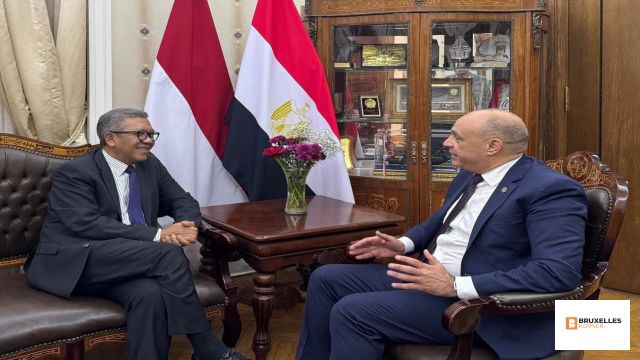





Bridging ASEAN and Africa: Indonesian Ambassador Outlines Strategic Roadmap with Cairo
Amr Yehia

Rooted in the spirit of the 1955 Bandung Conference, Egyptian–Indonesian relations have entered a dynamic new era. Following the Strategic Partnership Declaration signed by Presidents Abdel Fattah El-Sisi and Prabowo Subianto in April 2025, and El-Sisi’s subsequent visit to Jakarta in October 2026, both nations are translating political alignment into concrete economic, diplomatic, and humanitarian results. In an exclusive interview with Brussels Corner, Indonesian Ambassador to Cairo Kuncoro Giri Waseso outlines the roadmaps behind new bilateral agreements, Egypt’s indispensable role as a humanitarian lifeline for Gaza, and how both countries serve as mutual gateways to African and Southeast Asian markets.
Brussels Corner (BC): Following the Strategic Partnership Declaration, how is this upgraded status being implemented, and what are your priorities in Cairo?
Kuncoro Waseso: The signing of the Strategic Partnership Declaration by President Prabowo Subianto and President Abdel Fattah El-Sisi on 12 April 2025 marked an important new chapter in our bilateral relations. The priority now is to translate this political commitment into concrete and measurable cooperation.
During the recent visit of President Abdel Fattah El-Sisi to Jakarta on 10–11 October 2026, the two countries signed four agreements:
- Memorandum of Understanding between the Ministry of Foreign Affairs of the Republic of Indonesia and the Ministry of Foreign Affairs of the Arab Republic of Egypt on the Plan of Action for the Strategic Partnership;
- Memorandum of Understanding on Visa Exemption for Holders of Diplomatic, Service and Special Passports;
- Memorandum of Understanding on Statistics; and
- Memorandum of Understanding between the Ministry of Marine Affairs and Fisheries of the Republic of Indonesia and the Arab Republic of Egypt on Marine Affairs and Fisheries.
In my view, these agreements reflect the excellent state of relations between our two countries, and I am confident that our cooperation will continue to grow across a wide range of fields.
During my mission in Cairo, I would like to focus on three main areas. First, strengthening political dialogue and coordination between our two governments. Second, expanding economic cooperation, particularly trade and investment, by connecting our business communities and facilitating a more supportive framework for bilateral trade. Third, strengthening the long-standing people-to-people relationship through educational, religious, and cultural cooperation. My task as Ambassador is to turn this Strategic Partnership into tangible results that bring real benefits to our people.
(BC): How do Cairo and Jakarta coordinate on pressing global and regional political issues?
Kuncoro Waseso: Indonesia and Egypt share important principles in their foreign policies, including multilateralism, respect for sovereignty and international law, peaceful settlement of disputes, and support for a more balanced international order.

Our coordination takes place bilaterally and through multilateral forums such as the United Nations, the Organisation of Islamic Cooperation, and the Non-Aligned Movement. We also work together on issues of common concern, particularly developments in the Middle East and Palestine, where both countries consistently emphasize diplomacy, de-escalation, and regional stability.
Indonesia sees Egypt as an important partner in the Arab world and Africa, while Indonesia, in turn, brings a Southeast Asian and Asia-Pacific perspective. This complementarity allows our two countries to contribute constructively to a stronger voice for developing countries and the Global South.
(BC): How critical has Egypt’s role been in delivering Indonesian humanitarian aid to Gaza?
Kuncoro Waseso: Egypt’s role is absolutely essential. Its geographical position and logistical infrastructure make Egypt one of the most important humanitarian gateways for assistance to the Palestinian people in Gaza.
Indonesia deeply appreciates the cooperation of the Egyptian authorities in facilitating humanitarian assistance. Since the humanitarian crisis in Gaza began, assistance from Indonesia has continued to be channeled largely through Egypt. As recorded by the Embassy, by February 2026, Indonesian humanitarian assistance for Palestine facilitated through Egypt had reached approximately USD 22.55 million, weighing around 2,580 tons. In April 2026, I also had the opportunity to send off a further convoy of 24 trucks carrying around 500 tons of food, health packages, and blankets for approximately 150,000 beneficiaries in Gaza.
Indonesia has also deployed medical personnel. Indonesian military medical teams have treated Palestinian patients at the UAE Field Hospital in Rafah and the UAE Floating Hospital in Al-Arish.
For Indonesia, support for Palestine is a constitutional, historical, and humanitarian commitment. We continue to support the realization of an independent Palestinian state based on the two-state solution, in accordance with relevant international resolutions, with East Jerusalem as its capital. In both humanitarian efforts and the pursuit of peace, cooperation with Egypt remains indispensable.
(BC): What specific steps are underway to expand bilateral trade and joint investments?
Kuncoro Waseso: Our economic relationship is showing very positive momentum. Bilateral trade reached USD 2.38 billion in 2025, surpassing USD 2 billion for the first time. In the first half of 2026, trade had already reached around USD 1.74 billion.
The next step is to sustain this momentum while broadening the relationship beyond trade. We want to strengthen direct links between Indonesian and Egyptian businesses, facilitate market access, and encourage investment and mutually beneficial partnerships. The Indonesia–Egypt Joint Trade Committee is one mechanism that can help advance this agenda.
In agriculture and food security, there is considerable complementarity. Indonesia exports products such as vegetable oils, coffee, tea, and spices, while Egypt supplies Indonesia with products including fertilizers, fruits, and vegetables. For the Embassy, the objective is practical: more trade in both directions, stronger business connections, and, where commercially viable, greater two-way investment.
(BC): How can Egypt and Indonesia act as mutual gateways into African and Southeast Asian markets?
Kuncoro Waseso: This is one of the strongest strategic arguments for closer Indonesia–Egypt economic cooperation. Egypt has a unique geographical position connecting Africa, the Middle East, and the Mediterranean, supported by important industrial and logistical infrastructure and its participation in the African Continental Free Trade Area. Indonesian companies can therefore look at Egypt not only as an important market in its own right, but also as a potential platform for reaching wider African markets. We encourage Indonesian businesses to explore partnerships, distribution networks, and investment in Egypt, seeing particular potential in locations such as Aswan as a gateway toward Sudan and other African markets.
The same logic applies in the other direction. Indonesia is Southeast Asia’s largest economy and a founding member of ASEAN. Its large domestic market and commercial networks can provide Egyptian businesses with an entry point into Southeast Asia, allowing us to gradually build stronger business and supply-chain linkages between the two regions.
(BC): How does Indonesia support strengthening Egypt–ASEAN institutional ties and economic engagement?
Kuncoro Waseso: Indonesia strongly supports deeper engagement between Egypt and ASEAN. Egypt already has a solid institutional foundation, having accredited its Ambassador to ASEAN in 2011 and acceded to the Treaty of Amity and Cooperation in Southeast Asia in 2016, alongside the active ASEAN Committee in Cairo. Furthermore, the July 2026 meeting in Manila between the ASEAN Secretary-General and Egyptian Foreign Minister Badr Abdelatty reaffirmed our shared commitment to advancing mutual interests.
As a founding member, Indonesia plays a bridging role by connecting Egyptian government institutions, chambers of commerce, businesses, and universities with Southeast Asian counterparts. Immediate cooperation priorities include trade, investment, food and energy security, supply-chain resilience, renewable energy, digital transformation, tourism, and capacity building—reinforcing economic resilience and Asia–Africa solidarity.
(BC): How does Al-Azhar reinforce cultural diplomacy and moderate Islamic scholarship between Cairo and Jakarta?
Kuncoro Waseso: Al-Azhar occupies a unique place in our relations. Over 20,000 Indonesian students currently study in Egypt—mostly at Al-Azhar—returning home as scholars and community leaders who promote wasatiyyah, tolerance, and resilience against extremism.
Encouragingly, this intellectual bridge is becoming two-way. The Indonesian Language and Literature undergraduate program at Al-Azhar’s Faculty of Languages and Translation adds a vital institutional dimension, complementing our Indonesian Culture Center’s outreach in Egypt. Through academic exchanges, joint research, and scholarships, Al-Azhar remains one of the most enduring pillars connecting our two peoples.
Yorum Yazın