





What Two Central Asian Rivers Can Teach the UN About Development After 2030
By Dr Glenn Agung Hole
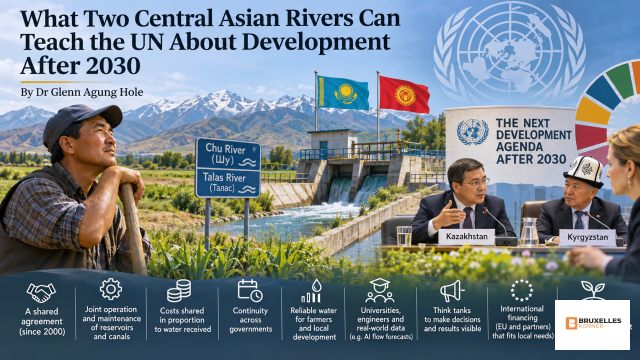
A farmer in southern Kazakhstan deciding what to sow has a stake in the maintenance budget of neighbouring Kyrgyzstan. On the Chu and Talas rivers, reservoirs and canals on Kyrgyz territory supply water to Kazakh fields. Under an agreement signed in 2000, the two countries share the cost of operating and maintaining specified facilities in proportion to the water each receives. When the United Nations considers what should follow the Sustainable Development Goals in 2030, I would give that agreement a place on the negotiating table.

At its Geneva seminar on 26 November, the Astana Platform discussed how the next development agenda should work. An international group formed in Astana in May had already presented its ideas at a side event during the UN’s High-Level Political Forum in July. In his opening remarks, science minister Sayasat Nurbek described President Kassym-Jomart Tokayev’s proposal for regular dialogue between the group and the UN around the 2027 SDG Summit. What should Kazakhstan bring to that conversation?
My answer, as an institutional economist, is that governments should explain who can act on a development target, who pays over its lifetime and who can demand a change. In the two river basins, an upstream government bears costs that benefit people downstream. A Kyrgyz finance minister answering to domestic taxpayers needs grounds to spend money on a canal that also serves Kazakh farms. A rule linking each country’s contribution to the water it receives makes that expenditure defensible in both capitals.
The two governments also have a joint commission that agrees on water allocations, repairs and financing. Between 2004 and 2021, Kazakhstan contributed over US$5.5 million towards operating and maintaining the infrastructure. Engineers have carried out repairs at the Kirov reservoir. Behind those repairs is what I call institutional capital. Officials retire and ministers change. Their successors still have a rule they can invoke, records they can consult and a counterpart obliged to discuss the matter. For the farmer choosing a crop, that continuity has economic value every planting season.
In February, the UN Resident Coordinator in Kazakhstan reported that the country had achieved, or was on course to achieve, nearly 40 per cent of its SDG targets, against a global estimate then standing at 18 per cent. The UN’s July global assessment found that 15 per cent of the 139 targets with sufficient data were on track. For a farmer at the end of a canal, the measure that matters is whether water arrives during the weeks when a crop needs it most.
My years in management before entering academia taught me to ask who inherits a project once its sponsors leave. Universities face a version of that question. Imagine a Kazakh and a Kyrgyz university jointly developing an artificial intelligence model to forecast summer river flows. An irrigation engineer who has seen a gauge give unreliable readings during a thaw may spot an error that escapes both research teams. Would the engineer have access to the underlying observations? Could the water authority revise its allocation in time? I would judge the value of that research partly by whether somebody on duty on a Friday afternoon had the authority and skill to act on a corrected local forecast.
Think tanks can make those decisions visible. Before the 2027 summit, the Astana group could invite the river commission, farmers’ associations and researchers to reconstruct one irrigation season. Publish the original forecast, the allocation each side expected, the repairs each funded and the dates on which water reached users. Invite farmers at the far end of a canal to challenge the account. Record who heard those objections and whether the allocation changed. The UN Regional Centre for the Sustainable Development Goals for Central Asia and Afghanistan in Almaty could bring neighbouring countries into that discussion.
Brussels already has somewhere to take the findings. In December 2025, Central Asian ministries met in Tashkent for EU-supported discussions on the Amu Darya and Syr Darya basins. European officials deciding how to finance water cooperation could ask local operators which running cost is hardest to cover. It might be a technician to keep a gauging station working through winter. Paying that salary for several seasons could do more for the reliability of a forecast than buying another generation of sensors.
For a middle power like Kazakhstan, writing the first draft of an international financing rule is an exercise in foreign policy. Whoever drafts it helps decide which costs count and whose evidence carries weight. Brussels should invite Central Asian partners to identify European grant conditions that make a shared service harder to run. A policy dialogue in which the donor also answers for its decisions would give practical meaning to Europe’s commitment to an equal partnership.
I would like Kazakhstan to make room at the 2027 summit for a Kyrgyz official who can explain who paid for a repair and a Kazakh farmer who can say whether it made a difference. The repair may have come in on budget and the water too late for the harvest. The next development agenda should make that discrepancy impossible for either government to ignore.
Dr Glenn Agung Hole is an institutional economist and Associate Professor at the University of South-Eastern Norway. He is an Honorary Professor at Sarsen Amanzholov East Kazakhstan University, a Non-Resident Fellow at the CFive Intellectual Platform in Astana and a board member of the Eurasia Policy Council in London.
Yorum Yazın