
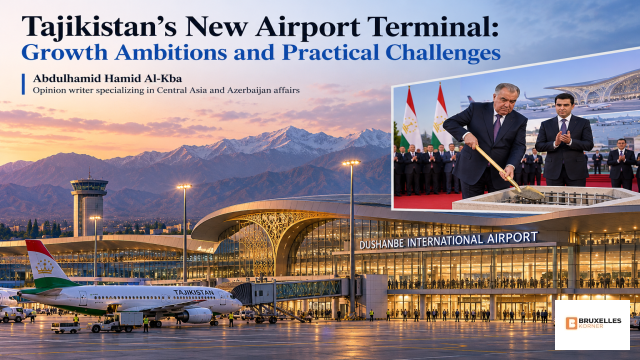





Tajikistan’s New Airport Terminal: Growth Ambitions and Practical Challenges
Abdulhamid Hamid Al-Kba
Opinion writer specializing in Central Asia and Azerbaijan affairs
BRUXELLES KORNER | CENTRAL ASIA | ANALYSIS
On the evening of October 9, 2026, Dushanbe International Airport witnessed the groundbreaking of a new international passenger terminal. The ceremony was led by President Emomali Rahmon of Tajikistan, joined by the mayor of the capital and chairman of the upper house of parliament, Rustam Emomali.
This project forms part of the country’s broader efforts to modernize its air transport infrastructure and aims to raise the airport’s annual capacity to 8.5 million passengers. The event marks the start of a new phase in the development of Tajik aviation—one that deserves a balanced analytical reading that weighs both the opportunities and the challenges.

Expanding Capacity to Meet Growing Demand
The importance of building the new international terminal stems from a clear and pressing need to expand capacity.
Designed to handle 8.5 million passengers a year, construction officially began on October 9, 2026. The project reflects an awareness that the existing infrastructure is no longer sufficient in the face of growing tourism and travel demand.
In the first half of the year, the airport recorded a noticeable increase in passenger numbers compared with the same period the previous year.
A modern terminal should improve the passenger experience, reduce congestion, and deliver services that meet international standards while still reflecting Tajik traditions of hospitality.
An Ambitious 18-Month Construction Timeline
According to the project plan, construction is scheduled to be completed within 18 months.
The terminal will be built to modern international standards, using high-quality materials and involving hundreds of experienced specialists. Its goal is to raise the level of passenger services and ensure compliance with international requirements.
During the visit, President Rahmon issued clear instructions to the airport management and other responsible officials to guarantee high-quality construction and stick to the set timeline.
This emphasis on quality and speed is positive, yet it also places pressure on implementation—especially given the continued absence of public details about the total cost, sources of funding, or the main contractor.
Strengthening Tajikistan’s International Connectivity
In the wider context, Tajikistan is working to modernize its transport infrastructure and improve its connectivity with global markets.
Developing aviation facilities is one part of these efforts, aimed at enhancing passenger services and strengthening regional and international links.
Dushanbe International Airport already plays an important role in supporting business travel, tourism, and international cooperation.
Upgrading its infrastructure can improve the traveler experience, facilitate movement, and reinforce the capital’s position as a gateway for visitors and partners.
Continued development of the aviation sector could also support tourism growth, encourage business mobility, and create additional opportunities for cooperation with international airlines and travel organizers.
Some reports have noted that the project aligns with the country’s “open skies” policy and with the rise in foreign tourist arrivals, which reached around 1.3 million in the first eight months of the year.
Could Dushanbe Become a Regional Aviation Hub?
From an analytical perspective, the project clearly carries significant weight.
The airport’s current capacity remains relatively limited compared with the ambition announced, and expanding it to 8.5 million passengers a year represents a substantial leap.
If accompanied by real growth in flights and destinations, it could help position Dushanbe as a potential regional hub in Central Asia.
In this sense, the terminal would strengthen Tajik aviation in terms of both capacity and efficiency, while opening the door to attracting more airlines and improving air connectivity.
At the same time, success will depend on several other factors:
The actual quality of construction.
The ability to attract new investment and routes.
The development of ground services.
The capacity to compete with more advanced regional airports.
The continued training of airport personnel to meet international standards.
The intention to combine traditional hospitality with international standards is commendable, yet it will require ongoing staff training.
Conclusion: Infrastructure Ambition Must Be Matched by Execution
In the end, this project is both a balanced and ambitious step.
It responds to a genuine need for growth and gives Tajikistan a real opportunity to strengthen its aviation standing.
Yet it is not a magic solution.
True success will only become clear after the terminal enters operation—when the airport can actually handle larger numbers of passengers with efficiency and comfort.
Until then, the outcome will rest on careful follow-through and precise execution, as is the case with any major infrastructure project in a region undergoing continuous change.
Abdulhamid Hamid Al-Kba
Opinion writer specializing in Central Asia and Azerbaijan affairs
Published by Bruxelles Korner
International Affairs | Central Asia | Aviation Infrastructure | Economic Development
Yorum Yazın