




Tajikistan and the Industrialization Option: Opportunities for Transformation and Implementation Challenges
By Abdulhamid Hamid Al-Kba
Opinion Writer Specializing in Central Asia and South Caucasus Affairs
Tajikistan is currently facing a decisive test of its development ambitions. During a recent meeting in the Sughd region, President Emomali Rahmon delivered a clear and unequivocal message: exporting raw minerals is no longer acceptable. Every ton of mineral resources must now be processed domestically and transformed into finished products before being exported. This policy represents a determined effort to move away from the country’s traditional resource-dependent economic model. What stands out most is the government’s commitment to advancing this strategy despite significant structural challenges.

The Ministry of Energy and Water Resources stated that the President has instructed regional and local authorities to urgently improve the industrial investment climate, develop infrastructure, allocate land for new projects, and support private export-oriented initiatives.
President Rahmon stressed that developing the mining sector is a national priority and that raw minerals must be processed locally before export. He also called on entrepreneurs and investors to expand manufacturing capacity and produce competitive industrial goods. Consequently, attracting private investment has become a cornerstone of the country’s industrial policy, particularly in mining, construction materials, energy, chemicals, and food processing.
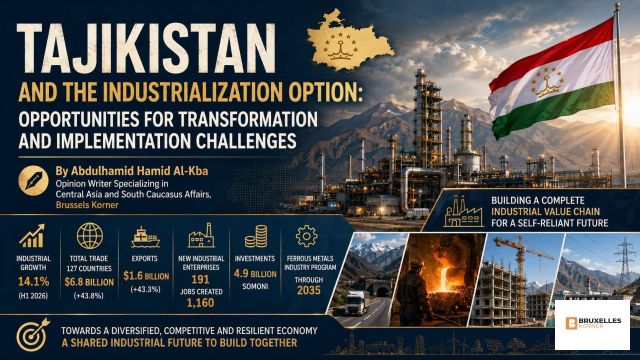
The core strategic shift lies in gradually moving from exporting raw minerals to producing high-value industrial goods. To support this transition, the President has ordered the preparation of a national ferrous metals industry development program through 2035, with the objective of establishing a complete industrial value chain.
According to Minister of Industry Sherali Kabir, industrial output reached 33.8 billion somoni during the first half of 2026, representing a 14.1% increase compared with the same period last year. Tajikistan now ranks among the fastest-growing industrial economies in the Commonwealth of Independent States (CIS), with the Sughd region accounting for 60.8% of the country’s total industrial production. During this period, 191 new industrial enterprises were established, creating 1,160 jobs and attracting approximately 4.9 billion somoni in investments.
This momentum is also reflected in foreign trade. Total trade with 127 countries reached $6.8 billion during the first half of 2026, an increase of 43.8% year-on-year. Exports rose to $1.6 billion (+65.3%), with industrial products accounting for 97.4% of total exports. The country’s principal export destinations included Switzerland, China, Türkiye, Uzbekistan, and Belgium. Precious metals and gemstones generated $517 million, while ores and concentrates contributed $451.7 million.
None of these ambitions can be achieved without modern infrastructure. Tajikistan is currently implementing 11 major road and transport projects valued at more than $1.193 billion. Meanwhile, construction of the Tajik Metallurgical Complex continues, with plans to incorporate seven industrial enterprises by 2029.
President Rahmon has explicitly linked this project to strengthening the country’s industrial self-reliance. He argues that greater self-sufficiency in the metals sector will enable Tajikistan to carry out large-scale national projects with fewer external constraints, whether arising from international sanctions or global crises. A fully integrated production cycle would enhance the country’s capacity to build industrial cities, strategic transport corridors, power plants, and other critical infrastructure.
This strategy is significant because it aims to increase domestic value addition, generate sustainable employment, reduce dependence on imports, and strengthen exports. It also creates new opportunities for international cooperation, particularly with China.
Nevertheless, significant challenges remain. Limited domestic financing, a shortage of skilled technical workers, difficulties in attracting Western investment in a complex geopolitical environment, and periodic electricity shortages could all constrain the development of heavy industry. At the same time, heavy reliance on Chinese investment presents both opportunities and strategic risks. Ultimately, the success of this industrial transformation will depend on sustained political commitment and transparent implementation.
Today, Tajikistan is attempting to write a new chapter in its economic history. Recent indicators—14.1% industrial growth, $1.6 billion in exports, and $6.8 billion in total trade—provide grounds for cautious optimism.
If the country successfully implements its ferrous metals development program through 2035 and succeeds in building genuine domestic industrial capacity, it could achieve meaningful economic diversification and emerge as a significant industrial player in Central Asia.
The opportunity is real, and the political commitment appears strong. In the end, however, implementation will be the decisive factor.
Yorum Yazın