
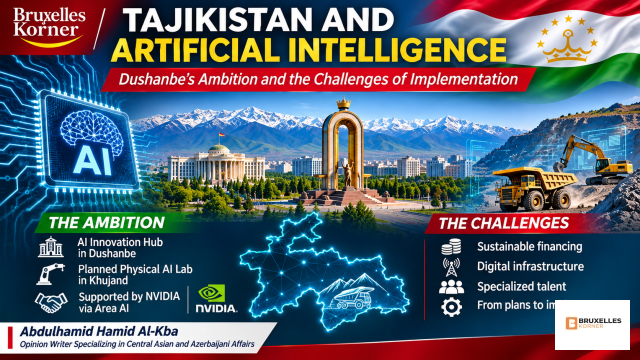





Tajikistan and Artificial Intelligence: Dushanbe’s Ambition and the Challenges of Implementation
By Abdulhamid Hamid Al-Kba
Opinion Writer Specializing in Central Asian and Azerbaijani Affairs

On 21 October 2026, Tajikistan announced plans to establish an Artificial Intelligence Innovation Hub in its capital, Dushanbe, with support from NVIDIA through the regional Area AI platform. The announcement was made during an event at the Tajik Embassy in Berlin, held in connection with the NVIDIA GTC conference and attended by company representatives and officials from several technology firms.
However, the fundamental question is not whether Tajikistan has joined the global artificial intelligence race, but whether it can transform this initiative into a sustainable ecosystem capable of generating knowledge, developing skills, and delivering practical solutions for its domestic economy.
The initiative envisages establishing an innovation center that brings together universities, software developers, startups, and industrial enterprises, with a particular emphasis on specialized training, research, and practical applications.
The technology company zehnlab.ai, a founding member of the regional AI consortium, is expected to develop and manage the hub, while the Artificial Intelligence Council under Tajikistan's Ministry of Industry and New Technologies will provide institutional support.
Plans also include establishing a Physical AI laboratory in Khujand, dedicated to testing industrial applications, particularly in the mining sector.
Azizjon Azimi, chairman of the Artificial Intelligence Council, explained that cooperation with NVIDIA would focus on specialized training and introducing physical AI technologies into industrial operations.
Tajikistan's ambassador to Germany, Imomudin Sattorov, emphasized that the initiative aligns with national development priorities and the United Nations General Assembly resolution adopted in July 2025 on the role of artificial intelligence in creating new opportunities for sustainable development in Central Asia. The resolution was initiated by Tajikistan under President Emomali Rahmon.
Nevertheless, a clear distinction must be drawn between political announcements, institutional commitments, and concrete implementation.
Official communications refer to NVIDIA's support within the regional platform, but detailed information concerning the scale of financing, equipment deliveries, technical obligations, and the precise structure of the partnership has not yet been publicly established.
Consequently, the initiative should be viewed primarily as an announced development project rather than an already operational technological ecosystem.
Central Asia's Emerging Artificial Intelligence Landscape
The significance of Tajikistan's initiative becomes clearer when examined within the broader transformation of Central Asia's digital economy.
Kazakhstan currently occupies a leading position in regional artificial intelligence readiness. It has designated 2026 as the Year of Digitalization and Artificial Intelligence, established a dedicated ministry, and announced major investment agreements involving NVIDIA and other international technology partners.
These initiatives encompass large-scale data center infrastructure, advanced computing systems, supercomputing capabilities, and the development of national language models.
However, announced investment volumes and projected computing capacities should not be confused with infrastructure already completed or fully operational.
Kyrgyzstan, meanwhile, is pursuing a different strategy. Its approach emphasizes the integration of artificial intelligence into public administration, the modernization of digital infrastructure, and a relatively flexible regulatory environment based on principles of self-regulation.
The country's considerable hydropower potential could also provide opportunities for energy-intensive digital infrastructure, although converting that potential into reliable computing capacity will require substantial investment.
Tajikistan presents a somewhat different case.
By adopting a national artificial intelligence strategy as early as 2022, the country demonstrated relatively early political recognition of the technology's strategic importance.
Nevertheless, adopting a strategy ahead of neighboring countries does not automatically confer superiority in technological infrastructure, human capital, computing power, or investment capacity.
An early strategic framework offers an institutional advantage only when it is translated into concrete programs, operational capabilities, and measurable economic outcomes.
Mining and Industry: A Potential Competitive Advantage
The most promising economic opportunity for Tajikistan may lie in connecting artificial intelligence directly to industrial production, particularly the mining sector, which represents an important component of the national economy.
Rather than attempting to replicate the large-scale computing infrastructure being developed elsewhere in the region, Tajikistan could pursue a more specialized strategy centered on industrial applications.
Physical AI and related advanced technologies could contribute to several areas of industrial modernization:
Improving mineral identification, classification, and sorting.
Developing predictive maintenance systems for industrial equipment.
Increasing operational efficiency in extraction and processing.
Reducing energy consumption and industrial waste.
Strengthening workplace safety through automated monitoring and intelligent systems.
Such applications could generate tangible economic benefits by improving productivity, reducing operating costs, and supporting more efficient resource management.
However, their successful deployment depends on several essential conditions.
Reliable industrial data, qualified engineers, specialized technicians, modern digital infrastructure, stable electricity supplies, and long-term financing are indispensable.
Without these foundations, advanced technological equipment risks becoming an expensive demonstration of innovation rather than a productive economic asset.
If the planned Physical AI laboratory in Khujand and the innovation hub in Dushanbe succeed in developing practical solutions adapted to domestic industries, Tajikistan could establish a distinctive position within Central Asia's emerging artificial intelligence ecosystem.
This approach would allow the country to build competitive advantages in selected industrial fields instead of engaging in a costly technological competition with larger and better-funded regional economies.
The Structural Challenges Behind the Technological Ambition
Despite the potential benefits, several structural challenges remain.
Tajikistan's digital infrastructure is still developing, its pool of highly specialized technological talent remains relatively limited, and the availability of sustainable long-term financing cannot be taken for granted.
These constraints are particularly significant in an economy that depends heavily on workers' remittances, natural resources, and a relatively narrow domestic industrial base.
Furthermore, cooperation with a major international technology company does not automatically guarantee technological independence or the emergence of a sustainable domestic innovation industry.
The real value of such partnerships depends on their ability to facilitate knowledge transfer, professional training, institutional development, and the gradual creation of local technological expertise.
The objective should not simply be to import artificial intelligence technologies, but to develop the domestic capacity to understand, adapt, maintain, and eventually improve them.
This distinction is fundamental.
A country that merely purchases advanced technological systems remains dependent on external suppliers. A country that develops the skills to operate, adapt, and improve those systems gradually strengthens its technological sovereignty.
For Tajikistan, the challenge is therefore both economic and institutional.
Successful implementation will require coordination between government institutions, universities, private enterprises, industrial operators, and international technology partners.
It will also require continuity in public policy and a regulatory environment capable of encouraging investment while supporting innovation.
Measuring Success Through Results, Not Announcements
The effectiveness of Tajikistan's artificial intelligence initiative should ultimately be assessed through concrete and verifiable indicators.
Among the most relevant measures are the annual number of engineers, researchers, and technicians receiving specialized training; the number of AI applications successfully implemented in industrial facilities; the volume of domestic and foreign private investment attracted; and the number of skilled jobs generated.
Additional indicators could include measurable improvements in industrial productivity, reductions in maintenance costs, the creation of technology-oriented startups, and the development of research partnerships between universities and businesses.
These outcomes would provide a clearer assessment of the project's economic contribution than announcements, memoranda of understanding, or the symbolic presence of major international technology brands.
The distinction between technological ambition and technological capability is particularly important for developing economies.
Innovation should not be measured solely by the sophistication of imported equipment, but by the economic value created, the knowledge retained domestically, and the ability of local institutions to sustain technological progress.
Conclusion: From Technological Ambition to Economic Transformation
Ultimately, the central challenge facing Tajikistan is not announcing its participation in the global artificial intelligence race, but demonstrating its ability to transform that ambition into a sustainable national innovation ecosystem.
Kazakhstan currently benefits from a stronger position in technological readiness, investment capacity, and digital infrastructure, while Kyrgyzstan is exploring a more flexible development model combining regulatory innovation and renewable energy potential.
Tajikistan, by contrast, has an opportunity to pursue a specialized strategy that connects artificial intelligence with the practical needs of its industrial economy.
The proposed innovation hub in Dushanbe and Physical AI laboratory in Khujand could become important instruments of this transformation, provided that announced partnerships are followed by adequate financing, operational infrastructure, professional training, and sustained institutional commitment.
The decisive factor will be the country's ability to absorb, adapt, and eventually develop technological capabilities rather than remaining dependent on imported solutions.
Artificial intelligence can contribute to economic diversification, productivity growth, and industrial modernization, but it cannot replace the underlying requirements of development: education, infrastructure, institutional efficiency, and investment.
The true significance of Tajikistan's initiative will therefore not be determined by the announcement itself, nor by the international prestige of its technological partners, but by the measurable results it produces in the years ahead.
For Dushanbe, the real race is not simply to enter the age of artificial intelligence. It is to ensure that artificial intelligence becomes an instrument of sustainable economic development rather than another technological ambition that remains confined to official declarations.
Abdulhamid Hamid Al-Kba
Opinion Writer Specializing in Central Asian and Azerbaijani Affairs
Bruxelles Korner | International Analysis & Opinion
Yorum Yazın