
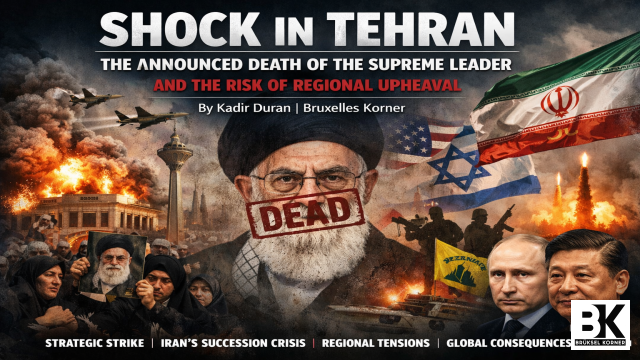





Shock in Tehran: The Announced Death of the Supreme Leader and the Risk of Regional Upheaval
Opinion – By Kadir Duran | Bruxelles Korner
Strategic strike, constitutional succession, Iranian retaliation and the reshaping of power balances

Introduction
Iranian state television has announced the death of Ayatollah Ali Khamenei following a military operation attributed to Israel, reportedly with American support according to several regional sources.
Israeli, Turkish and Anglo-Saxon media outlets have referred to a targeted strike on his residence in Tehran.
At the time of writing, certain operational details remain pending full independent confirmation. However, one element is established: Iran has activated the constitutional succession mechanism provided for under Article 111.
If the disappearance of the Supreme Leader is confirmed by all major international agencies, it would represent a strategic earthquake of historic magnitude for the Middle East.
Operational details are still undergoing comprehensive verification. Nevertheless, several major international media organizations have confirmed structural elements: activation of Iran’s constitutional mechanism, immediate diplomatic reactions, and a measurable impact on energy markets.
Beyond the event itself, the central issue lies in regional stability and systemic rivalry among major powers.
Reported Facts
According to information relayed by multiple media sources:
- An aerial operation allegedly targeted the Supreme Leader’s residence.
- Approximately 30 munitions were reportedly used.
- Several senior Iranian military officials are said to have been killed.
- Israeli media claimed that photographic evidence was transmitted to Israeli authorities.
- The Wall Street Journal reported that the timing was allegedly chosen to coincide with a strategic Iranian meeting.
- Reuters and the Associated Press confirmed that Iran activated the constitutional succession mechanism under Article 111 of the Constitution.
- Russia, through President Vladimir Putin, according to Russian agencies cited by Western media, reportedly condemned the operation.
Iran: Immediate Activation of the Constitutional Mechanism
In the event of a vacancy in the position of Supreme Leader, the Iranian Constitution provides a precise framework.
Powers are temporarily exercised by a council composed of:
- The President of the Republic,
- The Head of the Judiciary,
- A religious member of the Guardian Council.
The new Supreme Leader must be appointed by the Assembly of Experts, composed of 88 elected clerics.
Reuters and AP confirmed that this mechanism has been activated to prevent any institutional vacuum.
This is therefore not a power void, but a legally structured transition.
The End of a Leader, the Beginning of a Strategic Shift?
There are events that belong to military tactics.
And others that shift the tectonic plates of history.
The announced death of Ayatollah Ali Khamenei belongs to the latter category.
If definitively confirmed, this is not merely a targeted strike. It would constitute a major strategic rupture whose consequences extend far beyond Iran.
A Strike That Changes the Nature of the Conflict
Israel would not merely have neutralized an adversary.
It would have struck at the doctrinal core of the Iranian regime.
The Supreme Leader is not an ordinary head of state. He embodies the theological-political continuity of the Islamic Republic. His elimination through a foreign military operation transforms a geopolitical confrontation into a symbolic clash.
This would no longer be solely a strategic confrontation.
It would be perceived humiliation.
And in Iranian political culture, humiliation calls for response.
The Israeli Logic: Doctrine of Absolute Prevention
For years, Tel Aviv has applied a consistent doctrine: prevent Iran at all costs from reaching a military nuclear threshold.
If confirmed, this strike marks a qualitative leap:
- No longer targeting peripheral infrastructure.
- Targeting the head of the system.
The message would be clear: Israeli deterrence recognizes no taboos.
However, any decapitation doctrine carries risk: underestimating the ideological resilience of the adversary.
Iran: Between Revenge and Cold Calculation
Contrary to certain caricatures, Iran does not act impulsively.
The regime operates through strategic depth.
The most probable response would not be frontal, but asymmetric:
- Activation of Hezbollah,
- Pressure on U.S. bases,
- Maritime disruption,
- Cyber operations.
Tehran understands that direct conventional war with the United States would be devastating.
But Iran can make a conflict prolonged, costly, and unstable.
The Energy Variable: The Real Lever
The Middle East remains the energy core of the international system.
The Strait of Hormuz is not a geographical detail.
It is a strategic chokepoint.
A sustained disruption would trigger:
- A spike in oil prices,
- Increased global inflation,
- European economic fragility,
- Direct pressure on China.
At that point, the crisis exceeds the regional framework.
China: The Blind Spot
Iran is not economically isolated.
It is integrated into Asian energy dynamics.
China purchases substantial volumes of Iranian oil despite sanctions.
A sustained destabilization of Tehran indirectly weakens Beijing.
Are we witnessing an indirect confrontation involving China?
It would be naïve to dismiss that dimension.
The Middle East once again becomes the peripheral theater of a global rivalry.
Russia: Calculated Strategic Neutrality
Moscow condemns, but does not engage.
Russia has no interest in direct confrontation with Israel.
A sustained rise in energy prices even benefits it.
Its posture will remain pragmatic: official distance, strategic observation.
Europe: Political Alignment, Economic Vulnerability
Europe calls for de-escalation.
But it is not a central actor.
Its problem lies elsewhere:
- Energy dependence,
- Logistical vulnerability,
- Limited strategic autonomy.
Once again, the crisis exposes the limits of European power.
Turkey: Between Prudence and Exposure
Ankara will attempt to avoid direct involvement.
However, if the conflict spreads into Syria or Iraq, Turkey cannot remain indifferent.
Regional stability directly conditions its security.
The Real Risk: Miscalculation
For years, the Middle East has operated under a paradoxical logic:
- Permanent conflicts,
- Limited escalation,
- Cross-deterrence.
The death of the Supreme Leader alters that equation.
The stronger the symbol, the greater the internal Iranian pressure for visible retaliation.
The more visible the retaliation, the greater the risk of escalation.
We are not yet in a global war.
But we have entered a phase of heightened instability.
Three questions will determine the trajectory:
- Will Iran prioritize vengeance or strategic patience?
- Will Hezbollah cross the threshold into open war?
- Will China remain a spectator or become indirectly involved?
Conclusion: A Turning Point
The announced disappearance of the Supreme Leader does not close a cycle.
It opens a new one.
This moment may mark the end of a fragile equilibrium and the beginning of a more brutal regional recomposition.
Regional history teaches a constant:
Crises do not emerge from a single event;
They explode when multiple lines of tension converge.
Today, those lines are converging.
Uncertainty has become the dominant variable of the system.
What International Media Confirm
Reuters
Confirmed activation of Article 111 of the Iranian Constitution in case of vacancy of the Supreme Leader. Temporary powers are exercised by a council composed of the president, the head of the judiciary, and a cleric designated by the Guardian Council. Reuters also reports Russian diplomatic condemnation and international calls for restraint.
Associated Press (AP)
Emphasizes immediate institutional stability: no constitutional vacuum, maintenance of state structures, and continued control by the Revolutionary Guards. Succession remains the exclusive prerogative of the 88-member Assembly of Experts.
Wall Street Journal (WSJ)
Refers to meticulous operational planning, allegedly timed to coincide with a high-level Iranian strategic meeting. Frames the strike within Israel’s preventive neutralization doctrine concerning Iran’s nuclear program.
New York Times (NYT)
Reports recent reinforcement of U.S. military deployments in the Gulf, particularly naval assets, prior to the operation. Notes Washington’s balancing act: firm support for Israel while avoiding prolonged regional war.
Bloomberg
Highlights the immediate reaction of energy markets. Analysts warn that any disruption of the Strait of Hormuz could trigger a significant surge in oil prices. Markets remain highly sensitive to developments.
Yorum Yazın