





Kyrgyzstan’s Foreign Trade in 2026: Strong Growth, Persistent Imbalances and New Opportunities in the Gulf
Abdulhamid Hamid Al-Kba - Bruxelles Korner
An analysis of Kyrgyzstan’s trade performance during the first eight months of 2026 reveals a complex economic picture: expanding international trade, persistent import dependence, shifting regional partnerships and emerging opportunities in Gulf markets.

Kyrgyzstan’s latest trade figures tell a mixed story. An examination of the data for the first eight months of 2026 reveals a complex picture: clear growth accompanied by divergent underlying trends. These developments deserve careful analysis beyond the headlines.
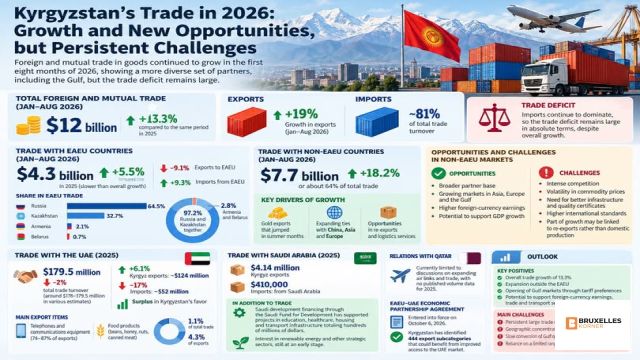
Foreign and mutual trade in goods increased by 13.3%, reaching approximately $12 billion between January and August 2026, according to preliminary data from the National Statistical Committee. In an economy that remains heavily dependent on imports, remittances and foreign investment, this increase signals stronger economic activity and expanding trade flows.
A balanced assessment, however, requires closer examination of the figures. Exports grew by approximately 19%, while imports continued to dominate, accounting for around 81% of total trade turnover. Consequently, the trade deficit remains substantial in absolute terms, and the expansion in trade volume has not yet translated into a more balanced trade structure.
This growth demonstrates the country’s ability to expand its commercial activities while highlighting the continued need to address its structural dependence on imports.
Trade Within the Eurasian Economic Union: Growth with Diverging Trends
Trade with other members of the Eurasian Economic Union (EAEU) reached $4.3 billion, representing an increase of 5.5% compared with the same period in 2025. This growth was slower than the overall expansion in Kyrgyzstan’s foreign trade.
Within the bloc, exports and imports moved in opposite directions. Kyrgyzstan’s exports to EAEU member states declined by 9.1%, while imports from those countries increased by 9.3%.
Russia accounted for 64.5% of Kyrgyzstan’s mutual trade within the union, followed by Kazakhstan at 32.7%. Together, these two countries represented 97.2% of the total, leaving Armenia and Belarus with a combined share of just 2.8%.
This concentration provides relative stability and logistical advantages, but it also exposes the Kyrgyz economy to economic fluctuations in these two major markets.
The decline in exports to EAEU countries may reflect several factors, including weakening competitiveness in certain product categories or a partial redirection of trade flows toward other markets. However, additional sector-specific data would be necessary to determine the precise causes.
Trade Beyond the EAEU: Diversification and Expanding Markets
A more pronounced shift can be observed in trade with countries outside the EAEU.
Trade with non-EAEU partners increased by 18.2%, reaching $7.7 billion, or approximately 64% of total foreign trade.
This expansion suggests a gradual diversification of Kyrgyzstan’s trading relationships, supported by stronger commercial ties with China, other Asian economies and Europe.
Several factors appear to be contributing to this development, including increased gold exports during the summer months and growing opportunities in re-exports and logistics services.
However, diversification also brings new challenges, including intense international competition, fluctuations in commodity prices and the need to improve transport infrastructure, product certification and compliance with international quality standards.
Furthermore, part of the recorded growth may be associated with re-export activities rather than an increase in domestic production. This distinction is particularly important when assessing the contribution of trade expansion to domestic value added and long-term economic development.
Gulf Markets: Emerging Opportunities for Kyrgyzstan
Within this broader expansion, Kyrgyzstan’s commercial relations with the Gulf countries, particularly the United Arab Emirates (UAE), deserve closer attention.
Although trade volumes remain relatively limited, these relationships provide an indication of the country’s efforts to develop new economic partnerships beyond its traditional markets.
According to available figures based on data from the National Statistical Committee, bilateral trade between Kyrgyzstan and the UAE reached approximately $179.5 million in 2025, although some reports place the figure closer to $176 million.
This represented a slight decline of approximately 2% compared with 2024.
Nevertheless, Kyrgyz exports to the UAE increased by 6.1%, reaching approximately $124 million, while imports declined by 17% to around $52 million. This resulted in a trade surplus in Kyrgyzstan’s favour.
Telephones and telecommunications equipment accounted for the largest share of exports, estimated at between 74% and 87%, depending on the classification and reporting source.
Other exported products included agricultural and food items such as beans, honey, nuts and canned meat.
In 2025, the UAE accounted for approximately 1.1% of Kyrgyzstan’s total trade and 4.3% of its exports, following a more than tenfold expansion in bilateral trade since 2020.
As of October 2026, detailed official trade figures covering the early months of 2026 were not yet available.
Saudi Arabia and Qatar: Economic Relations Beyond Merchandise Trade
Recorded merchandise trade between Kyrgyzstan and Saudi Arabia remains modest.
According to trade data reported by Kyrgyzstan for 2025, exports to Saudi Arabia reached approximately $4.14 million, while imports from the Kingdom amounted to around $410,000.
These figures should, however, be distinguished from the broader economic relationship between the two countries.
Saudi development financing, particularly through the Saudi Fund for Development, has supported projects in education, healthcare, housing and transport infrastructure, with financing commitments amounting to hundreds of millions of dollars.
There is also growing interest in strategic sectors such as renewable energy, although cooperation in these areas remains at an early stage compared with Kyrgyzstan’s more developed commercial relationship with the UAE.
Relations with Qatar are currently focused on discussions concerning the expansion of air connectivity and bilateral trade. However, comprehensive, publicly available trade-volume figures remain limited.
The EAEU–UAE Economic Partnership Agreement: A New Commercial Framework
The economic partnership agreement between the Eurasian Economic Union and the United Arab Emirates entered into force on 6 October 2026, introducing preferential tariff treatment for a broad range of goods.
Kyrgyzstan has identified 444 export subcategories that could benefit from improved access to the UAE market.
The agreement represents a potentially important opportunity for Kyrgyz exporters, particularly in the agricultural and food-processing sectors.
However, its practical impact will depend on several factors, including compliance with rules of origin, product standards, logistics costs and exporters’ ability to maintain consistent supplies.
The agreement could help transform currently modest bilateral trade into a more significant commercial relationship. Achieving this objective will nevertheless require sustained investment in product quality, transport infrastructure, certification and export capacity.
Economic Outlook: Opportunities and Structural Challenges
From an economic perspective, Kyrgyzstan’s recent trade performance presents both encouraging developments and persistent structural weaknesses.
The positive indicators include overall trade growth, the expansion of commercial relationships beyond the EAEU and the emergence of new opportunities in Gulf markets through preferential tariff arrangements.
These developments could support foreign-currency earnings, stimulate the trade and transport sectors, and contribute to economic growth if the expansion of exports continues.
However, the impact on foreign-exchange reserves will depend on net currency flows rather than the overall volume of merchandise trade.
Several major challenges remain.
The first is the persistent trade deficit, reflecting the country’s continued reliance on imported goods.
The second concerns the geographical concentration of trade within the EAEU, particularly the dominant roles played by Russia and Kazakhstan.
A third challenge lies in translating commercial opportunities in Gulf markets into meaningful and sustainable trade volumes.
Finally, Kyrgyzstan remains dependent on a relatively narrow range of export products, including gold and certain re-exported goods.
Strengthening light manufacturing, improving the quality and competitiveness of agricultural exports, and developing international trade corridors could help address these structural vulnerabilities.
In particular, expanding access to Gulf and wider Arab markets may offer opportunities for agricultural producers, food-processing businesses and logistics operators.
If these measures are implemented effectively, Kyrgyzstan could gradually transform quantitative trade growth into more sustainable, production-driven economic development.
Conclusion: Turning Trade Growth into Sustainable Economic Value
Ultimately, Kyrgyzstan’s latest trade figures tell the story of an economy seeking to balance regional integration with broader international engagement.
The country continues to benefit from its economic relationships within the Eurasian Economic Union while simultaneously expanding commercial ties with partners in Asia, Europe and the Gulf.
The 13.3% increase in trade turnover during the first eight months of 2026 represents a significant development, but it should not be interpreted as evidence that the country’s structural economic challenges have been resolved.
The central question is whether this growth can generate stronger domestic production, more competitive exports and greater economic resilience.
The long-term objective should therefore be to convert expanding commercial activity into higher domestic value added while developing a more diversified and sustainable export base.
Achieving this transformation will require consistent economic policies, investment in infrastructure, improved production standards and a gradual reduction in excessive dependence on imports.
Kyrgyzstan’s challenge is no longer simply to trade more, but to ensure that expanding trade contributes to a stronger, more diversified and more resilient national economy.
Bruxelles Korner | Economic and Geopolitical Analysis
Yorum Yazın