




Kyrgyz SNAP Initiative: A Step Toward Empowering Small Nations in Artificial Intelligence
By Abdulhamid Hamid Al-Kaba
Opinion writer specializing in Central Asia and Azerbaijan
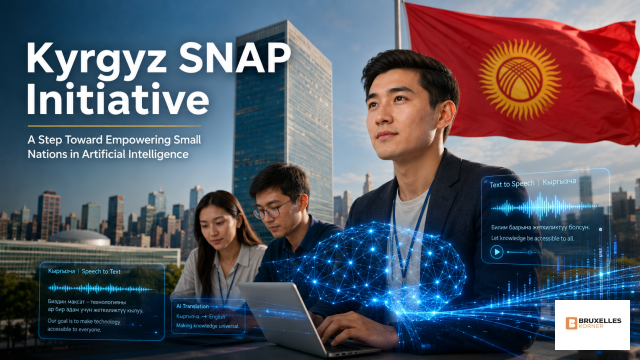
On June 25, 2026, Kyrgyzstan chose the United Nations headquarters in New York to launch the SNAP initiative — Small Nations AI Powerhouses.

The goal was clear: to create a shared space for countries that are often left out of the spotlight in the global AI race. The Kyrgyz mission organized a side event titled “AI for All,” focusing on practical issues far removed from mere slogans.
How do we build open datasets? How can we make speech-to-text technologies serve local languages such as Kyrgyz? The meeting produced practical recommendations on strengthening partnerships and supporting local linguistic content, with Kyrgyzstan emphasizing the importance of digital inclusion and cultural diversity.
What is even more impressive is that this initiative was not born out of the moment. It was the culmination of tangible previous steps.
On October 28, 2025, the AiRUN team presented a new language model. What caught my attention personally was that the model was not a translated or modified version of an existing one — it was built almost from scratch using 59 million words of authentic Kyrgyz data.

This is not just a statistic. When you see the model successfully passing BoolQ, HellaSwag, and PIQA benchmarks with remarkable results, you feel that something truly different is happening. These tests do not measure rote memorization of information, but rather the machine’s ability to think in a human-like manner: Does it understand context? Can it logically complete a story? Does it realize that ice melts faster in hot water? AiRUN succeeded in ways that make you wonder: Why did we wait so long to develop local models?
Frankly, AiRUN gives a feeling of hope. Suddenly, it has become possible to build government services that understand citizens naturally in Kyrgyz, a banking assistant that grasps customer intent, or an educational platform that interacts with students in a personalized way.
Even better, it fully supports voice technologies — STT and TTS — opening the door wide to local voice solutions without the need to rely on foreign servers. Chingiz Arziyev, the company’s CEO, summarized it powerfully: “We have proven that Kyrgyzstan is capable of innovation. Our language is no longer on the margins — it has moved to the heart of progress.” The team is now continuing to expand the model, support local dialects, and develop a multilingual version: KG-RU-EN.

Then, in January 2026, another global touch was added. At CES in Las Vegas, the startup NineNineSix stood out with its KaniTTS speech synthesis model. The model is three times faster and ten times cheaper than its leading global competitors. It can generate 15 seconds of speech in just one second on a standard NVIDIA RTX 5080 graphics card, and it has been downloaded more than 15,000 times on Hugging Face.
In parallel, the company introduced the Kyrgyz Whisper model, which reduced the word error rate in Kyrgyz speech recognition from nearly 100% to just 0.2%, after training on more than 2,000 hours of local audio. These are truly impressive numbers.
All of this reflects real growth in Kyrgyzstan’s technology sector. Over the past five years, exports of IT services have increased 45-fold, and the sector alone generated $130 million in 2024, with 40% coming from the U.S. market.
Within the Organization of Turkic States, Kyrgyzstan has helped place digital transformation among the summit priorities — whether through designating Bishkek as a Digital Capital, developing models like AkylAI, or signing digital economy agreements.
In the end, the Kyrgyz scene raises an important question: Can countries that are not among the big powers create a place for themselves in the world of artificial intelligence? The answer so far appears positive, but it is conditional. True success will not come from announcements and experimental models alone, but from the ability to transform these technologies into everyday services that serve ordinary people while preserving their linguistic and cultural identity.
The SNAP initiative may be just the beginning. But it is a promising one, carrying within it the hope that the digital future does not have to be the exclusive domain of a handful of countries and companies. The coming days will reveal whether Kyrgyzstan can turn this ambition into a sustainable reality.
Yorum Yazın