





BRUXELLES KORNER | CENTRAL ASIA • BANKING • ECONOMY • ISLAMIC FINANCE
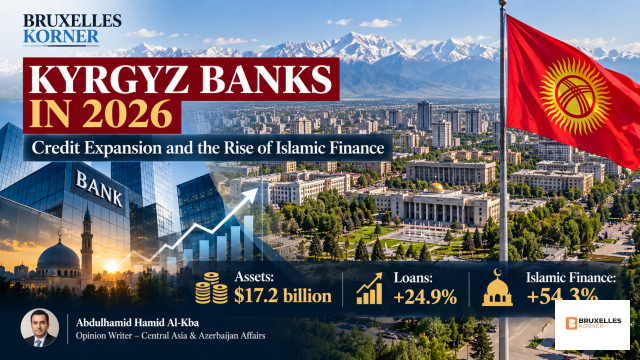
Kyrgyz Banks in 2026: Credit Expansion and the Rise of Islamic Finance
Rapid lending growth, the emergence of Islamic finance and strong capital buffers are reshaping Kyrgyzstan’s banking landscape. Yet rising problem loans, slower deposit growth and declining profitability raise important questions about the sustainability of this expansion.
By Abdulhamid Hamid Al-Kba Opinion writer specializing in Central Asia and Azerbaijan affairs
Bruxelles Korner | Economic Analysis | 16 October 2026

A banking sector entering a new phase of expansion
Kyrgyzstan’s banking sector is experiencing a period of significant expansion, reflecting the country’s evolving financial landscape and the growing role of commercial banks in supporting economic activity.
According to figures from the National Bank of the Kyrgyz Republic, the first eight months of 2026 were marked by substantial increases in banking assets, credit portfolios and net profits. Islamic finance emerged as one of the fastest-growing segments of the financial system.
However, beneath these encouraging developments lies a more complex reality. The rapid expansion of lending has been accompanied by an increase in classified and overdue loans, while customer deposits have grown at a considerably slower pace. At the same time, profitability ratios have declined despite higher aggregate profits.
These contrasting trends suggest that Kyrgyzstan’s banking system is not facing an immediate systemic crisis, but is entering a phase in which the quality and sustainability of growth will become increasingly important.
The central question is no longer simply how rapidly Kyrgyz banks can expand, but whether they can maintain financial stability while financing a growing economy.
1. Banking assets surpass 1.5 trillion som
As of 31 August 2026, total banking-sector assets reached 1,504.8 billion Kyrgyz som, representing an increase of 24.2% since the beginning of the year.
At an indicative exchange rate of 87.45 som per US dollar, this corresponds to approximately $17.2 billion.
Net profits for the January–August period amounted to 24.07 billion som, equivalent to approximately $275 million, an increase of 16.9% compared with the same period in 2025.
KEY BANKING INDICATORS | AUGUST 2026

Source: National Bank of the Kyrgyz Republic, figures supplied for 31 August 2026. USD equivalents are approximate.
Although these figures remain modest compared with the banking systems of larger economies, their significance should be assessed in relation to Kyrgyzstan’s economic size and financial development.
A growing banking sector can support investment, facilitate domestic trade, improve access to financing and strengthen financial intermediation.
Nevertheless, the expansion of banking assets must be accompanied by effective supervision and prudent risk management to ensure that financial growth contributes to long-term economic resilience.
2. Credit expansion: a powerful engine of economic activity
One of the most striking developments is the acceleration of bank lending.
The total loan portfolio increased from approximately 507 billion som at the end of 2025 to 633.3 billion som by the end of August 2026, representing growth of 24.9%.
In dollar terms, the outstanding loan portfolio reached approximately $7.24 billion.
This expansion indicates stronger demand for financing and a growing capacity among banks to support businesses, households and investment projects.
Credit growth can generate several positive economic effects. It provides enterprises with working capital, enables companies to invest in equipment and infrastructure, and supports consumption and entrepreneurial activity.
For an economy seeking to strengthen its productive capacity, access to bank financing is an essential component of economic development.
However, the pace of credit expansion also requires careful examination.
Rapid lending growth may increase financial vulnerability if credit assessments, borrower repayment capacity and collateral valuations fail to keep pace with the volume of new loans.
The sustainability of the expansion will therefore depend not only on the quantity of credit extended, but also on its allocation to productive activities and the quality of borrowers.
3. Islamic finance: the fastest-growing segment of the banking market
Perhaps the most strategically significant development is the rapid expansion of Islamic finance.
By the end of August 2026, financing provided under Islamic banking principles reached 29.7 billion som, an increase of 54.3% since the beginning of the year.
Six of Kyrgyzstan’s 26 commercial banks offered financial services structured in accordance with Islamic principles, in national and/or foreign currencies.

Growth comparison: January–August 2026
Percentage growth since the beginning of 2026
Islamic finance is becoming an increasingly visible component of Kyrgyzstan’s financial ecosystem.
Its expansion reflects opportunities to diversify banking products and serve customer groups seeking financial structures consistent with Sharia principles.
Unlike conventional interest-based lending, Islamic financial products generally rely on contractual structures involving trade, leasing, partnership or asset-backed financing, depending on the product and applicable regulatory framework.
The development of these services may also broaden financial inclusion by attracting individuals and enterprises that have traditionally been reluctant to use conventional banking products.
From a strategic perspective, Islamic finance could create additional opportunities for cooperation with financial institutions and investors in the Gulf countries, Türkiye and other markets where Islamic financial instruments are established.
However, rapid growth from a relatively small base should not be confused with market dominance.
At 29.7 billion som, Islamic financing represents approximately 4.7% of the banking sector’s total loan portfolio.
The segment is therefore expanding quickly but remains a comparatively small part of the overall market.
Its long-term success will depend on regulatory clarity, professional expertise, product transparency and effective risk management.
4. A widening gap between lending and deposits
While bank lending expanded by 24.9%, customer deposits increased by only 6.1%, reaching 919.2 billion som.
This divergence deserves particular attention.
Deposits remain a fundamental source of funding for commercial banks. When credit expands significantly faster than the deposit base, banks may increasingly depend on other sources of financing or changes in their liquidity positions.
Sector liabilities rose by 21.6% to 1,204.5 billion som.
The available figures do not establish an immediate funding shortage. Indeed, the sector’s liquidity indicators remain strong.
Nevertheless, a persistent imbalance between loan growth and deposit accumulation could eventually increase funding costs and create additional pressure on banks’ financial margins.
The challenge for Kyrgyz financial institutions will be to attract more stable domestic savings while maintaining competitive financing conditions.
This may require innovation in deposit products, greater customer confidence, stronger digital banking services and broader access to formal financial institutions.
5. Rising problem loans: the warning behind the growth
The most important area of concern is the deterioration in certain asset-quality indicators.
The share of classified loans increased from 10.5% at the beginning of the year to 11.5% by the end of August.
In absolute terms, classified loans rose from 53 billion to 72.5 billion som, an increase of 19.5 billion som, or 36.8%.
Overdue loans also increased, reaching 11.6 billion som, equivalent to approximately 1.8% of the total loan portfolio.
Their volume rose by 33.3% since the beginning of the year.
Asset-quality indicator | Beginning of 2026 | August 2026 |
|---|---|---|
Classified loans | 53.0B som | 72.5B som |
Classified-loan share | 10.5% | 11.5% |
Overdue loans | 8.7B som | 11.6B som |
Overdue-loan share | — | 1.8% |
These developments suggest that credit risk is increasing alongside lending activity.
However, classified loans and overdue loans should not be treated as interchangeable indicators. They measure different aspects of credit quality and may be subject to distinct regulatory definitions.
The figures therefore require careful interpretation.
The increase in classified loans does not automatically imply an impending banking crisis, but it indicates that banks must reinforce borrower assessment, portfolio monitoring and provisioning practices.
The relatively limited volume of overdue Islamic financing is also noteworthy.
Overdue financing under Islamic principles amounted to approximately 0.2 billion som, or 0.7% of the segment’s financing portfolio.
This compares favourably with the overall overdue-loan ratio of 1.8%, although differences in portfolio maturity, customer composition and risk-classification standards prevent a definitive conclusion that Islamic financing is inherently less risky.
More detailed supervisory data would be required for such a comparison.
6. Strong capital and liquidity buffers support stability
Despite the increase in credit risk, Kyrgyzstan’s banking system continues to report substantial capital and liquidity cushions.
Net total regulatory capital increased by 36.7% to 295.9 billion som.
Capital adequacy stood at 31.8%, significantly above the regulatory minimum of 12%.
The leverage ratio reached 16.9%, compared with a required minimum of 6%, while the liquidity ratio stood at 86.4%, against a minimum of 45%.

Banking stability indicators versus regulatory minimums
Capital adequacy
31.8%
Regulatory minimum: 12%
Leverage ratio
16.9%
Regulatory minimum: 6%
Liquidity
86.4%
Regulatory minimum: 45%
Gold represents the regulatory minimum; green represents the additional buffer. Figures as of August 2026.
These ratios provide important reassurance regarding the sector’s capacity to absorb financial shocks.
A banking system with adequate capital and liquidity is generally better positioned to withstand unexpected losses, fluctuations in funding conditions and periods of economic uncertainty.
Nevertheless, strong aggregate indicators do not eliminate vulnerabilities at the level of individual institutions.
Supervisory authorities must therefore continue assessing risk concentration, asset quality and the resilience of banks under adverse economic scenarios.
7. Profitability declines despite higher aggregate earnings
Another important feature of the latest figures is the decline in profitability ratios.
Return on assets (ROA) decreased from 3.3% at the end of 2025 to 2.5% by August 2026.
Return on equity (ROE) declined from 22% to 15.1% over the same period.
This development may appear contradictory given the 16.9% increase in net profits during January–August compared with the corresponding period of 2025.
However, higher absolute profits do not necessarily translate into higher returns relative to assets or capital.
The banking sector’s balance sheet and capital base expanded rapidly, which can affect profitability ratios.
Other potential influences include operating expenses, provisioning requirements, competition and changes in the composition of financial assets.
The available data do not permit these factors to be isolated conclusively.
Moreover, comparisons between end-of-year profitability ratios and interim figures should take account of the National Bank’s calculation methodology.
The decline nevertheless highlights the need for banks to preserve operational efficiency while pursuing expansion.
8. Domestic capital gains importance
Foreign participation in paid-in authorized capital presents another interesting development.
The foreign-owned share declined from 16.5% to 14.1%, even though the absolute amount of foreign participation increased from 26.6 billion to 34.9 billion som.
This apparent contradiction reflects faster growth in the overall capital base than in foreign-owned capital.
The result is a relative increase in the weight of domestic capital within the banking sector.
This evolution may contribute to the development of locally financed banking institutions, although it does not necessarily indicate a withdrawal of foreign investors.
On the contrary, foreign capital continued to increase in absolute terms.
A diversified ownership structure combining domestic and international investment can strengthen competition, governance and access to financial expertise.
9. Financial intermediation deepens, while dollarization declines
The banking sector is becoming more deeply integrated into Kyrgyzstan’s economy.
Banking assets increased from 61.3% to 66% of GDP, while the loan-to-GDP ratio rose from 25.7% to 27.8%.
By contrast, the deposit-to-GDP ratio declined from 43.8% to 40.3%.
These indicators reinforce the observation that credit intermediation is expanding faster than deposit mobilization.
At the same time, the reduction in financial dollarization represents a positive structural development.
The share of foreign-currency loans declined by 0.3 percentage points to 18%, while the foreign-currency share of deposits fell by 3.3 percentage points to 31.5%.
Lower dollarization can reduce exposure to exchange-rate movements, particularly for borrowers whose income is denominated in Kyrgyz som.
It may also strengthen the effectiveness of domestic monetary policy.
Nevertheless, the banking system remains exposed to currency-related risks, especially through foreign-currency deposits and the broader economy’s international financial connections.
10. Strategic outlook: growth, diversification and financial discipline
Kyrgyzstan’s banking sector stands at an important stage of its development.
The expansion of credit and financial assets demonstrates increasing banking activity and a growing capacity to finance economic needs.
Islamic finance introduces an additional dimension of diversification and may strengthen financial inclusion and international investment connections.
Strong capital and liquidity indicators provide a foundation for continued development.
However, three challenges will be decisive.
First, credit quality must remain a supervisory priority. The rise in classified and overdue loans shows that expanding lending volumes must be accompanied by rigorous risk assessment.
Second, funding growth must become more balanced. Banks will need to strengthen deposit mobilization and diversify stable funding sources if lending continues to expand rapidly.
Third, profitability must be protected without weakening financial discipline. Sustainable banking development depends on efficient operations, prudent lending and adequate capital.
For policymakers, the objective should not be to restrict financial development unnecessarily, but to ensure that banking expansion remains compatible with macroeconomic stability.
For financial institutions, the priority should be to transform rapid balance-sheet growth into durable profitability and improved financial services.
For investors, Kyrgyzstan presents an expanding banking market with emerging opportunities, particularly in Islamic finance, but one that requires careful attention to credit quality, regulatory developments and funding structures.
Conclusion: cautious optimism, not complacency
The performance of Kyrgyzstan’s banking sector during the first eight months of 2026 offers grounds for cautious optimism.
Banking assets have expanded substantially, lending has accelerated, profitability remains positive in absolute terms, and Islamic finance has recorded particularly strong growth.
The sector also maintains capital and liquidity ratios comfortably above regulatory requirements.
Yet the increase in classified loans, the slower expansion of deposits and the decline in profitability ratios demonstrate that rapid growth brings additional responsibilities.
Kyrgyzstan’s banking system is not showing the aggregate characteristics of an immediate financial crisis. However, neither should its current expansion be interpreted as evidence that risks are absent.
The real measure of success will not be how quickly Kyrgyz banks grow in 2026, but how effectively they convert that growth into a resilient, diversified and sustainable financial system.
If financial institutions strengthen credit-risk management, maintain adequate capital buffers and develop more balanced funding structures, the present expansion could become a foundation for long-term economic development.
The rise of Islamic finance may contribute to this transformation, provided its growth remains supported by sound regulation, transparency and responsible financing practices.
For Kyrgyzstan, the opportunity is significant. The challenge is to ensure that financial expansion strengthens the economy without creating vulnerabilities that could undermine future progress.
Abdulhamid Hamid Al-Kba Opinion writer specializing in Central Asia and Azerbaijan affairs
BRUXELLES KORNER — International Economic Analysis
Editorial note: This article is an analytical revision of the author's supplied text, based on banking figures attributed to the National Bank of the Kyrgyz Republic as of 31 August 2026. The figures have not been independently verified for this edition. Correction to the accompanying visual: Islamic financing is 29.7 billion som (approximately US$340 million), not US$29.7 billion. The visual should be corrected before publication.
Yorum Yazın