
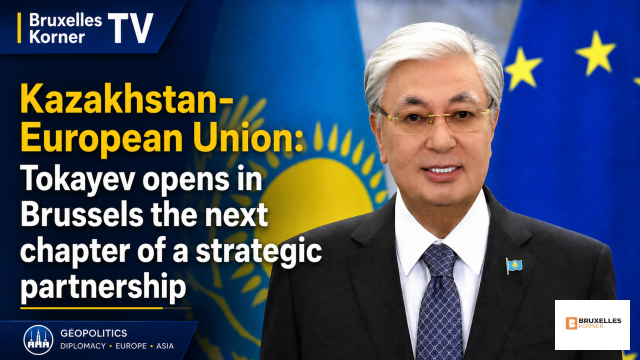





Kazakhstan–European Union: Tokayev Opens in Brussels the Next Chapter of a Strategic Partnership
Between energy, critical raw materials, the Middle Corridor, innovation and human mobility, Astana wants to transform its relationship with Europe into a value-added partnership.
By Kadir Duran – Bruxelles Korner

Kazakh President Kassym-Jomart Tokayev arrives in Brussels with a clear message: the partnership between Kazakhstan and the European Union can no longer remain confined to the traditional frameworks of trade, energy and investment. In an opinion article published by Euronews, the Kazakh head of state calls for a new strategic phase between Astana and Brussels.
Ten years after the Enhanced Partnership and Cooperation Agreement signed in 2015 between Kazakhstan and the European Union, the international context has changed profoundly. Supply chains have become more fragile, competition between major powers has intensified, energy has once again become a matter of national security, and transport corridors between Europe and Asia are now at the heart of geopolitical balances.
In this new world, Kazakhstan wants to present itself not only as a supplier of resources, but as a central partner at the heart of Eurasia.
Three Strategic Objectives
In his article, Kassym-Jomart Tokayev identifies three priorities for the next decade of cooperation between Kazakhstan and the European Union:
strengthening common resilience;
expanding all forms of connectivity;
creating new concrete opportunities for citizens.
This triptych summarises Kazakhstan’s ambition: to move from a mainly economic relationship toward a comprehensive partnership that includes energy, agriculture, critical raw materials, transport, digital technology, education, research and mobility.
A Rapidly Rising Economic Partner
Kazakhstan is now highlighting its growing economic weight. According to the figures cited by President Tokayev, Kazakhstan’s economy grew by 6.5% in 2025, with GDP reaching 306 billion dollars. The IMF projects that it will exceed 360 billion dollars in 2026.
For the European Union, this rise is far from insignificant. Kazakhstan is already a major partner: thousands of European companies are active in the country, while the European Union remains one of its leading investors.
But Astana believes that the time has come to go further. The objective is no longer simply to export raw materials in exchange for investment, but to build common value chains, with more local processing, technology transfer, joint research and industrial joint ventures.
Energy, Uranium and European Security
The energy dimension remains central. Kazakhstan currently supplies a significant share of Europe’s imports of oil and natural uranium. In a context marked by the war in Ukraine, sanctions against Russia and the search for new supply security, this relationship takes on a strategic dimension.
For Tokayev, energy is the most visible example of mutual trust already established between the two sides. The reasoning is simple: if Kazakhstan can contribute to Europe’s energy security, it can also play a greater role in other sensitive areas.
Agriculture is one of them. As a major producer and exporter of grain, Kazakhstan wants to become a more important player in European and global food security. In return, European technologies and investment could help the country develop a more modern, more processed and more profitable agricultural sector.
Critical Raw Materials: A Key Issue for Europe
Europe’s energy transition depends increasingly on critical raw materials: rare metals, industrial components, and resources needed for batteries, green technologies and new industrial ecosystems.
Kazakhstan has significant potential in this field. For the European Union, which seeks to reduce certain strategic dependencies, Astana represents a credible and politically stable alternative at the heart of Central Asia.
But the Kazakh president implicitly sets a condition: Europe must not simply come to extract resources. It must also bring technology, expertise, training, industrial processing and sustainable investment.
In other words, Astana wants to move away from the traditional extractive model and enter into a logic of industrial partnership.
The Middle Corridor, a New Artery Between Europe and Asia
The second pillar of this new relationship is connectivity.
Kazakhstan lies at the centre of the Middle Corridor, the route linking China, Central Asia, the Caspian Sea, the Caucasus, Türkiye and Europe. In a context where traditional routes through Russia have become more politically sensitive, this route is becoming strategic for Brussels.
Tokayev presents the Middle Corridor not as a simple trade route, but as the backbone of a new Eurasian system. It is not only about transporting goods faster. It is about connecting markets, stimulating investment, bringing economies closer together and creating new industrial opportunities.
For the European Union, this vision naturally fits within the Global Gateway strategy, which aims to finance reliable, sustainable and geopolitically coherent infrastructure.
Artificial Intelligence, Digital Governance and Innovation
Kazakhstan also wants to expand cooperation with Europe in the technologies of the future.
Artificial intelligence, digital governance, digitised public services, cybersecurity, innovation and trusted technologies: Astana wants to position itself as a modern state, capable of working with European technology companies and developing inclusive digital growth.
The message sent to Brussels is clear: Kazakhstan does not want to be seen only as a transit country or a resource provider. It wants to become an innovation actor in Central Asia.
Cooperation That Must Benefit Citizens
Tokayev also insists on an often underestimated element: human mobility.
The Kazakh president refers to progress made on the visa issue, with the aim of facilitating travel between Kazakhstan and the European Union. This dimension is essential for students, researchers, entrepreneurs, families and economic actors.
Education and research also occupy an important place. Kazakhstan’s participation in Erasmus+ and Horizon Europe already demonstrates the potential for stronger academic cooperation. Astana wants more university mobility, more joint scientific projects and more pathways for younger generations.
Internal Reforms and Political Message
Finally, Tokayev links this external partnership to Kazakhstan’s internal reforms.
He presents his country as a nation undergoing institutional renewal, engaged in political and economic modernisation. He highlights a formula: a strong president, an influential parliament and an accountable government.
This message is addressed directly to European partners: Kazakhstan wants to attract investors, but also to offer them a stable, predictable and transparent framework based on clear rules.
This is where an important part of the partnership’s credibility is at stake. Europe is not only looking for resources or trade routes; it is also looking for partners capable of ensuring stability, legal predictability and reliable economic governance.
Brussels at the Centre of the Game
The visit of Kassym-Jomart Tokayev to Brussels on 22 and 23 June therefore comes at a strategic moment. The European Union is seeking to diversify its energy, industrial and logistical partners. Kazakhstan, for its part, is seeking to consolidate its role as a pivot power between Europe and Asia.
In this meeting, each side needs the other.
Europe needs a stable, connected Kazakhstan, rich in resources and open to investment. Kazakhstan needs a technological, financial, industrial and educational Europe to accelerate its transformation.
The next chapter of the Kazakhstan–European Union partnership will therefore not be only diplomatic. It will be energy-based, logistical, digital, agricultural, industrial and human.
And in this new Eurasian game, Brussels and Astana seem ready to write a common page.
Verified sources: The opinion article by Kassym-Jomart Tokayev was published by Euronews on 22 June 2026, on the occasion of his visit to Brussels for talks with European Union leaders on 22 and 23 June 2026.
Yorum Yazın