




Kazakhstan–European Union: In Brussels, the Final Shanyraq Dialogue Paves the Way for the New Kurultai
Just weeks before the installation of the new Kurultai, Kazakhstan concludes in Brussels its cycle of dialogues dedicated to the country’s new Constitution
By Kadir Duran – Bruxelles Korner
Brussels, 7 July 2026. Just weeks before the official establishment of the new Kurultai, scheduled for the end of August, the Embassy of the Republic of Kazakhstan to the Kingdom of Belgium, the European Union and NATO organized the final edition of the Shanyraq Dialogues before the summer break.

Held under the theme “Kazakhstan–European Union: New Horizons of Enhanced Partnership and Cooperation,” the meeting brought together in Brussels several dozen representatives of European institutions, the diplomatic corps, business and academic circles, the media and civil society to discuss the future of relations between Kazakhstan and the European Union in the context of Kazakhstan’s new Constitution.
The conference took place only a few days after the entry into force, on 1 July 2026, of Kazakhstan’s new Constitution, described by the authorities as the culmination of a broad process of institutional modernization initiated by President Kassym-Jomart Tokayev.
The reform will be fully completed at the end of August with the installation of the new Kurultai, a new assembly expected to become one of the pillars of Kazakhstan’s political system.
A High-Level Audience
The event was chaired by H.E. Mr. Roman Vassilenko, Ambassador of the Republic of Kazakhstan to the Kingdom of Belgium and Head of Mission to the European Union and NATO.
The keynote speaker was Ms. Audrone Perkauskiene, Deputy Managing Director for Eastern Europe and Central Asia at the European External Action Service.
The meeting also brought together several leading figures, including:
Luc Pierre Devigne, Chief Adviser at the European Commission and former Director for Central Asia at the EEAS;
Marilyn Josefson, Diplomatic Adviser to the President of the European Council;
Thomas Huet, EEAS;
Jean Spinette, Mayor of Saint-Gilles;
Kęstutis Jankauskas, former EU Ambassador to Kazakhstan and currently Head of Division for Field Security at the EEAS;
Dr. Antoine Bondaz, China–Indo-Pacific expert at the European Commission’s DG IDEA;
Andrea Lo Presti, Chevron;
Dive Van den Boss, CEO of Ahlers;
Jan Felix Nédée, CEO of Corsendonk Hotels;
Vince Leeman, City of Antwerp;
Anna Sussarova, Honorary Consul;
Valentin Seiker, geopolitical analyst at the European Commission;
Ieva Valutyte, European Parliament;
Veronika Blazejova, Senior Assistant to MEP Tomas Zdechovsky;
Vasyl Belmega, Panterra Adviser;
Evgeniya Ulkina, AWEX;
Derya Soysal, Eureflect;
Valikhan Bakhretdinov, President of the NGO Kazakhstan–EU Gateway;
Galymzhan Beimbetov, journalist at Kazakhstan’s national television channel 24.kz;
as well as Kadir Duran, Editor-in-Chief of Bruxelles Korner, who was invited to take part in the question-and-answer session.
The diversity of participants reflected Brussels’ growing interest in Kazakhstan’s political evolution and in the development of the strategic partnership between Astana and the European Union.
The Shanyraq: Much More Than a Yurt
In his opening speech, Roman Vassilenko recalled the profound meaning of the Shanyraq, the central element of the Kazakh yurt.
Far more than a simple architectural symbol, the Shanyraq represents family, continuity, trust, dialogue and collective responsibility.
Quoting a Kazakh proverb “What is decided through consultation never misses its goal” the ambassador underlined that dialogue remains at the heart of Kazakhstan’s political culture.
According to him, this philosophy perfectly captures the spirit of the meetings regularly organized in Brussels.
A Relationship Entering a New Dimension
The ambassador returned to the recent official visit of President Kassym-Jomart Tokayev to Brussels, which marked a turning point in relations between Astana and the European Union.
During that visit, more than 30 economic agreements worth over 12 billion dollars in investments were concluded in strategic sectors, including:
transport and logistics;
aviation;
agriculture;
critical raw materials;
energy;
infrastructure.
The horizontal aviation agreement was notably signed, while significant progress was also made on visa facilitation between Kazakhstan and the European Union.
For Roman Vassilenko, this visit marks the transition from a phase of political declarations to a phase of concrete implementation.
“The real work begins after the handshakes and official photographs,” he summarized.
.jpeg)
A New Constitution as a New Social Contract
The ambassador then explained at length the political significance of the Constitution that entered into force on 1 July.
According to him, this reform goes far beyond a mere legal amendment.
It represents a new social contract between the state and its citizens.
The new Constitution strengthens:
the rule of law;
constitutional guarantees;
fundamental freedoms;
the accountability of public institutions;
dialogue with society;
institutional stability.
For European partners, this development also brings greater legal certainty, political predictability and confidence for long-term investment.
Roman Vassilenko emphasized that the strength of national institutions has now become one of the main drivers of the deepening partnership with the European Union.
Cooperation That Now Goes Beyond Trade
The ambassador recalled that the European Union remains Kazakhstan’s leading trading partner and its largest foreign investor.
However, according to him, the relationship is no longer limited to economic exchanges.
It now extends to:
energy security;
the development of the Middle Corridor, also known as the Trans-Caspian corridor;
critical raw materials;
infrastructure;
digitalization;
innovation;
artificial intelligence;
higher education;
people-to-people exchanges.
He stressed that every new railway line, every new air connection, every visa simplification and every university project brings Kazakh and European societies closer together.
Finally, Roman Vassilenko recalled that after several years of negotiations, relations between Brussels and Astana have now entered a new phase.
The challenge is no longer to sign new agreements.
The challenge is now to implement them concretely.
It was in this context that he invited Ms. Audrone Perkauskiene to share her vision for the future of Kazakhstan–European Union relations, opening a particularly rich exchange with the many diplomats, experts and institutional representatives present.
.jpeg)
Kazakhstan–European Union: A Partnership Entering a New Phase
Part 2 – The European Union’s Perspective and Exchanges with Participants
Taking the floor after Ambassador Roman Vassilenko, Ms. Audrone Perkauskiene, Deputy Managing Director for Eastern Europe and Central Asia at the European External Action Service, delivered a particularly notable address combining geopolitical analysis, a review of bilateral relations and future prospects.
From the very beginning of her speech, she congratulated Kazakhstan on two events she described as major milestones.
The first was the entry into force, on 1 July 2026, of Kazakhstan’s new Constitution, which she considered an important step in the country’s institutional modernization and in the construction of a new contract between the state and its citizens.
The second was the official visit of President Kassym-Jomart Tokayev to Brussels two weeks earlier, which she described as one of the most successful bilateral visits in recent years.
A Political Relationship That Has Never Been So Intense
Audrone Perkauskiene recalled that political exchanges between Brussels and Astana have accelerated significantly.
Since the first European Union–Central Asia Summit held in Samarkand, meetings between President Tokayev, European Council President António Costa and European Commission President Ursula von der Leyen have multiplied.
She also emphasized that several European leaders have visited Kazakhstan in recent months, illustrating the growing strategic importance attached to the country.
According to her, this intensification of contacts is far from insignificant.
“This level of political dialogue had never been reached before between Kazakhstan and the European Union.”
For the European official, this development shows that Kazakhstan is now regarded as a fully-fledged strategic partner.
A Reliable Partner in a Complex Geopolitical Context
In the face of global upheavals, Audrone Perkauskiene argued that partnerships based on trust have become essential.
She highlighted several values shared by Brussels and Astana:
respect for the United Nations Charter;
support for multilateralism;
regional stability;
international cooperation;
the search for peaceful solutions.
According to her, Kazakhstan now plays a stabilizing role in Central Asia and constitutes a credible interlocutor for the European Union.
She recalled that Kazakhstan was the first Central Asian country to sign an Enhanced Partnership and Cooperation Agreement with the European Union, as well as the first to conclude negotiations on visa facilitation and cooperation on critical raw materials.
.jpeg)
Concrete Results from President Tokayev’s Visit
Returning to the presidential visit to Brussels, Audrone Perkauskiene cited several concrete achievements.
She notably mentioned:
industrial agreements concluded with Airbus, representing several billion euros;
new projects in infrastructure and transport;
the development of the Trans-Caspian corridor, or Middle Corridor;
the strengthening of European investment in Kazakhstan;
the deepening of energy cooperation.
However, according to her, one of the most significant advances remains the conclusion of negotiations on visa facilitation.
She recalled that this issue had been among the priorities of the EU–Kazakhstan partnership for nearly ten years.

The Time for Implementation
While agreements are now numerous, the European representative believes that the real challenge begins now.
“It is no longer just about signing agreements. They must now be implemented.”
She stressed the need to transform political commitments into tangible results.
According to her, several sectors are expected to develop significantly in the coming years:
connectivity;
rail infrastructure;
energy transition;
digital technologies;
artificial intelligence;
scientific research;
higher education;
university exchanges.
She particularly called for the strengthening of Erasmus+, Horizon Europe and scientific cooperation between European and Kazakh universities.
Questions and Answers: An Open Dialogue
The second part of the meeting took the form of a direct exchange with participants.
Diplomats, European representatives, political leaders, journalists and economic actors questioned the representative of the European External Action Service on the prospects of the partnership.
Among the topics discussed were:
Kazakhstan’s political evolution;
the effects of the new Constitution;
opportunities for young people;
academic mobility;
economic cooperation;
tourism;
regional security;
major infrastructure projects.
Astana, Symbol of a Transformation
Asked by Roman Vassilenko about Kazakhstan’s evolution since her first visit nearly twenty years ago, Audrone Perkauskiene offered a personal testimony.
She explained that at the time she had discovered a capital still under construction.
During her recent visit, she said she was impressed by the transformation of the city.
Today, she described Astana as a modern, green, dynamic, lively capital turned toward the future.
According to her, this evolution reflects the broader transformation of Kazakhstan.
Jean Spinette: Making Kazakhstan Better Known
The Mayor of Saint-Gilles, Jean Spinette, took the floor to underline a paradox.
Although Kazakhstan is the ninth-largest country in the world and a major geopolitical actor, it remains largely unknown to the European public.
He regretted the lack of publications, books and documentation available in French about Kazakhstan.
For him, cultural and academic exchanges, as well as local initiatives, will gradually help make the country better known in Europe.
He confirmed his support for future cultural projects developed with the Embassy of Kazakhstan.
.jpeg)
The Question from Bruxelles Korner
During the exchanges, Kadir Duran, Editor-in-Chief of Bruxelles Korner, intervened to ask Audrone Perkauskiene about two issues.
The first question concerned the recently concluded agreement between Brussels and Astana that she considered the most important.
The second focused on the area in which cooperation is currently progressing most rapidly: energy, artificial intelligence or transport.
The European official answered without hesitation.
In her view, visa facilitation represents the most important advance of recent years.
She recalled that this file had required nearly a decade of negotiations and that it would above all promote human exchanges between Kazakh and European citizens.
As for future sectors, she believes that connectivity has now become the priority.
The development of the Middle Corridor, rail infrastructure, air links, ports and logistics corridors are today the most dynamic axes of cooperation between the European Union and Kazakhstan.
According to her, connectivity is not only about transporting goods.
It also brings economies, universities, businesses, researchers and citizens closer together.
.jpeg)
What Impact Will the New Constitution Have on Relations with the European Union?
Asked about the consequences of the new Constitution for bilateral relations, Audrone Perkauskiene stated that it would not directly change relations between Brussels and Astana.
However, it will strengthen the very foundations of the partnership.
Stronger institutions, more predictable governance and a consolidated rule of law create a more favorable environment for investment, economic cooperation and joint projects.
For Brussels, greater institutional stability in Kazakhstan represents an additional factor of confidence.
The question-and-answer session continued in a particularly open atmosphere, illustrating the spirit of the Shanyraq Dialogues: to encourage frank, direct and constructive dialogue between European officials, Kazakh authorities and various actors from civil society.
Kazakhstan–European Union: A Partnership Entering a New Phase
Part 3 – A Dialogue That Continues Beyond the Speeches
As the official exchanges drew to a close, several speakers wished to share a more personal reflection on the evolution of relations between Kazakhstan and the European Union.
Among them was Kęstutis Jankauskas, former European Union Ambassador to Kazakhstan and currently Head of Division for Field Security at the European External Action Service. Drawing on several years spent in Astana, he delivered a testimony that was particularly appreciated by the audience.
“Kazakhstan Is a Country That Remains to Be Discovered”
Reflecting on his years of mission in Kazakhstan, Kęstutis Jankauskas explained that he had rarely encountered a country so open to dialogue.
According to him, Kazakhstan has demonstrated its ability to develop a balanced foreign policy, based on the defense of its own interests while maintaining constructive relations with all its international partners.
He also emphasized the country’s still largely underestimated potential among Europeans.
“There is now in Europe a real desire to discover new destinations. Kazakhstan has all the assets: exceptional landscapes, great cultural diversity, stability appreciated by travelers and tremendous tourism potential. Yet it remains largely unknown.”
For the former ambassador, future visa facilitation should help bring populations closer together and encourage not only tourism, but also academic, economic and cultural exchanges.
.jpeg)
A Partnership Now Built on Citizens
Throughout the interventions, one observation was repeated several times: relations between Kazakhstan and the European Union can no longer be driven solely by governments.
Businesses, universities, local authorities, the media, researchers, students and civil society organizations are called upon to play an increasingly important role.
Cooperation between Astana and Brussels is no longer limited to major diplomatic agreements. It is now being built through human exchanges, economic projects, university partnerships, cultural initiatives and contacts between citizens.
Several speakers also recalled that every new air connection, every joint university project, every investment and every administrative simplification brings the two societies a little closer together.
The New Kurultai at the Heart of Expectations
This final edition of the Shanyraq Dialogues had particular significance.
It concluded several months of meetings organized in Brussels around Kazakhstan’s new Constitution, only a few weeks before the establishment of the new Kurultai, scheduled for the end of August.
For the Kazakh authorities, this new institution represents one of the main innovations of the constitutional reform. It is expected to support the modernization of the country’s governance, strengthen participation in public debate and consolidate dialogue between institutions and society.
Throughout the meeting, European speakers emphasized that they would closely follow the concrete implementation of this new institutional architecture.
The message from Brussels was clear: beyond the constitutional reform itself, it is its practical translation that will be decisive.
A Family Photo Under the Shanyraq
After more than two hours of exchanges, Ambassador Roman Vassilenko thanked all participants for their presence and for the quality of the discussions.
He recalled that the aim of the Shanyraq Dialogues was not merely to organize conferences, but to create a space where diplomats, political leaders, academics, journalists, entrepreneurs and representatives of civil society could engage freely and build lasting relationships.
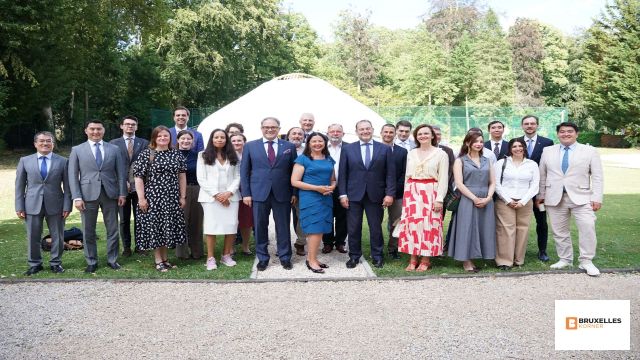
Before officially closing the meeting, all participants gathered in the embassy garden for a group photograph, symbolizing this community of partners brought together under the Shanyraq — an image of the openness and dialogue that characterize these meetings.

A Reception with the Flavors of Kazakhstan
The evening then continued with a friendly reception organized by the embassy.
Guests were able to discover several traditional Kazakh specialties, accompanied by refreshments, while discussions continued in a more informal setting.
European diplomats, representatives of EU institutions, political leaders, business executives, academics, journalists and members of civil society continued to exchange views on the prospects for cooperation between Brussels and Astana.
These conversations, often extending well beyond the official session, illustrated the very spirit of the Shanyraq Dialogues: making dialogue a concrete instrument of rapprochement between peoples.
.jpeg)
A New Stage in Relations Between Brussels and Astana
Beyond the political announcements, this final meeting before the summer break confirmed a deeper evolution.
In just a few years, relations between Kazakhstan and the European Union have changed dimension.
The European Union remains Kazakhstan’s leading trading partner and largest foreign investor, but the partnership now extends to increasingly strategic areas: connectivity, energy transition, critical raw materials, regional security, innovation, artificial intelligence, research, higher education and mobility.
The recent visit of President Kassym-Jomart Tokayev to Brussels, the numerous agreements concluded with European institutions and companies, the progress made on visa facilitation and the projects linked to the Middle Corridor all reflect this new dynamic.
At the same time, the entry into force of the new Constitution and the forthcoming installation of the Kurultai mark a new stage in Kazakhstan’s institutional evolution.
For the European partners present in Brussels, the priority is now clearly identified: to support this new phase through concrete cooperation, based on trust, stability and shared projects.
.jpeg)
As Roman Vassilenko recalled, quoting a Kazakh proverb:
“The path is built by walking.”
At the end of this final edition of the Shanyraq Dialogues before the holidays, one conviction seemed to be shared by all participants: the partnership between Kazakhstan and the European Union has entered a new phase one of implementation, concrete achievements and lasting rapprochement between societies.
Just weeks before the installation of the new Kurultai, Brussels thus became the stage for a final moment of collective reflection before the opening of a new chapter in Kazakhstan’s institutional life.
Yorum Yazın