

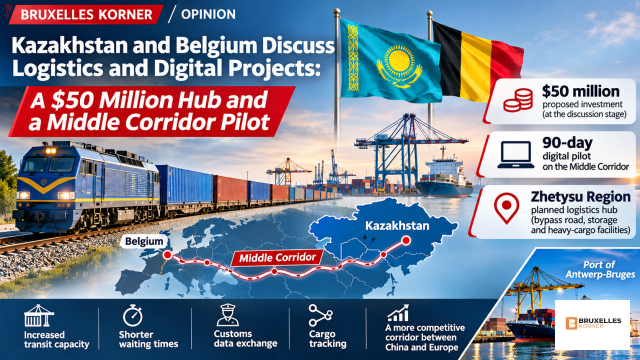





Kazakhstan and Belgium Discuss Logistics and Digital Projects: A $50 Million Hub and a Middle Corridor Pilot
By Abdulhamid Hamid Al-Kba
Opinion Writer Specialising in Central Asia and Azerbaijan
Amid global efforts to diversify trade routes between Asia and Europe, Kazakhstan continues to leverage its geographical position to develop more efficient transit infrastructure. Discussions held by Foreign Minister Mukhtar Tileuberdi with Belgian companies on 16 November 2026, concerning a transport and logistics centre in the Zhetysu Region and a 90-day digital pilot project along the Middle Corridor, are firmly aligned with this strategy.

The proposed $50 million investment remains at the discussion stage, with no contracts signed or implementation timeline announced. Nevertheless, it reflects a shared interest in addressing cargo bottlenecks and improving the movement of goods between China and Europe.
During his official visit to Belgium, Tileuberdi met with senior representatives of Sarens Group, Ahlers Logistics and BIM e-Solutions. In discussions with Hendrik Sarens and Matthias Sarens, the parties reviewed plans for a logistics hub in Zhetysu, including a 2.1-kilometre bypass road, temporary storage facilities and specialised infrastructure for heavy cargo.
Sarens Group has operated in Kazakhstan since 2003 and brings extensive experience in heavy-lift transport, particularly in areas close to the Chinese border. Separate discussions with Dave van den Bos and Michael Barrie focused on expanding logistics operations and introducing digital technologies. Ahlers Logistics has been present in Kazakhstan since 1998 and operates warehouses in Karaganda and Almaty, while BIM e-Solutions specialises in electronic and digital solutions.
The proposed project aims to ease pressure on freight movements at the Nur Zholy border crossing, at a time when the strategic importance of international transit routes continues to grow. Once operational, the hub is expected to increase the crossing's capacity and reduce waiting times, thereby strengthening Kazakhstan's role as a key link in the Trans-Caspian International Transport Route.
The proposed digital pilot project seeks to introduce cargo-tracking systems, facilitate customs data exchange, reduce border delays and improve transparency. Together, these initiatives represent an effort to combine infrastructure investment with the technological solutions required to make the corridor more efficient and competitive.
Potential links between the Port of Antwerp-Bruges and the Caspian ports of Aktau and Kuryk remain under discussion as part of the bilateral dialogue. These discussions have gained particular relevance following the Belgian royal visit to Astana in October 2026, which highlighted the importance of cooperation in logistics and critical raw materials.
Belgian companies contribute European expertise in supply-chain management, while Kazakhstan offers a strategic geographical position along a transport route that has experienced growing container traffic despite the challenges of coordinating multiple operators and national transport systems.
However, the Middle Corridor requires more than roads, warehouses and physical infrastructure. Its long-term competitiveness depends on reducing the time and financial costs that currently place a burden on businesses and logistics operators.
The 90-day digital pilot could provide valuable insights into the readiness of customs authorities and operational systems for effective integration. If successful, it could encourage additional investment and strengthen confidence in the corridor's commercial potential.
Nevertheless, the transition from discussions to implementation remains uncertain. Progress will depend on the results of the initial trials, administrative coordination and the ability of the parties involved to overcome operational and regulatory challenges.
Two central questions therefore remain: will these discussions translate into concrete projects in the coming months, and can the digital pilot demonstrate its effectiveness in a complex environment involving multiple stakeholders?
The current economic climate favours such partnerships. Europe is seeking to diversify its supply chains and transport routes, while Kazakhstan is working to attract European expertise and investment to improve transit efficiency.
Ultimately, the real test will be whether Kazakhstan can transform its strategic geographical position into a measurable operational advantage, delivering tangible benefits to businesses, logistics operators and international trade.

Yorum Yazın