
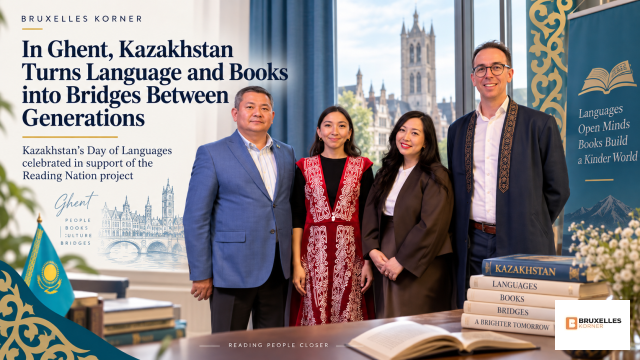





In Ghent, Kazakhstan Turns Language and Books into Bridges Between Generations
Kazakhstan’s Day of Languages was marked in Ghent with a cultural and educational gathering centred on reading, identity and transmission. Beyond the celebration itself, the event highlighted a broader challenge for diaspora communities: how to preserve language and cultural roots while remaining fully integrated into Belgian society.
By Kadir Duran – Bruxelles Korner | Brussels
Ghent became a small meeting point between Kazakhstan and Belgium on 5 September, as the Qazaq Roots Kazakh Cultural Centre hosted an event dedicated to Kazakhstan’s Day of Languages and the “Kitap Oqityn Ult – Reading Nation” initiative.

Organised with the support of the Embassy of Kazakhstan in Belgium, the gathering brought together members of the Kazakh community living in Flanders, children adopted by Belgian families, and Belgian participants interested in Kazakhstan’s language, literature and culture.
At first sight, it was a cultural event built around books, quizzes and language games. But behind the informal atmosphere lay a more strategic issue: the preservation of cultural identity among younger generations growing up far from their country of origin.
Participants read books in Kazakh, explored works by Kazakhstani authors and took part in interactive activities designed to make the language more accessible, particularly for children.
For families living abroad, language often becomes much more than a means of communication. It can become a link with family history, collective memory and a sense of belonging.
That message was central to the intervention of Ayan Sakoshev, Executive Director of the “Kitap Oqityn Ult – Reading Nation” Public Foundation, who joined the event online.
He stressed that the project seeks to make reading part of everyday life and to create stronger connections between generations.
For Kazakhstanis living abroad, he argued, books can also help preserve a direct relationship with the Kazakh language, national culture and the country itself.
Books as an instrument of cultural continuity
As part of the Reading Nation programme, the library collection at Qazaq Roots was expanded with new works by Kazakhstani authors.
These books will be made available for reading and exchange, giving the centre a role that goes beyond language teaching.
The objective is to create a cultural space where children and adults can read, meet, speak Kazakh and deepen their understanding of Kazakhstan.
Mainur Zhumanova, Head of the Qazaq Roots Centre, underlined the importance of this mission for children growing up in Belgium.
For them, she explained, the Kazakh language remains an important connection to their roots.
The centre therefore seeks not only to teach vocabulary and grammar, but also to create an environment in which children can communicate with each other, discover literature and develop a more concrete understanding of Kazakhstan’s history and culture.
This dimension is particularly significant for children of Kazakh origin adopted by Belgian families.
For some of them, language and cultural activities may provide one of the few structured opportunities to reconnect with the country of their birth and to explore an identity that can otherwise remain distant or abstract.

A form of cultural diplomacy at local level
Kazakh cultural centres in Brussels and Ghent now offer Kazakh-language courses open to a wider public.
Their role therefore has two dimensions.
The first is directed towards the diaspora: preserving linguistic and cultural continuity.
The second is directed towards Belgian society: introducing Kazakhstan to people who may know relatively little about the country beyond its geopolitical position in Central Asia.
This is where cultural initiatives take on a diplomatic dimension.
Diplomacy is not conducted only through embassies, summits and official negotiations. It is also built through literature, language, education and personal contact.
For Kazakhstan, which is increasingly seeking to strengthen its visibility in Europe, such initiatives contribute to what is often described as soft power: building familiarity and long-term relationships through culture rather than political messaging alone.
Belgium is a particularly relevant setting for this type of outreach.
As the seat of the European institutions and a highly international society, the country provides Kazakhstan with a platform not only for formal diplomacy but also for cultural engagement with local communities.
Preserving roots without creating distance
The deeper question raised by the Ghent event is one faced by many diaspora communities across Europe: how can a younger generation remain connected to its cultural origins without being isolated from the society in which it grows up?
The most effective answer is rarely to choose between identities.
Language, literature and cultural education can instead allow children to develop several layers of belonging at the same time.
A child can be Belgian, European and connected to Kazakh heritage without contradiction.
That is precisely why initiatives such as Qazaq Roots may matter beyond their modest scale.
They offer a space where identity is transmitted not through nostalgia, but through learning, reading and participation.
In this sense, Kazakhstan’s Day of Languages in Ghent was not simply a celebration of vocabulary or tradition.
It was an illustration of how culture can help preserve memory, strengthen communities and create bridges between Kazakhstan and Belgium — one book, one language lesson and one generation at a time.
Yorum Yazın