
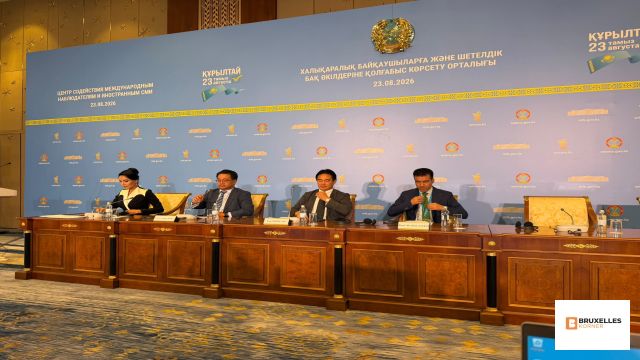





Foreign Experts Assess Kazakhstan’s Kurultai Elections: Stability, Strong Institutions and the Test of the Post-Election Period
International experts observing Kazakhstan’s first elections to the new Kurultai highlighted the orderly conduct of voting, the country’s strategic position at the heart of Eurasia and the importance of translating electoral participation into effective political representation. While several observers emphasised transparency and stability, they also noted that the real institutional test would begin after polling day.
Bruxelles Korner / Kadir Duran — Reporting from Astana

As Kazakhstan voted to elect its new unicameral parliament, the Kurultai, foreign experts present in the country offered their initial assessments of a ballot taking place amid major constitutional reforms and an increasingly unstable international environment.
Their comments converged around several central themes: the orderly conduct of the electoral process, Kazakhstan’s need for strong institutions, the preservation of political stability and the continuation of its multi-vector foreign policy.
Yet the assessments also contained an important note of caution. Observations made at a limited number of polling stations cannot provide a complete picture of an entire national election. Nor can the technical organisation of voting alone determine whether the new institutional framework will produce greater accountability, representation and public trust.
Basel al-Haj Jasem: Kazakhstan’s Stability Matters to the Entire Region
Dr Basel al-Haj Jasem, a Netherlands-based political commentator specialising in international relations and Middle Eastern politics, said the immediate task of foreign observers was to assess whether electoral procedures and legislation were being respected.
He underlined the particular significance of the elections in light of Kazakhstan’s geographical position.
“Kazakhstan is situated between Russia, China and Europe. Kazakhstan’s stability is important not only for the country itself, but for the entire region,” he said.
According to his initial observations, the voting process was being conducted transparently and openly. His remarks placed the election within a wider geopolitical framework: in Central Asia, Kazakhstan’s domestic stability has consequences extending well beyond its national borders.
Glenn Agung Hole: The Real Work Begins After the Elections
Professor Glenn Agung Hole of the University of South-Eastern Norway offered the most institutionally focused assessment. An expert in economics and international relations, he described Kazakhstan as a country located “at the very heart of Eurasia.”
This position, he argued, requires Kazakhstan to maintain international cooperation while simultaneously building domestic institutions capable of defining and protecting its national interests.
Hole said his conversations with voters revealed a diversity of concerns, ranging from geopolitical positioning and political reform to environmental protection. That diversity, he stressed, should not be regarded as a weakness.
“The purpose of strong institutions is not to make everyone think alike,” he said. “Their role is to hear different interests and give them a legal form, so that they have a legitimate place in the political process and are reflected in relevant policies.”
.jpeg)
For the Norwegian academic, polling stations are where constitutional principles and political rules cease to be abstract concepts. They become tangible when citizens interact directly with the electoral system.
However, he cautioned against drawing broad national conclusions from a handful of polling-station visits and voter conversations. Such encounters provide insights, but not a comprehensive assessment of the country.
His central message concerned what comes next.
“Elections themselves are not a product or an end result; they are about participation, representation and legitimacy,” Hole said. “The most serious institutional challenges will arise after the elections.”
The expectations expressed by citizens will therefore have to be converted into concrete policies and genuine representation. The effectiveness of the new Kurultai will be judged by its capacity to listen to different sections of society and respond to their concerns.
“Elections give citizens a voice. What happens afterwards will show how effectively institutions respond to those voices. Therefore, the main work will begin after the elections,” he concluded.
Hole also linked institutional credibility to Kazakhstan’s economic prospects. A stable, predictable and accountable political framework, he suggested, would strengthen confidence among international investors and help demonstrate that investments in the country are secure.
Ken Moriyasu: “Trust the Process”
Ken Moriyasu, Senior Fellow at the Washington-based Hudson Institute, drew attention to a speech delivered by President Kassym-Jomart Tokayev two days before the election.
Tokayev had argued that the true value of major decisions may only become clear many years later. Moriyasu summarised the message in three words: “Trust the process.”
For Moriyasu, political stability remains essential if Kazakhstan is to preserve its multi-vector foreign policy—a strategy based on maintaining balanced relations with major powers and international partners without becoming exclusively aligned with any single geopolitical bloc.

He noted that the elections were taking place in an exceptionally volatile international environment. Against this background, strong political institutions are indispensable both for citizens and for the country’s long-term success.
According to Moriyasu, Kazakhstan’s leadership is seeking to establish a clear political and institutional direction that will enable the country to continue navigating between competing centres of power.
Jerzy Olędzki: Stability Must Be Accompanied by Oversight
Jerzy Olędzki, a member of the Board of the M. Boym Institute for Asian and Global Studies and a specialist on Central Asia, said the elections could consolidate Kazakhstan’s political landscape and strengthen its administrative system.
He nevertheless underlined the need for reforms to continue after the vote. In particular, he argued that oversight of the executive branch should be reinforced.
His assessment reflects a broader question surrounding the new Kurultai: will institutional consolidation result primarily in greater administrative efficiency, or will it also strengthen parliamentary scrutiny and political accountability?
Olędzki also emphasised the European dimension of the election.
For Poland and the other European Union member states, he said, Kazakhstan must remain a stable and reliable economic and political partner. Continued economic development would help build a more prosperous society while deepening relations between Kazakhstan and the European Union.
Stability as a Strategic Priority
Taken together, the experts’ comments reveal a shared understanding of the stakes involved. Kazakhstan’s elections cannot be viewed exclusively as a domestic political event. The country occupies a pivotal position between Russia, China, Europe and the wider Central Asian region. Its stability directly affects trade routes, energy cooperation, investment flows and the geopolitical balance across Eurasia.
The concept of stability, however, carries more than one meaning. It may refer to institutional continuity and the absence of political disorder. But lasting stability also depends on public confidence, effective representation, accountable government and institutions capable of responding to social expectations.
This distinction will be crucial for the new Kurultai.
The orderly conduct observed at polling stations constitutes one part of the electoral process. The deeper test will concern the political system that emerges from the vote: its capacity to represent diverse interests, oversee the executive, sustain economic reforms and maintain Kazakhstan’s carefully balanced foreign policy.
The ballot boxes may close at the end of election day. The institutional process, as several foreign experts stressed, is only beginning.
Yorum Yazın