
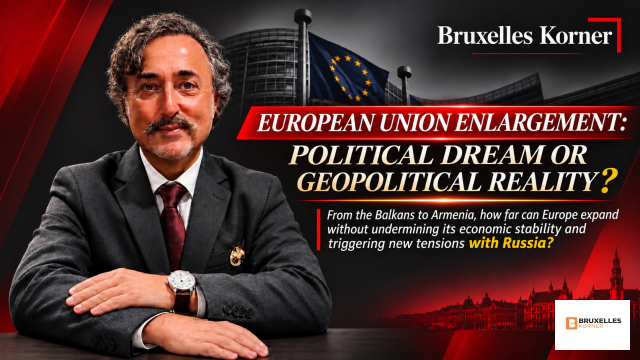





EUROPEAN UNION ENLARGEMENT: POLITICAL DREAM OR GEOPOLITICAL REALITY?
From the Balkans to Armenia, how far can Europe expand without undermining its economic stability and triggering new tensions with Russia?
THE OPINION — KADIR DURAN
Bruxelles Korner | Geopolitical and Economic Analysis | 6 November 2026

The Euronews summit held in Brussels on 3 November 2026, dedicated to European Union enlargement, has reignited a debate that now extends far beyond the geographical boundaries of Europe.
Behind Brussels' ambitions lies a fundamental question: Does the European Union still possess the economic, political and strategic capacity to expand while facing significant challenges of its own?
From the Western Balkans to Armenia, including Ukraine, Moldova and Georgia, several countries regard eventual EU membership as a promise of greater stability, prosperity and closer integration with Western institutions.
Yet these aspirations, however legitimate, cannot be separated from geopolitical realities.
The European Union of 2026 is no longer the Union that experienced the major enlargement waves of the early 2000s. Today, it must contend with modest economic growth, mounting public debt in several member states, the consequences of the war in Ukraine, energy vulnerabilities, international industrial competition and increasing defence expenditure.
Against this backdrop, enlargement represents both a historic opportunity and a potential strategic risk.
Is Europe simply seeking to welcome new members, or is it attempting to redefine the balance of power across Eurasia through its expansion?
This question becomes particularly sensitive in the case of Armenia, whose growing rapprochement with Brussels could profoundly reshape relations between Russia, Türkiye, Azerbaijan and the countries of Central Asia.
The Western Balkans: A European Promise Still Waiting to Become Reality
Since the breakup of Yugoslavia, the European integration of the Western Balkans has been one of the continent's major long-term stabilisation objectives.
Slovenia and Croatia joined the European Union in 2004 and 2013 respectively, demonstrating that this prospect can become a reality.
For the remaining countries, however, the path towards membership remains long and complicated.
Montenegro currently appears to be the most advanced candidate, having provisionally closed 21 negotiating chapters according to the European Commission's November 2026 enlargement assessment.
Albania has also made substantial progress and aims to conclude its accession negotiations in 2027.
These two countries could represent the next stage of European enlargement, provided they continue implementing reforms and secure the necessary approval of EU member states.
The situation is considerably more complicated for Serbia, whose relations with Russia, democratic shortcomings and unresolved dispute with Kosovo continue to complicate accession negotiations.
Bosnia and Herzegovina remains constrained by political and institutional divisions, while North Macedonia continues to face obstacles arising from bilateral disputes, particularly with Bulgaria.
Kosovo's European future remains uncertain, notably because five EU member states do not recognise its independence.
These situations illustrate an often underestimated reality: joining the European Union is not simply a matter of political will.
Membership requires strong institutions, compliance with demanding economic and democratic criteria, the resolution of regional disputes and the necessary consent of existing member states.
The accession of the Western Balkans is therefore not an illusion. It remains a credible prospect, although the timetable differs considerably from one country to another.
The European Union must nevertheless avoid transforming this promise into an endless waiting process.
Repeatedly announcing a European future without delivering tangible progress risks undermining Brussels' credibility and creating additional opportunities for other influential powers, including Russia, China and Türkiye.
Armenia: A European Rapprochement With Potentially Explosive Geopolitical Consequences
The most sensitive geopolitical issue, however, lies further east, in the South Caucasus.
During the Euronews summit on 3 November 2026, Armenian Prime Minister Nikol Pashinyan suggested that his country could formally apply for European Union membership in 2027 or 2028.
It is important to emphasise that, as of 6 November 2026, Armenia has not submitted a formal application and does not hold official EU candidate status.
Its European ambitions therefore remain a political objective rather than a formally launched accession process.
Nevertheless, this legal distinction does not diminish the strategic significance of Armenia's changing orientation.
Since the collapse of the Soviet Union, Armenia has maintained close military, economic, energy and diplomatic relations with Russia.
For decades, Moscow served as Armenia's principal security partner.
However, these relations have deteriorated significantly, particularly following the conflicts with Azerbaijan and Baku's restoration of control over Nagorno-Karabakh in September 2023, which was followed by the mass departure of the region's Armenian population.
For many Armenians and political leaders in Yerevan, these developments exposed the limitations of the security guarantees they had expected from Moscow.
The Pashinyan government consequently accelerated its diplomatic diversification, seeking closer relationships with the European Union and other Western partners.
From Russia's perspective, this development represents a loss of influence in a region it has long regarded as strategically important.
Armenia remains a member of the Russian-led Eurasian Economic Union and has not formally withdrawn from the Collective Security Treaty Organization, although its participation has been severely undermined.
Eventual integration into the EU would therefore raise significant questions about the compatibility of Armenia's existing customs and trade commitments with the European single market and customs union.
Yerevan's European choice would not merely represent a diplomatic adjustment.
It would involve a fundamental transformation of its economic relationships and strategic orientation.
Moscow would be unlikely to regard such a shift as insignificant.
Russian authorities have repeatedly warned of the economic consequences that could follow Armenia's alignment with European regulations.
Energy restrictions, commercial pressure and political measures could potentially be used to discourage or slow this transformation.
However, it would be excessive to conclude that an EU application would automatically lead to military confrontation.
Russia possesses numerous instruments of influence beyond military force, and Armenia's circumstances cannot simply be equated with those of Ukraine.
Nevertheless, one fundamental question remains:
Would Brussels be prepared to provide Armenia with sustained support if its European ambitions triggered a serious economic or diplomatic confrontation with Moscow?
Türkiye and Azerbaijan: Indispensable Actors in the Caucasian Balance of Power

Armenia's European future cannot be analysed without considering its relations with Türkiye and Azerbaijan.
Both countries play decisive roles in the political, economic and logistical transformation of the South Caucasus.
The rapprochement between Yerevan and Baku is among the most important regional developments of recent years.
On 8 August 2025, during meetings in Washington, Armenian Prime Minister Nikol Pashinyan and Azerbaijani President Ilham Aliyev initialled a draft peace agreement, accompanied by a political declaration.
Although the normalisation process still requires consolidation, this development has opened new possibilities after decades of confrontation.
Türkiye, Azerbaijan's strategic partner, also plays an essential role in shaping regional developments.
Ankara seeks to preserve its close cooperation with Baku while exploring opportunities for a lasting normalisation of relations with Yerevan.
This situation highlights an interesting paradox in European policy.
Türkiye remains an official candidate for EU membership, yet its accession negotiations have effectively been at a standstill since 2018.
At the same time, Brussels is paying increasing political attention to Armenia's European aspirations, despite Yerevan not yet having submitted a formal membership application.
These two situations are not legally equivalent.
Nevertheless, the apparent difference in political attention raises legitimate questions about the consistency of the European Union's enlargement strategy.
How can Brussels expect to strengthen its influence in the Caucasus while maintaining complicated relations with Türkiye, a major regional actor in security, trade and infrastructure?
The European Union would be mistaken to regard Ankara as a secondary player in this equation.
Türkiye occupies a strategically important geographical position between Europe, the Caucasus, the Black Sea, the Middle East and Central Asia.
Its diplomatic influence, economic links and transport infrastructure make it an indispensable regional partner.
Azerbaijan, meanwhile, maintains important relations with the European Union, particularly in the energy sector.
Baku therefore has no automatic interest in seeing its relations with Brussels deteriorate.
It would also be incorrect to assume that Russia, Türkiye and Azerbaijan form a unified geopolitical bloc.
Their interests converge on certain issues but diverge considerably on others.
Armenia's European rapprochement could therefore contribute to a new period of regional cooperation, provided it supports the peace process rather than becoming another instrument of confrontation between competing geopolitical blocs.
Can an Economically Weakened Europe Finance Its Enlargement Ambitions?

The financial dimension represents another major challenge for the European Union's enlargement strategy.
The EU already faces considerable budgetary commitments related to energy, the green transition, industrial development, security, defence and support for Ukraine.
According to the European Commission's spring economic forecast, EU growth was projected at just 1.1% in 2026.
Eurostat figures for 2025 also indicated an aggregate public deficit of 3.1% of GDP and public debt equivalent to 81.5% of GDP.
These indicators do not mean that the European Union is economically incapable of enlargement.
They do, however, demonstrate that every additional accession will require significant financial and political decisions.
Integrating new member states would alter the distribution of cohesion funds, agricultural subsidies and other European budgetary resources.
It could also create additional tensions between net contributing countries, already facing domestic financial constraints, and the new beneficiaries of European programmes.
The financial requirements would be particularly significant in Ukraine's case, given the scale of wartime destruction and the investments required for reconstruction.
For the Western Balkans, the main priorities involve institutional modernisation, economic development and convergence in living standards.
Armenia's potential accession would introduce further challenges related to its geographical position, infrastructure, economic dependence on Russia and the security environment of the South Caucasus.
Nevertheless, the European Union is not merely a mechanism for financial redistribution.
Previous enlargement rounds have created new markets, strengthened production networks, improved trade opportunities and encouraged investment.
Yet these benefits require carefully managed integration, institutional coherence and sufficiently prepared economies.
The principal danger would be to turn enlargement into an essentially political response to international rivalries without establishing how its long-term economic consequences will be financed.
A larger Europe will not necessarily be a stronger Europe if enlargement intensifies its existing internal imbalances.
The Caucasus, Central Asia and the New Transport Corridors: The Overlooked Strategic Dimension
Beyond Russia and the Balkans, European enlargement could also affect the economic prospects of Central Asia.
Kazakhstan, Uzbekistan and other countries in the region have been working to diversify their commercial outlets, investment partnerships and transport infrastructure.
The Middle Corridor, also known as the Trans-Caspian International Transport Route, represents one of the principal instruments of this diversification.
Connecting Central Asia across the Caspian Sea to Azerbaijan, Georgia, Türkiye and ultimately European markets, this route offers a partial alternative to transport networks crossing Russian territory.
For Kazakhstan, the development of the Middle Corridor represents an important opportunity to strengthen its position within Eurasian trade.
Uzbekistan, which is seeking to expand its industrial and logistical capabilities, could also benefit from improved regional connectivity.
The European Union itself is showing growing interest in these infrastructure projects.
Brussels seeks to secure supply chains, diversify commercial relationships and strengthen connectivity between Europe and Asia.
Within this context, the TRIPP initiative — the Trump Route for International Peace and Prosperity — deserves particular attention.
Envisaged as part of the Armenian-Azerbaijani rapprochement, the project aims to facilitate a transport connection between mainland Azerbaijan and the Nakhchivan exclave through Armenian territory, while respecting Armenian sovereignty.
If implemented, it could strengthen regional economic exchanges and improve elements of Eurasian connectivity.
However, these opportunities remain closely linked to political stability in the Caucasus.
A renewed confrontation between Moscow and Yerevan, deteriorating Armenian-Azerbaijani relations or excessive competition between the powers involved in these transport projects could delay investment and increase commercial risks.
Conversely, lasting peace between Armenia and Azerbaijan, accompanied by normalisation between Türkiye and Armenia, could transform a region long associated with conflict into an increasingly important international trade crossroads.
Central Asia should therefore not be regarded as a peripheral consideration in European policy.
Kazakhstan, Uzbekistan and their neighbours have their own strategic priorities.
Their principal objectives are to preserve diplomatic autonomy, diversify partnerships and strengthen their integration into international trade.
They have little interest in becoming indirect casualties of a renewed confrontation between Russia and the West.
What they need is a stable environment that facilitates the movement of goods, capital, energy and investment.
Russia and the Risk of a New Geopolitical Divide
The European Union traditionally presents enlargement as an instrument of peace, prosperity and democratic consolidation.
Russia, however, views part of its neighbours' institutional rapprochement with Western organisations as a reduction of its strategic influence.
These positions are not legally equivalent.
Sovereign states have the right to choose their partnerships and alliances.
Moscow therefore has no legitimate veto over the European aspirations of Armenia, Ukraine, Moldova or any other sovereign country.
Nevertheless, national sovereignty does not eliminate geopolitical realities.
In international relations, a legitimate political decision can still generate significant economic and security consequences.
This is precisely the dilemma currently facing Europe.
EU accession does not automatically mean NATO membership. The two organisations have different structures, obligations and strategic purposes.
Yet deeper European integration can involve commercial, regulatory and diplomatic transformations that reduce Russian influence in neighbouring states.
Moscow could respond through economic, energy and political pressure.
In the Caucasus, where regional interdependencies remain considerable, such measures could produce consequences extending far beyond Armenia.
Europe must therefore avoid two opposing mistakes: abandoning its principles under Russian pressure or underestimating the risks associated with accelerated enlargement.
Diplomacy does not consist of ignoring potential dangers.
It requires anticipating them before they develop into crises.
Should Europe Expand or First Consolidate the Existing Union?
This question deserves serious consideration.
For several decades, European integration has helped consolidate peace and connect economies that were previously divided.
It remains one of the major political achievements of the post-war period.
However, the European Union must now confront its own contradictions.
Economic disparities persist between member states.
Migration policies continue to divide governments.
Debates over national sovereignty and institutional integration are becoming more intense.
At the same time, financing requirements for defence, energy and industrial development are increasing.
Under these circumstances, another enlargement could become a source of economic growth but also an additional layer of institutional complexity.
An EU with more members would have to address questions concerning decision-making procedures, voting systems, financial resources and shared political priorities.
A model of differentiated or multi-tier European integration could therefore provide an intermediate solution.
Some countries could gradually gain wider access to European markets, infrastructure, investment mechanisms and programmes without immediately becoming full members.
Such an approach could preserve accession prospects while recognising the Union's actual economic and institutional capacities.
For the Balkans, it could accelerate economic convergence.
For Armenia, it could encourage closer cooperation with Brussels without forcing a sudden rupture with all its traditional partners.
For Central Asia, it could support the development of commercial corridors within a less confrontational regional environment.
However, this strategy would only be credible if accompanied by clear commitments and measurable objectives.
Gradual integration must not become an excuse for indefinitely postponing political decisions.
Economic Power: Europe Against the United States and China, 2016–2025
An examination of economic performance over the last decade illustrates the scale of the challenge facing the European Union.
Despite its relatively weak growth, the EU remains one of the world's largest economic powers.
According to the World Bank data cited in this analysis, nominal GDP in 2025 stood at approximately:
Economy | Nominal GDP in 2025 |
United States | $30.8 trillion |
European Union | $21.2 trillion |
China | $19.5 trillion |
World | $118.4 trillion |
These figures show that the EU still accounts for approximately 18% of global economic output measured in current US dollars.
Its economic size remains substantial, but the growth trajectories of the major powers reveal important differences.
Between 2016 and 2025, the EU's nominal GDP rose from approximately $14 trillion to $21.2 trillion. Over the same period, the United States increased its economic output from approximately $18.8 trillion to $30.8 trillion, while China expanded from around $11.5 trillion to $19.5 trillion.
However, nominal GDP growth includes inflation and exchange-rate effects. Real GDP growth therefore provides a clearer indication of changes in economic output.
Economic Growth: Europe's Structural Weakness
The European economy contracted sharply during the COVID-19 crisis in 2020.
Although the subsequent rebound was significant, growth slowed considerably from 2023 onwards.
In that year, EU real GDP growth was approximately 0.4%, compared with 2.9% in the United States and 5.4% in China.
The figures illustrate an important structural challenge: Europe remains economically powerful, but it is generating new wealth more slowly than its principal global competitors.
This relative weakness raises questions about productivity, industrial competitiveness, investment, innovation and Europe's capacity to finance future strategic commitments.
Inflation: The Lasting Consequences of the 2022 Shock
Inflation has also played a significant role in Europe's economic difficulties.
After years of relatively modest price increases, the EU experienced a sharp inflationary shock in 2022, when annual inflation reached approximately 9.2%.
Although inflation subsequently declined, the slowdown in the rate of price increases did not reverse the earlier rise in the general price level.
By 2025, consumer prices in the European Union were approximately 33% higher than in 2016, according to the Eurostat figures cited in the underlying analysis.
This distinction is essential.
Lower inflation does not mean lower prices. It means prices are increasing more slowly.
For European households, businesses and public authorities, the consequences of the inflationary shock continue to influence purchasing power, production costs and budgetary decisions.
Comparing Economic Performance in 2025
Economic indicator | EU | United States | China | World |
Real GDP growth | 1.5% | 2.2% | 5.0% | 2.9% |
Inflation | 2.5% | 2.9% | 0.1% | 3.0% |
Nominal GDP | $21.2 tn | $30.8 tn | $19.5 tn | $118.4 tn |
GDP per capita | $47,089 | $90,027 | $13,862 | — |
Figures reproduced from the economic analysis accompanying the article. GDP values are rounded. Inflation series may differ depending on whether national consumer price indices or harmonised European indices are used.
The comparison reveals a mixed picture.
Europe retains a substantial share of global economic output and a relatively high level of prosperity.
However, the United States has strengthened its nominal economic position, while China has continued to expand its influence within global production and trade.
The challenge facing Brussels is therefore not merely to preserve the European Union's existing economic weight.
It is to restore its capacity for growth, technological development, investment and industrial competitiveness.
Conclusion — Europe Must Choose Between Political Ambition and a Genuine Strategy for Global Influence
European Union enlargement remains a realistic prospect for some countries and a distant objective for others.
Montenegro and Albania currently appear best positioned among the Western Balkan candidates to advance towards eventual membership.
Serbia, Bosnia and Herzegovina, North Macedonia and Kosovo face considerably greater political and institutional obstacles.
Armenia represents a particularly sensitive case because its potential application extends beyond the traditional logic of EU enlargement.
Closer relations with Brussels could contribute to democratic development, economic diversification and national sovereignty.
However, they could also provoke strong Russian reactions and complicate the strategic balance of a region seeking to emerge from decades of confrontation.
Türkiye and Azerbaijan will inevitably play important roles in shaping these developments.
Their economic and strategic interests must be considered in any durable approach to stability in the South Caucasus.
Meanwhile, Central Asian states are seeking to develop infrastructure, commercial corridors and international partnerships without being drawn into another confrontation between major powers.
For the European Union, the fundamental challenge is therefore twofold.
It must determine whether enlargement can strengthen European stability and influence while ensuring that its own economic and institutional foundations remain sufficiently robust.
The economic figures of the past decade reinforce this concern.
The EU continues to represent a major economic power, but its relatively modest growth, industrial challenges and exposure to inflationary shocks underline the need for a more coherent strategy.
Europe cannot rely indefinitely on the economic strength inherited from previous decades. Before expanding further, it must demonstrate that it can become more productive, innovative, competitive and resilient.
This does not mean abandoning enlargement.
It means approaching enlargement as a long-term geopolitical, economic and institutional responsibility rather than simply a political objective.
A larger European Union will not automatically become a more influential European Union.
Its global strength will depend on its ability to defend common interests, maintain internal cohesion, generate sustainable growth and establish balanced relationships with neighbouring countries.
An economically weakened and politically fragmented Union could ultimately be less influential than a more cohesive Europe capable of strengthening its existing institutions.
European enlargement is therefore much more than a political dream.
It could become a historical reality, but its success will depend on strategic coherence, respect for national sovereignty and a realistic understanding of Eurasia's complex balance of power.
Ultimately, the question is not how far Europe can extend its borders, but how far it can extend its responsibilities without jeopardising its own stability.
By Kadir Duran
The Opinion — Bruxelles Korner
Brussels, 6 November 2026
Sources and References
- Euronews, 3 November 2026 — European Union Enlargement Summit in Brussels and interview with Armenian Prime Minister Nikol Pashinyan.
- European Commission, 4 November 2026 — 2026 Enlargement Package.
- Council of the European Union — EU-Armenia relations and the South Caucasus peace process.
- European Commission, 21 May 2026 — Spring Economic Forecast.
- Eurostat, 21 October 2026 — European government deficit and debt statistics.
- World Bank — World Development Indicators, GDP and economic growth data, 2016–2025.
- International Monetary Fund — World Economic Outlook, October 2026.
- European External Action Service — Connectivity between Europe, the South Caucasus and Central Asia.
- Washington Declaration, 8 August 2025 — Armenia-Azerbaijan peace process.
Editorial note: Assessments concerning geopolitical confrontation, the future of Eurasian transport corridors and the European Union's strategic capacity represent the author's analysis and should not be interpreted as official forecasts.
Yorum Yazın